Robert Llimós, a visionary artist who still looks at us
The Vila Casas Can Framis Foundation revisits its conceptual stage with the exhibition curated by Blanca Arias

-
CAT -
CAST
BarcelonaBefore dying on October 26th, the artist Robert Llimós followed the exhibition that the Can Framis museum of the Vila Casas Foundation is dedicating to him: Are there still not enough eyes on the face?, curated by Blanca Arias, which can be visited from this Tuesday until February 7th. An artist, researcher, and mediator, she is not yet thirty and starts from feminisms as a framework for thought and action. So the dialogue with Llimós's conceptual stage between 1969 and 1973 is not obvious, but the result is very much worth it. As she herself says, she did not want to enthrone Llimós as a genius, but rather she has absorbed his "visionary" character to show that "his practice is contagious and that we can learn this desire to look." The title Are there still not enough eyes on the face? is an expression taken from a poem that Rafael Santos Torroella dedicated to Llimós.
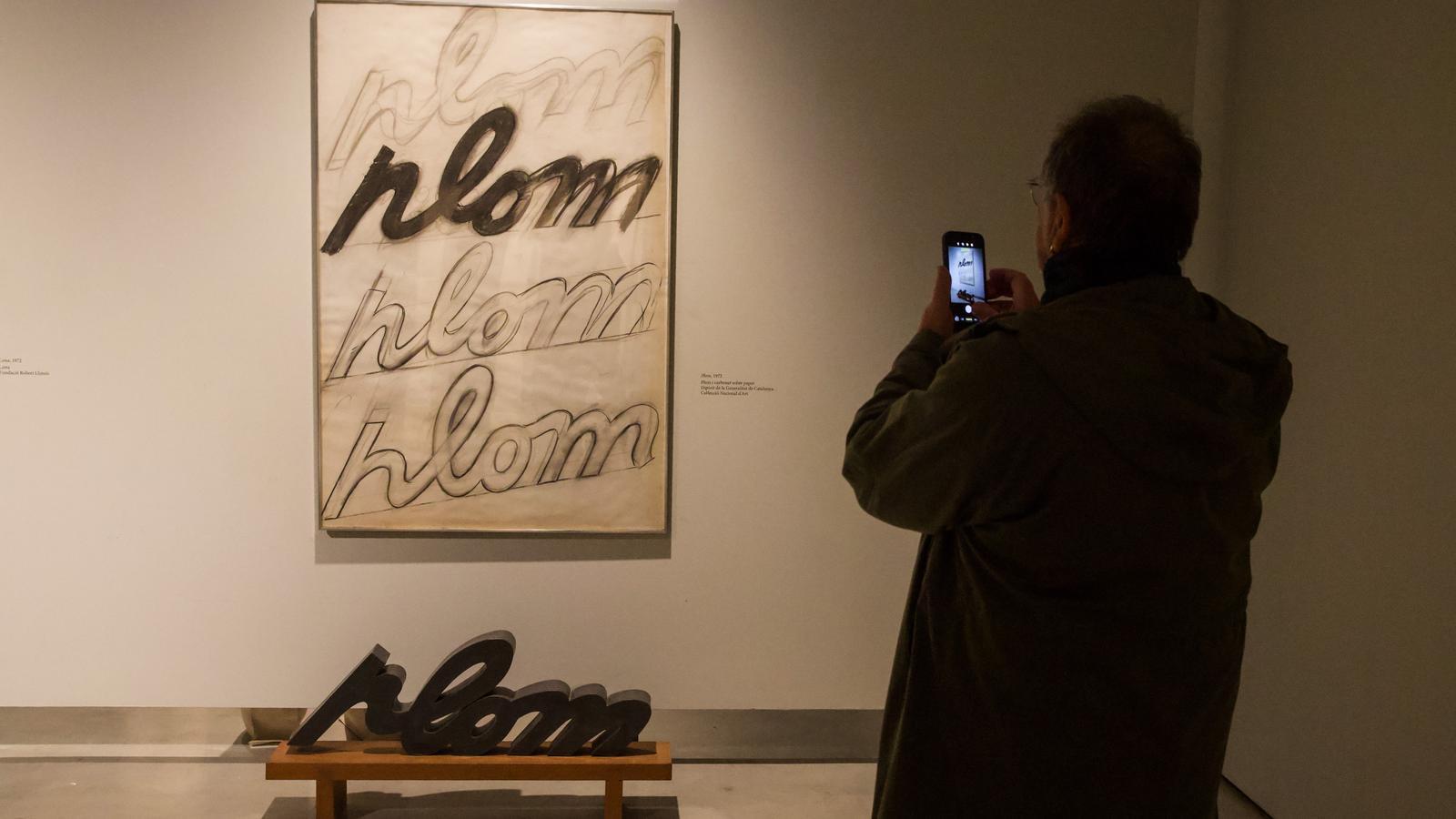
"First and foremost, Robert was a painter. When he makes a sculpture or a performance, he does it as a painter," says the curator. Llimós was the son of an amateur painter and a dressmaker. The latter can be seen especially in the soft canvas sculptures in the first room. One of them reproduces the word canvas. "This is an exhibition that, although it speaks of mystery and the mystery of seeing, does not intend to play any games with the visitor, but rather reveals itself from the beginning. What we see is what it is. While Robert engaged with the abstraction of unforeseen and very intelligent forms, it was never to play a trick on us or to fall into the traps of the symbol, but rather we are facing an exercise of working in the material that anticipates many of the concerns that artists linked to new materialisms work on today," explains Arias.
The bodily aspect of conceptual art
For the exhibition's curator, Catalan conceptual art, like all conceptualisms, has been read from the desire to dematerialize the artistic object, but it is also "intimately linked to the body". "Any work, any action has been created by a body that has a situation in the world, that has a vital experience and that, therefore, informs this relationship with the materials", says Arias. "What interested me was to point out that, even in the case of exhibitions made by male, white, cis-heterosexual artists, that is to say, who fulfill the composite sketch of that artist we invoke all the time when we think of the great artists in the history of art, this body also informs artistic practice". With this gesture, Arias wants to point out that often the way the body of women or LGBTI and racialized people is highlighted is treated with paternalistic tics. "For me, the recognition of Robert's body also functions as a reminder that when we talk about the body it is never the body in the abstract but rather it is a body", the curator asserts.
In the next room, the films of three actions, one of which is titled Mediterrani, show how painting is embodied in bodies, and recall the desire to go out into the public space freely and take ownership of it at the end of Francoism. Further on, three neons that reproduce the word veure show the paradox that they are blinding. "Often these phenomena linked to dazzling are also those that we relate to the mystical experience, to the visionary experience", she warns.
"In the last years of his practice, Robert repeats the gestures of looking up, of looking in a spiral, of mirroring himself, illuminating himself or the fact of letting himself be illuminated by the image", says the curator. "The gesture of looking up accompanies him throughout his career, even in those final years in which he identified with that whole universe of aliens and organisms", explains Arias.
Precisely, in the last room, four canvases hanging in the center of the space are surrounded by a series of small watercolors of extraterrestrial ships made in recent years. "For me, it is important that it is also understood that seriality is a desire to find the perfect image –concludes Arias–. Robert is an extremely prolific painter because he was never satisfied with any image; he insisted until he found it. And this was revealed to me in a very direct way when I read the text he wrote in 2009 after the sighting, where he said he was lucky to have a sketchbook and a pencil with him because he had finally found a new image. Then I understood that it did not matter if they were aliens or whatever it was; what excited him about that phenomenon was that he had found something he had not yet represented before".
