Maryam El Hamidi: "They see you as very integrated, but in the end they end up asking you if your mother wears the veil and if you eat pork"
This teacher from Castelló d'Empúries, who is a mirror for many of her students, asks to be able to remove the eternal label of 'newcomer'

-
CAT -
CAST
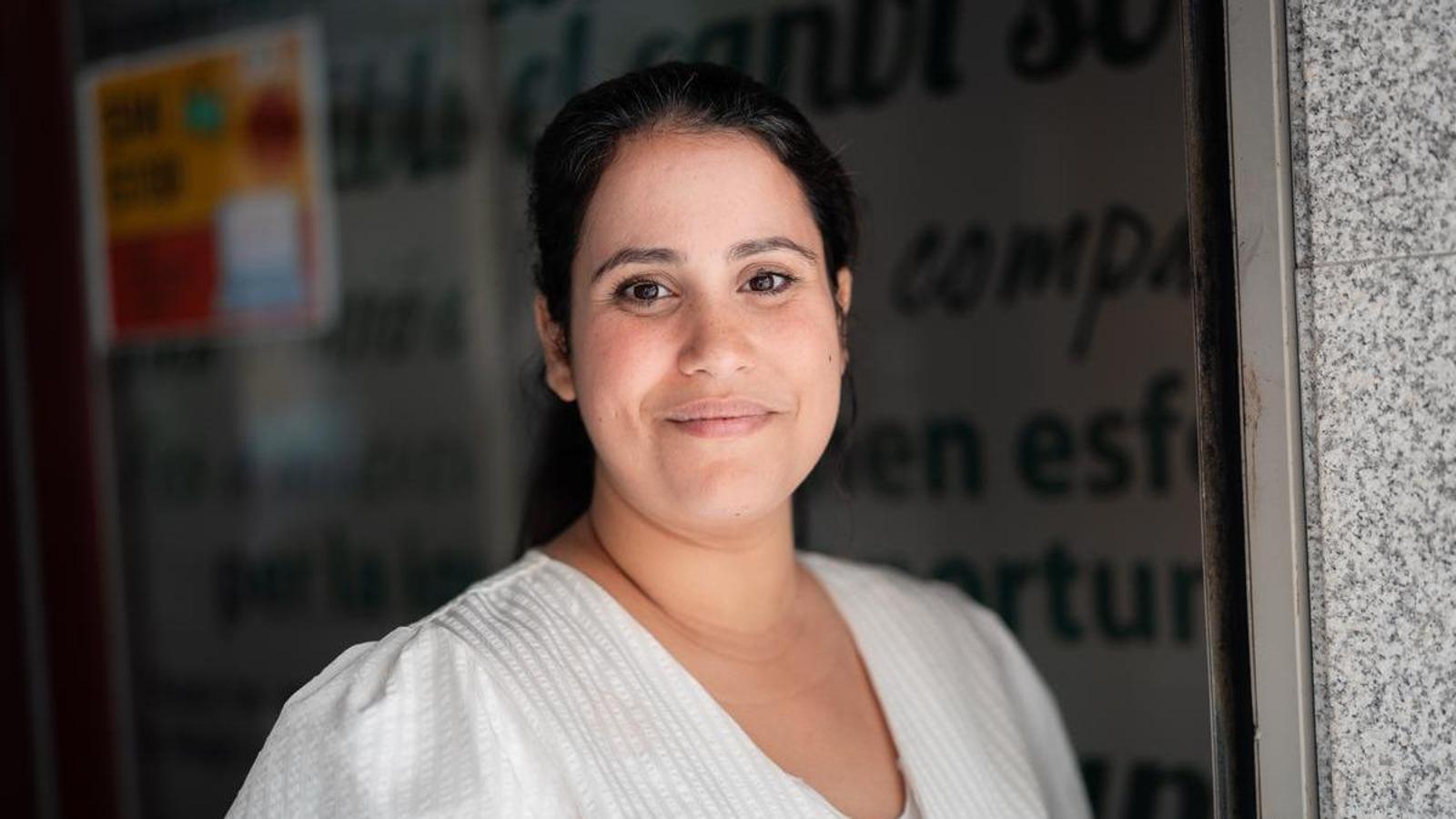
BarcelonaWhen she was 6 years old, teacher Maryam El Hamidi (Tangier, 1994) experienced firsthand the ordeal her students have recently gone through. With her mother and sister, they came to live in Castelló d’Empúries to reunite with her father in the year 2000. "In the schools where I have worked, they see me as a mirror. Especially women, they see a role model. Perhaps I haven't gone through the same circumstances as them, but I know their needs. I give them confidence and motivation. If the road is long, I make it shorter," assures El Hamidi.
The professor has just rejoined the teaching pool after a maternity leave. Before that, she worked at the Language Classroom of Casal dels Infants, in Salt, accompanying young people and adults who were in a vulnerable situation: teaching them Catalan is giving them tools and opportunities. She found in the Escola Ruiz Amado in Castelló a Catalan-speaking and encouraging environment that she acknowledges was key to continuing her studies. "Thanks to the school, I am where I am; teachers are very important," she says, not in vain is she a teacher. "Being the child of immigrants limits the perception of you and your capabilities, doors are closed to you. But I knew I had capabilities and had clear goals: I would go to university, I didn't doubt myself. You can have parents who don't know much Catalan, but who trust you, give you self-esteem, and encourage you to move forward," she explains. Catalan was not a problem at all; she learned it quickly and, in fact, it became the language among sisters, cousins, and the whole social circle, while with her parents they maintained Arabic.
Identity bubbles
Her path was very solitary. El Hamidi was the only immigrant in high school and university, where she studied teaching with a specialization in English. "Now this is changing. I have seen a difference in the generation of my younger sisters, who are studying medicine and engineering. Now for teachers you are equally capable; before it was very difficult, you had to prove it and they valued your context more than your skills. Your origin does not define your abilities," she affirms.
The socialization of the children of immigrants in the classrooms is also changing. Now there is more diversity among classmates, but she also sees less mixing. "Children of migratory origin form a small circle, and those who are not form theirs. They make friends with one or the other depending on where they are from. And this is happening from a very young age in school, from primary school, before it happened in high school. It is increasing, and behind this are the parents. Who do they invite to birthdays? Who do they invite to play at home?" she poses. Now that she is a mother, she feels "tremendous frustration" at these attitudes. "After twenty years, I see that things are getting worse and I don't want my children to go through this, I want them to be friends with everyone. It's an anguish, really. They deserve to be included," she defends. El Hamidi criticizes the generalizations made based on ethnicity, whether for choosing their children's friends or for pointing to crime.

The immigrant label
Living between two cultures adds complexity to the daily lives of immigrant children. Not only because of the ordeal of change, but because integration is a very long process. "You have to rediscover your 'self'. The reality is that I am not 100% Catalan. I have Moroccan origins and I grew up in Catalan culture: this confusion of identities takes years to assimilate," reflects El Hamidi. In fact, her education has also made her change her relationship with languages, which evolves over the years. She categorizes it like this: "Catalan is my language from here, I think in Catalan and it comes out when I express affection. Formality, I find it in English. Spontaneity, in Arabic," she states. Family, her culture of origin, and her father as a figure of reference, have served as her roots but have not limited her expectations: "We have lived in a very warm environment, they have protected us and allowed us to live, travel, study. I do not come from a conservative culture. Religion exists but it does not limit me, the limits are my convictions".
Participation in Catalan identity, for her, has nothing to do with her origin or religion. It has to do with language –"if you don't have the language, you have a barrier, it closes doors to you"– and with participation in local culture, activities, and popular festivals –"they are a form of inclusion", she defends–. But it goes much further: "Respect, punctuality, responsibility, being hardworking, honest, with that I feel very Catalan, they are values I have learned here. I think it would be difficult for me to live in Morocco", she admits.
And despite that, El Hamidi continues to be seen as an immigrant, twenty-five years later. It's a battle she considers lost. "They put the label on me when I arrived and I still wear it. I have accepted it and it no longer affects me because I see that I cannot change it. We'll see how many generations it will take", she laments. Although she hasn't felt excluded or marginalized because of her origin, she hasn't been able to stop being an immigrant or a newcomer because she is not white and was not born here.
"I have shown with everything I can that I am valid. I think in Catalan! –she exclaims–. But for them to still rank or separate, it's annoying. Let's cross our fingers that it changes", she wishes. For now, she has found that prejudices eventually come out sooner or later: "They see you as very integrated, but in the end they end up asking you if your mother wears a veil, where your parents were born, if you eat pork... But why do I have to explain all this?", she asks herself.

