Luis, 13 years old: "I'm fed up with not being invited to birthdays"
The lack of invitations, of shared play, and of relationships outside of school impacts the mental health of children with special needs and also their families

-
CAT -
CAST
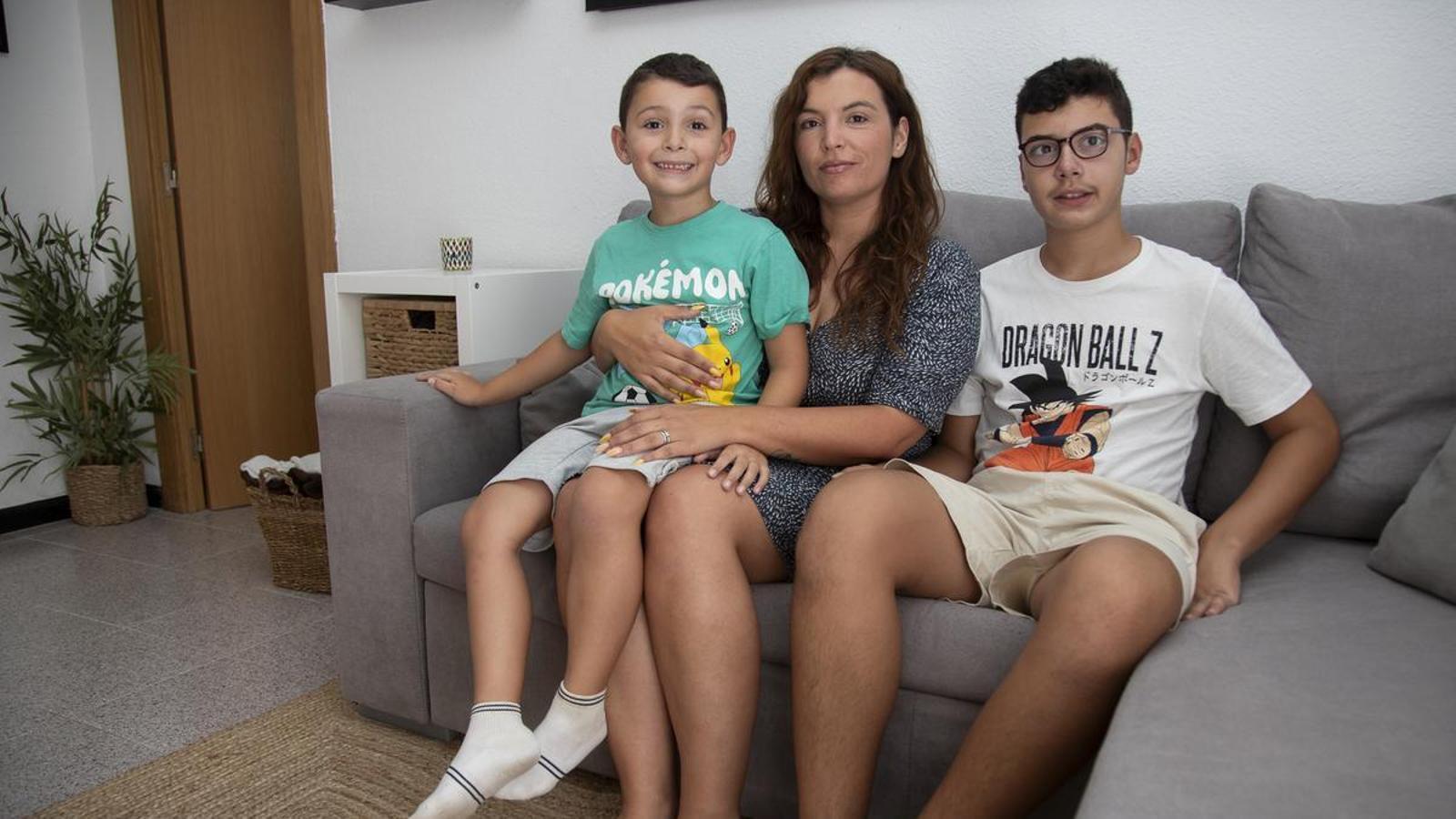
Barcelona“With my eldest son, Luis, I experienced how, little by little, he was left alone. At first, due to his intellectual disability and his autism, he didn't perceive it as much, he didn't understand it. But as he grew, he realized it, and this had a very big impact on his mental health,” explains Denisse, mother of Luis, 13 years old; of Izan, 12; and of Hugo, 6. This mother lives with the disability of two of her children: the eldest, Luis, who in addition to autism has a rare disease, and the youngest, who also has autism and ADHD. Knows well what it means to be left out of the social circle: no birthday parties, no cinema outings, no invitations to spend the afternoon. She suffers from it, and so does Luis, who is fully aware of it. “Having an illness or a disability doesn't mean I can't play. I want to play with friends, I want to have fun, I want to go to birthdays, I'm tired of not being invited, I have the same rights,” explained Luis himself in a video on his mother's Instagram profile. explained Luis himself in a video on his mother's Instagram profile.
According to the report Inclusive Education in Catalonia, prepared by the Ombudsman with data from the Department of Education, the student population with special educational needs –a concept that includes children with intellectual disabilities, ASD, sensory or motor disabilities, or severe behavioral disorders– has grown by 59.4% in Catalonia since the 2017-2018 academic year. Specifically, in the second cycle of early childhood education, primary school, and ESO, the number has gone from 23,857 students to 38,027 in the 2023-2024 academic year. Being there doesn't always mean participating
“Inclusive education has a very important aspect, which is participation. The challenge is to get these children to be part of the group. It is not enough for them to be inside the classroom, they must be in the classroom relating to their classmates, sharing the playground, parties, etcetera”, comments Ignasi Puigdellívol, professor at the University of Barcelona (UB) an expert in inclusive education.

“At school they told me he was very integrated, that the other children loved him very much, but in activities, both inside and outside, he was alone. He didn't play with the boys in his class; not because he didn't want to, but because he didn't understand the game or the other children preferred to do something else and didn't feel like playing with him,” Denisse comments about Luis. Some afternoons it was his brother Izan, one year younger, who went to play with him in the playground. For Puigdellívol, the difficulties that a boy or girl with special needs may have – in speech, in behavior or resulting from an intellectual disability – can affect their relationships with others.
“We had to do a lot of therapy. There came a point when I felt the emptiness of the class group. Seeing your child cry, frustrated, having a hard time, was very difficult. He didn't want to go to school,” Denisse explains about that stage.
“Loneliness affects everyone, including children, because the need to belong to a group is a fundamental human condition, regardless of any disability. When this need is not met, isolation is a very painful experience that directly impacts emotional well-being and self-esteem,” warns Àngels Ponce, family therapist and expert in psychological support for families with disabled children.
The “shadow caregiver”, when support can exclude
In some schools there is the figure of the "vetllador" – officially, special education assistant – who accompanies children with greater support needs in spaces such as the classroom, during travel, or in the playground. Their function is to foster the student's autonomy so that they can participate in the center's activities. However, various research studies on inclusive educational support warn that this resource can have the opposite effect if applied too individually or if the professional ends up becoming a kind of "shadow" of the child.
“In kindergarten, Luis had the supervisor for very few hours a day and not every day; they told us that there were not enough resources and that he had to accompany more boys and girls. I also think that the figure of the supervisor in the playground directing the game would not have helped him,” comments Denisse.
In the same vein, Ignasi Puigdellívol warns that support must serve to facilitate the student's participation within the group, not to symbolically separate him: “The supervisor must above all help the teacher, so that he can be with the whole class and can also attend to this student well within the group, but if the supervisor becomes the child's shadow, that is, if he is with him all the time, he is breaking inclusion,” he warns.
The social wall grows with age
Students with some type of disability or special need are present in the classroom, but in many cases they do not participate in group dynamics, neither within nor outside of school. This situation is especially difficult – according to experts – when transitioning from primary to secondary school, although in Denisse's case it happened earlier.
“When they are three, four or five years old, they are still very young and the differences are not so noticeable, especially when there is an intellectual disability or a significant cognitive difference. With Luis, we started to experience it, more or less, from second grade of primary school. He went from being invited to birthdays to never being invited”, explains Denisse.
This wall of social division becomes more intense as children grow older. “Young children don't interpret difference as something negative; we are all different, and that's okay, there's no negative connotation. But as they get older, and especially from adolescence onwards, they seek to belong to a group of peers with whom to share affinities, appearance, or whatever it may be, and they will do everything possible to resemble the group they want to belong to,” warns Ponce. This feeling of being left out also appears in the data. According to the second Dincat report, families of students with intellectual disabilities warn that, as children grow, support in mainstream schools is less tailored to their needs. Furthermore, 24.5% of people with intellectual disabilities state that they did not feel welcomed at school. “I understand that whoever invites whom to birthdays, the school cannot get involved, nor can the parents. We used to invite the whole class and only two children would show up. We always asked our family to come so he wouldn't be aware of it. We have felt a great emptiness with all of this,” explains Denisse.

The social grief of the family
The grief from the diagnosis is discussed, but little is said about the family's social grief and how this exclusion psychologically affects them. “It has a very big impact. Sometimes it affects parents more than the children themselves, because one of the most inherent fears and main concerns is that their son or daughter will not be alone in life,” explains the therapist.
In fact, during this stage, Denisse went through a depression. “When you have a diagnosis, you go through stages of grief; sometimes it weighs more when you see your child suffering at school, or when they are hospitalized, and other times you are better, because they are stable and happy,” she comments.
This loneliness often stems from the silence of other families, who either do not want to or do not know how to approach. “It is ignorance and lack of information. We should talk openly about each child's condition, with teachers, with families, and with classmates. When children have the tools to understand why a classmate behaves differently, empathy arises naturally,” points out Ponce.
Along these lines, Puigdellívol advocates for clarity with the diagnosis and involving the whole class: “We must answer the questions that other children ask, without it being an invasion of privacy. Answer the questions and always tell the truth,” she warns.
Puigdellívol argues that it is not enough to explain the difference to the rest of the students; positive expectations must be conveyed and they must be guided on how to help. In this regard, she suggests making them see that the child will progress: “You will see how before the end of the course they will start to read and write a little,” and give them concrete guidelines so that the support is real. “Don't do things for them,” she warns, but rather teach them how to help their classmate with special needs. “When there are guidelines with good expectations and clear orientations, children love to help a classmate,” she explains.
Also at times, it is the silence of the family itself that acts, not knowing how to approach others because they feel isolated: “A point is reached where, because their children are not taken into account, they themselves do not feel integrated into the conversations or gatherings of other parents. They feel invisible. It would be as easy as others taking an interest in the child without needing to constantly talk about the disability. A parent of a child with special needs is an absolutely normal mother or father,” recalls Ponce.
Precisely with her youngest son, Hugo, who also has ASD and ADHD, Denisse has opened up much more with the parents of the class. She has explained how he relates and what her son's behavior might be in certain situations, and this has helped them. “At the beginning of I3, I approached some mothers and explained that Hugo is autistic, and that it is possible that sometimes he might want to play but doesn't know how to start this game or doesn't know how to play it. I didn't have to do it, but I did it as a precaution and because I felt more integrated,” she explains.
“The key is to see them. As people, we must look at them, be interested in them, and not turn away when we are at the park or at extracurricular activities. Genuine interest and curiosity, without fear, is the first step,” points out Ponce.
The effort of sustaining inclusion
Since the beginning of ESO, Luis has attended a school for children with special needs. “After the emptiness I had felt, I was very clear. Besides, cognitively, I didn’t see him ready to go to secondary school in an ordinary school, I wanted him to go to a special education college. I know there are parents who don’t want that,” explains Denisse. “It’s a common path because, unfortunately, high schools are not adapted. Real support is lacking, and often families have to fight against architectural or pedagogical barriers until they reach a point of exhaustion that forces them to leave,” explains Àngels Ponce about her experience.
Puigdellívol also understands that some families opt for special schools because the process of inclusion in ordinary schools can be very exhausting. Nevertheless, she argues that, in the long term, ordinary schools offer more learning and socialization opportunities, because children also learn a lot from living with their peers. Therefore, she believes that before giving up, it is important to well assess what each environment can contribute to the child’s development.
Denisse is aware of this, but she feels calm with the change. “It has changed his life. Now he is a happy child, he is no longer a frustrated child. He used to go to school sad; now he has real friends with whom he makes plans,” she explains. She also recalls that, in the ordinary school he attended, inclusion was very insufficient and often children with some type of need were separated from the classroom.
The fear that the wall will be repeated
But Denisse now has the uncertainty of this insurmountable social barrier with Hugo, who is approaching second grade: “I had to work on it a lot psychologically, because the stage is approaching when my first son was rejected and I'm afraid it will happen to us again now with Hugo. I see him more integrated, but I'm afraid he'll go through the same thing and I'll see him suffer”.
For her part, the therapist understands the fear, but recommends not to shy away from it: “If this happens, we will have to explain to him that we cannot please everyone nor will everyone be our friend. Friends are valuable, but they don't have to be numerous. It is a reality that must be accepted. Protecting children from this truth is a mistake, because we are hiding the reality of life from them”.
A few months ago, Denisse posted a video of Luis on her Instagram profile. “Hello, family, I want to tell you something super cool: today is the first time I've been invited to a friend's house, and what's more, I'm going with two friends. We'll play Switch, hang out, and have lunch,” he said, visibly happy. For many children, an afternoon like this might seem like any other plan. For Luis, after years of emptiness, it was the first time that wall had begun to crack.
