The arrival of AI in classrooms has not been met with the same response around the world. In New York public schools, for example, its use has been banned during the 2026-2027 school year. The decision affects around 600,000 students and, among other measures, also implies the imposition of daily screen time limits for students. A measure similar to the one implemented by Norway this year, which has decreed that students between the ages of six and thirteen will not be able to use tools like ChatGPT in the classroom with the intention of reinforcing reading, writing, and mathematics in accordance with traditional learning. In contrast, Estonia has chosen to do the opposite and open the doors of educational centers to AI, but with certain conditions: free access has been provided to educational versions of AI that will not do their homework for them, but rather will guide them, orient them, and offer them recommendations to do their work better and promote critical thinking.
AI at school: what is really happening in the classrooms
The teaching staff is suspicious of this technology which, for now, plays against the students' learning while looking for formulas to coexist with it
-
CAT -
CAST
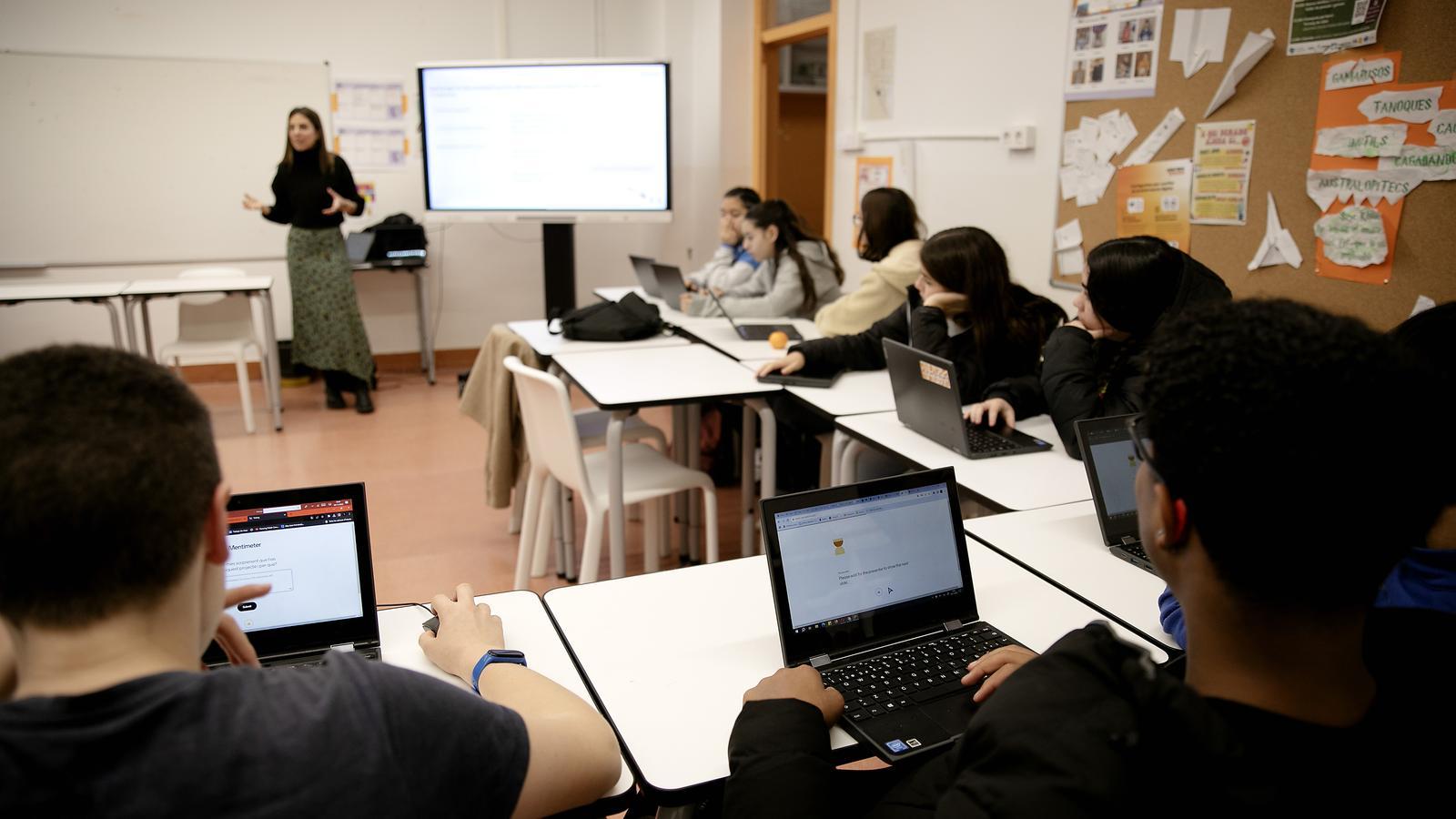
The arrival of the internet, web pages, social networks, and artificial intelligence. New technologies and new ways of communicating have evolved in just a few years and have entered every dimension of our lives. Also in that of the youngest, and consequently, in the classrooms. If many educational centers have considered that it was necessary to leave mobile phones out of the classroom, along with WhatsApp, Instagram, and TikTok notifications, the challenge now is what to do with artificial intelligence and the chatbots that students access from the laptops they work with in class and at home. And not because new technologies cannot be integrated into the pedagogical reality of each center, but because, right now, the pedagogy that should be practiced is, precisely, about the use and abuse of these tools and how they affect learning.
“AI has become the most dangerous tool in the classroom,” asserts Cristian Olivé from the outset, a writer and secondary school teacher. He says this despite acknowledging that he has always defended the internet as a support tool in learning. “Until now, if they wrote a text and had any linguistic doubts, they could turn to digital tools, but right now I can no longer use them in the classroom because I do not have the certainty that while they are consulting Optimot, in reality, they are not asking ChatGPT to solve the work for them.” Olivé explains that he began to perceive the “danger” of AI last school year, when he realized that some assignments that students handed in were done partially or totally with artificial intelligence. “This has led me to use the computer less and less in the classroom, to give up on doing more complex activities or those that extend beyond class time, and to have to settle for asking them for short essays so that they can finish them in the classroom and not at home, thus avoiding them seeking help through AI.” And he adds that one of the things that worries him most about this situation is competency-based learning, which he emphasizes is not resolved in just one hour.
“Things that you previously saw as the student’s own, that had come from their own head, now make you doubt and wonder whether what they have done is modify some text produced by AI or if they have copied it directly,” explains Magda Minguet, art historian, journalist, and high school teacher. She also laments that this technology is being used to replace more creative work and that it all ends up being a copy-paste job. Despite this, the students' “creativity” finds other paths. Minguet asserts that they know very well what to ask AI and how prompts], since they ask it to do their assignments as if they were done by a teenager with their profile and to include some of the mistakes they might make themselves. “It is very hard to detect when a piece of work is genuine or if it is made by AI, because it is getting more precise all the time,” she acknowledges. And it is also hard to convey this to the students’ parents. Olivé adds that confirming whether a piece of work was done by the student or not depends above all on the teacher’s experience and intuition. “Distrust has increased on our part, but also on the part of the students, because if they produce a piece of work that is very well done, they know there will be that point of suspicion.”
The use of AI not only causes anxiety for language teachers, but the same also happens for science teachers. “Before, you could search the internet for a specific formula, but how to perform the operation and apply it was up to you. Now, just by taking a screenshot of a problem statement, AI can solve it for you, and that is a drawback,” explains Virgínia Melendres, a secondary and high school science teacher. “We don’t correct essays, but I see that students are increasingly losing abstract skills specific to mathematics. They look for the answer on ChatGPT and no longer need to think about it further.” And, she asserts, this also makes them lose comprehension capacity. She cites as an example a situation she encountered in the classroom: students had to apply a formula to solve a physics problem, but when she asked the only student who succeeded how she had done it, she confessed that she had done it with ChatGPT. “The problem is that they lose mathematical faculties. With a calculator, they don’t even know their multiplication tables, but this is taking another step back in the mathematical agility they could achieve, because with AI, they save themselves the effort.” Regarding situations like these, Olivé also observes a general loss of learning which, he says, young people are not sufficiently aware of because they do not reflect on it.
It is because of cases like these that in classrooms, paper, pencils, and pens have regained prominence. Melendres states that she minimizes the use of computers and has students hand in their work done by hand. “But if they use a chatbot at home, the impact hits them at the time of the exam, when they can't manage,” she adds. In this sense, Minguet explains that if students take notes by hand, they synthesize the information calligraphically, and this exercise of engaging the mind, the hand, and the sheet makes the ideas stick much better. He also acknowledges that, in his case, he looks for ways in the classroom to value conversation and return to more paced things, achieving a little more reflection and encouraging debate.
Feeding the “beast”
“If beyond secondary school, we think about high school or university, we find that last year many research projects, final degree projects, or master's theses were submitted, I am sure, made with AI. I believe this poses a great danger, because in the end, as citizens, we are also talking about the loss of the ability to communicate and to know how to express ourselves,” warns Olivé. And, in his view, these practices of AI abuse can lead to the homogenization of thoughts and ways of writing. For this reason, he also points out that this technology offers answers “according to an algorithm that has an ideological and political interest behind it, and this entails accepting another part that is nothing less than a new danger.”
Aside from this, it must also be taken into account that some of the answers that AI can provide to students can be erroneous, although increasingly less so. “If the AI is making fewer mistakes each time, it is because we are giving it more information. And, therefore, I believe we should also reflect together on what use we are making of it, if it is excessive, and if we are pouring information into it that will later work against us.” Fortunately, Olivé acknowledges, AI still presents many errors. “And I say fortunately because I can still detect them.”
Turning AI into a pedagogical tool
“Right now, the challenge is not just deciding whether AI enters the classroom, because many students are already using it, but also teaching them to evaluate what it offers them, what they must verify, and what they should not delegate to it. Knowing how to obtain an answer is not the same as knowing if that answer is good,” points out Marta López Costa, coordinator of the Education Research Group (GREDU) at the Universitat Oberta de Catalunya (UOC). She has been part of the coordinating team for a study conducted by the UOC and the Escola Pia de Catalunya on the use of generative artificial intelligence (GAI) in schools, which concludes that verifying the information contained in the answers provided by GAI is the great weak point of the academic application of this technology.
The data collected in this study indicate that only 10% of students always cross-check the answers obtained, while 23.8% state that they verify them often, 32.9% point out that they do so sometimes, 21.7% respond that they do so rarely, and 11.5% acknowledge that they never verify them. “Verification is not yet a consolidated habit. Furthermore, the strategy that the surveyed students have declared using most is trusting their own judgment, which is necessary, but does not replace cross-checking with other sources. That an answer seems reasonable to us does not guarantee that it is correct,” indicates López.
The report, which is the first of its kind to be carried out on a European scale, collects indicators of trends and behavioral patterns regarding GAI from a broad sample of 3,700 secondary and high school students from seventeen Catalan charter schools. Among the data it provides, it also exposes that knowledge of AI among students is uneven: 34.8% declare low or very low knowledge of this technology, while 46.6% are at high levels. “In the centers we have analyzed, they use it above all to search for information, understand concepts, make summaries, or revise texts. They make a combination of their own work and help from AI, which varies depending on the activity. But this does not mean that they are making good use of it.”
López emphasizes that teachers also need training. Although the study did not directly evaluate the teachers' preparation, it has been verified that there is still unequal support: nearly half of the students state that they learn little or nothing about the use of AI at school. “This points to an improvement, but it should not be framed as an individual responsibility of the teaching staff. They need more pedagogical training, not just technological. It is not enough to learn how to use an application.” According to López, teachers must be able to decide in which activities it makes sense to incorporate it, what help is acceptable, and how to verify what the students have learned, and this requires shared criteria within the school. “We cannot leave each teacher alone to face these decisions or give contradictory messages to the students.”
For this reason, López also states that it is necessary to build a pedagogical culture for the use of AI that goes beyond saying “This can be done” or “This is prohibited” and justifying why, with what objective, and with what limits. As he states, each school should agree on which uses it considers appropriate and what part of the learning process the student must continue to do without AI, with limited support from AI, or with full support from AI. At the same time, they must be taught what this technology is, what limitations it has, and what using it implies regarding privacy and authorship. Afterwards, these criteria should be translated into concrete activities. “For example, if a student uses an AI response, we can ask them to contrast it with class materials or other reliable sources, to explain what they found to be correct and what they had to change. And to take this into account during the evaluation. We should not look only at the final result, but also at the decisions behind it,” adds López.
While Olivé assures that she does not mind AI being used to generate ideas or to overcome writer's block, Minguet acknowledges that her students tell her that AI is useful for making summaries or reviewing things they have not understood. With this dichotomy posed by the arrival of this tool, the writer and teacher compares its use to the arrival of social media and says that, just as they had to teach young people how to manage it well, now they will have to do the same with AI, which has come to stay and we will have to live with it. “But, for now, we have to overcome this tsunami that, at the moment, we do not know how to stop”. In turn, Olivé expresses that perhaps it is too late for there to be strong legislation on AI, since it is a tool that is available on all computers in the world, but she calls for guidelines and continuous training for teachers, especially because AI is constantly changing and evolving.
According to the Open University of Catalonia (UOC), AI chatbots such as ChatGPT, Gemini, or Claude often provide false and biased information regarding gender and diversity. That is why the educational center has developed a guide to raise awareness about the biases of these aspects of AI in the classroom. Thus, the Edugenia project—led by researchers Milagros Sáinz, from the GenTIC research group at the UOC-IN3 research center, and Marie-Monique Schaper, Serra Húnter professor and lecturer at the GRIHO group at the University of Lleida—proposes a set of resources to address the challenge posed by the entry of AI tools into the classroom, with a special focus on the gender perspective. It is an open and pioneering guide in the Spanish context, as until now there were no guidance materials that delved into the educational implications of AI tools from an ethical perspective or provided practical examples for working in class.
The Edugenia guide, which proposes activities for different educational levels, has been developed in collaboration with education professionals and students at risk of social exclusion. It includes recommendations, best practices, and resources to control AI biases, such as equity-aware machine learning principles, which allow for the identification of discrimination in AI chatbots related to gender, ethnicity, or socioeconomic status. It also introduces terms and concepts about artificial intelligence, a summary of the regulatory-legal framework on AI to understand how this technology can be used ethically in the classroom, and practical cases and guidelines on the use of this technology as an educational tool.
