Ukrainian drones isolate Crimea, leaving it without gasoline and tourists
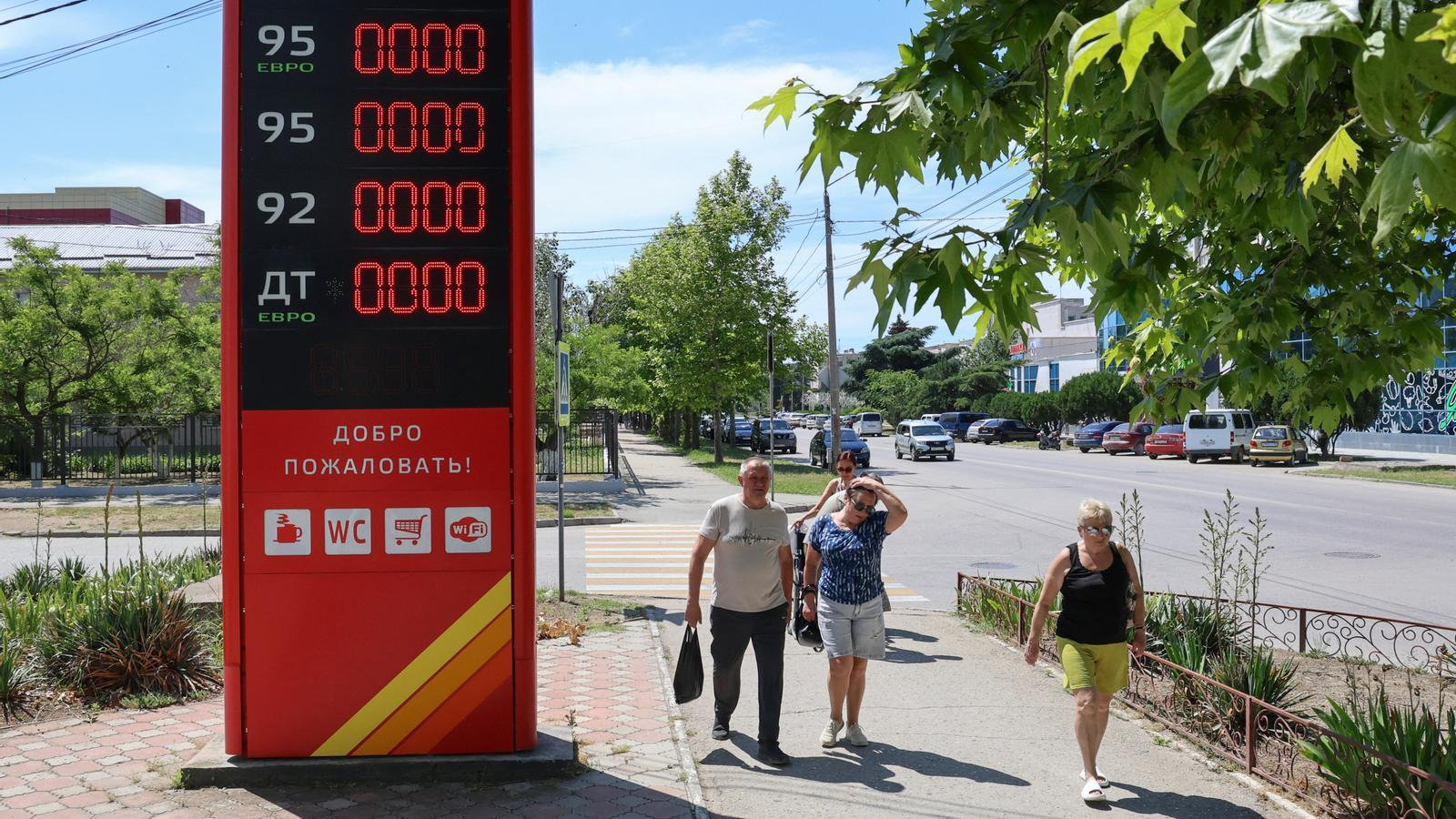
A new attack kills five people and forces authorities to suspend fuel sales

-
CAT -
CAST
MoscowUkraine is determined to de facto turn the occupied peninsula of Crimea into an island. On Sunday morning, Kyiv's drones attacked the ports on both sides de facto the occupied Crimean Peninsula into an island. In the early hours of Sunday, Kyiv's drones attacked ports on both sides During the last few days, Ukrainian medium-range drones
have attacked all the bridges connecting Crimea from the north with the occupied territories. Although they have not destroyed them, they have disrupted the main route supplying the region with goods. Since the beginning of June, local authorities had limited fuel supplies at gas stations to a maximum of 20 liters per vehicle per week, but this Saturday, the Russian head of the peninsula, Sergei Aksyonov, announced that only public transport and emergency vehicles could fill their tanks.
Grocery stores have restricted the sale of cereals, pasta, sugar, and sunflower oil. “People do not believe that the authorities can normalize the situation; they are panicking and hoarding food,” warns a local activist to the opposition media Krim Realii
. “Small shops are closing en masse: there are no stocks,” he adds. Nevertheless, the rulers deny the food crisis. “Crimea fully satisfies its internal food needs,” says Aksyonov.
Fed up neighbors
In statements to ARA, economic analyst Vyacheslav Chiriayev assures that Crimea is only the first link in a fuel crisis that will spread throughout the country and that, to a lesser extent, already affects 53 regions. "It is a vicious circle that Russia is entering because all its refineries are affected by drone attacks," he explains. He predicts that the lack of gasoline will lead to more logistical difficulties that will translate into "a more pronounced contraction of the economy".
Transport problems in Crimea have been exacerbated by Ukrainian shelling of trains, which have stopped running at night for safety. The night-time use of motorcycles and scooters has also been prohibited because their buzzing is confused with that of drones. Without planes, without ferries, without gasoline and with few trains, millions of Russian tourists have preferred not to go on holiday to Crimea this year, despite it being one of the most popular destinations since the Soviet era.
At the same time, videos of residents fed up with the situation have begun to circulate online. “What’s the point of living here if you can’t go anywhere, breathe the air or see the sea? I don’t understand, I’m leaving,” laments a resident of Sevastopol, between tears. Even pro-Russian activists are pessimistic. “The worst is yet to come; we have to prepare for autonomous survival mode,” says blogger Aleksandr Serguiéiev.

Was life better before the annexation?
Xiriàiev points out that this is “the most difficult period for Crimea” since its annexation by the Kremlin in 2014. Vladimir Putin wanted to distance the war from this territory, which has become the spiritual cradle of Russia and a symbol of imperial glory, but, according to the analyst, the semi-blockade could, in the worst-case scenario, precede a forced evacuation of the peninsula's inhabitants. For this reason, he sees an outbreak of citizen protests as likely, although he dismisses the idea that people will direct their discontent towards the president. “Unfortunately, they will not demand that the war be stopped, but rather they will appeal to the authorities to solve their problem,” he indicates.
Ruslan Jàdnov, director of the pro-Ukrainian NGO Crimea Activa, points out to ARA that these adversities will particularly affect the region's main social group, apolitical citizens who live off tourism. “We Crimeans remember well that before the occupation we did not have these problems – he comments –; therefore, the number of people who think they lived better before 2014 will increase.” According to the activist, the Ukrainian army's eagerness to isolate Crimea is of “fundamental” importance and constitutes “an important reason to maintain hope” for the eventual reintegration of the peninsula into Ukraine.
