Trump says he is negotiating with "a new Iranian regime" and threatens to destroy its oil infrastructure
Tehran states that it is "waiting for American soldiers to enter by land so that they can be shot"

-
CAT -
CAST
WashingtonDonald Trump insists he is holding "serious" talks with "a new, more reasonable" Iranian "regime." He stated this in a message on his social network, Truth Social, in which he again threatened Iran with attacks on electrical, oil, and civilian facilities. "Great progress has been made, but if for some reason a deal is not reached soon [...] and if the Strait of Hormuz is not immediately "open for business," we will conclude our lovely "stay" in Iran by completely blowing up and destroying all of its power plants, oil wells, and Kharg Island (and possibly all desalination plants!), which, by the way, we have not yet "touched," the message read.
Despite the US president speaking of a "new regime," White House spokeswoman Karoline Leavitt later referred to the Iranian interlocutors as "the remnants of the regime." "It is not surprising that the remaining elements of the regime are more open to sitting down and talking with us while they still can," she told reporters, insisting that despite Tehran's public denial of talks, they "are going well." Similarly, Leavitt stressed that Tehran should take advantage of the new extension of the ultimatum to reach an agreement. Otherwise, "we will see what happens when this period is over."
Hours earlier, Trump had made his intentions clear to Iran in an interview with the British newspaper Financial Times. The US president asserted that he would like to "take control of the oil" from the Islamic Republic, just as he did in Venezuela, where Washington intends to control the oil industry "indefinitely." "If I'm being honest, what I'd most like is to take Iran's oil. But some stupid people in the United States reply, 'Why are you doing this?' But they are stupid," he said.
In this regard, the Pentagon has been sending trained soldiers to the region for days. According to the latest estimates from the New York Times, the United States already has more than 50,000 troops deployed in the Middle East, about 10,000 more than usual. The latest to arrive were 3,500 soldiers, who arrived on Friday, including approximately 2,200 marines who came on an amphibious ship. This convoy joins another 2,200 marines en route and thousands of soldiers from the 82nd Airborne Division, who have also been ordered to move there.
Regarding the deployment of specialized troops for ground operations in the region, Leavitt said that "it does not mean a decision has been made" on whether American boots will be on the ground. Likewise, when asked if they would consult Congress – something that was not done with the February 28 attack –, the spokeswoman replied that "that is something the administration will always do".
Kharg Island, in the crosshairs
Meanwhile, President Trump also left the door open to the possibility of taking Kharg Island, through which the vast majority of Iranian crude oil is exported. To carry it out, he acknowledged, it would be necessary for the United States to have a prolonged presence on the ground. "Maybe we take Kharg Island or maybe we don't. We have many options –Trump assessed in the interview–. It would also mean that we would have to stay there [on the island] for a while." In any case, experts assure that an assault on the island would pose many risks for the American administration, as soldier casualties could call into question even more the management it is making of the conflict.
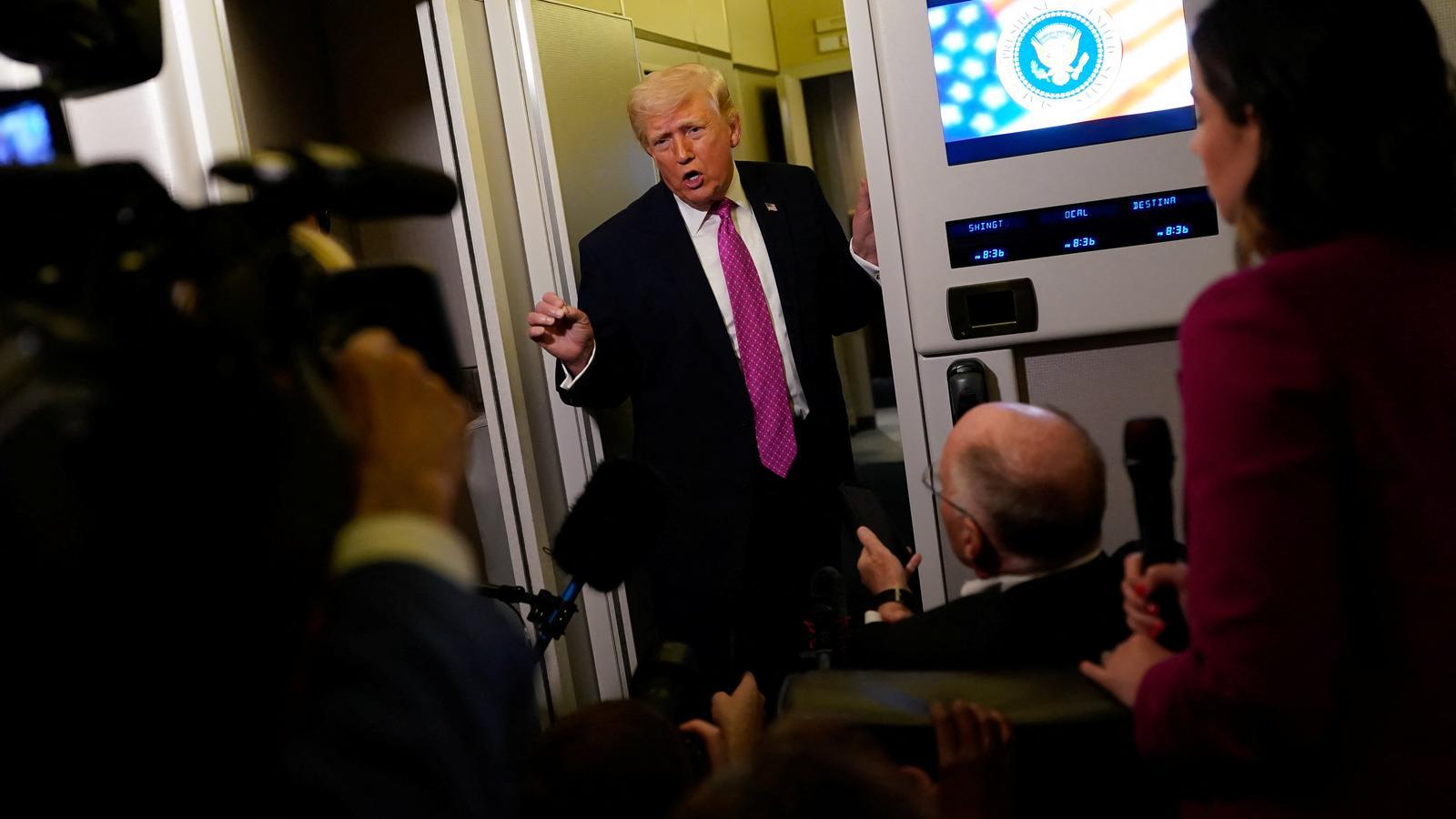
These threats come after the American president assured on Sunday that Washington and Iran had held "direct and indirect" talks in which the new Iranian leaders had been "very reasonable". After Pakistan assured that it will host "significant talks" in the coming days with the aim of ending the war, Trump once again sowed doubt: "I think we will reach an agreement, I am quite sure, but it is possible that we will not," he told reporters on Sunday night while traveling aboard Air Force One to Washington.
Therefore, the president of the Iranian Parliament has criticized the contradictory stance of the White House, which, he says, while sending messages about negotiations, at the same time proposes a ground invasion. Mohammad Bagher Ghalibaf stated that Tehran is "waiting for American soldiers to enter by land so that we can shoot them".
More crossfire
Meanwhile on the military front, four weeks of American and Israeli bombings do not seem to deplete the batteries of Tehran's missiles, which has promised to "punish the aggressor" for the constant attacks. This Monday, Iranian forces have fired several waves of rockets at Israel. Some have hit the oil refinery in Haifa, Israel's most important city in the north, for the second time during the war, according to various local media, which report that the attack has left no victims.
For its part, the Israeli army has continued bombing Tehran this early morning, in attacks that supposedly targeted military infrastructure. Tel Aviv also claims to have intercepted two drones from Yemen, two days after the Houthis, allies of Iran, entered the war in the region with an attack on Israel.
Israeli fire has also reached Beirut, where the air offensive continues while ground troops are deployed in southern Lebanon. The army claims to have attacked "terrorist" infrastructure belonging to Hezbollah in the south of the Lebanese capital, and that the Shiite militia has also launched projectiles against Israel. In total, more than a million people have been displaced in Lebanon since the start of the conflict, and the death toll exceeds 1,100.
