The ceasefire: a headline to cover up the war
The ceasefire agreements in Gaza, Lebanon, Iran, or Ukraine have not ended the violence but have normalized it

-
CAT -
CAST
BarcelonaA ceasefire is a pause in the war, a moment when the bombs fall silent, either to give a respite to exhausted civilians and soldiers or, in the best of cases, to open an opportunity for diplomacy. But in recent months, in the mouths of Donald Trump, Vladimir Putin or Benjamin Netanyahu, this concept has been completely emptied of content to become merely a smokescreen behind which the war continues.
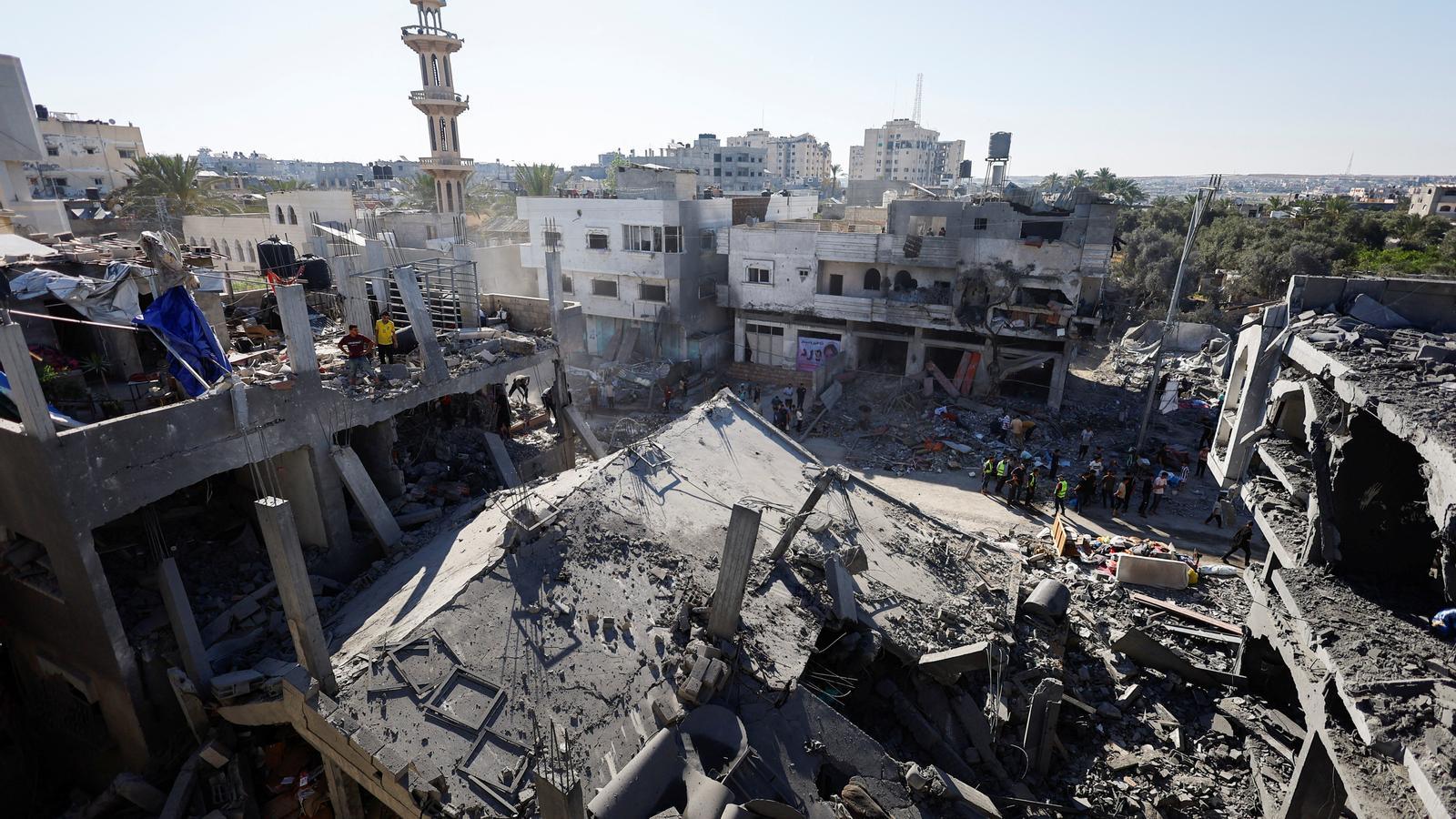
Last October, Trump declared a ceasefire in the Gaza Strip. Since then, the Israeli army has killed at least 932 Palestinians and wounded nearly 3,000, continues to block the entry of humanitarian aid (while foreign staff from major NGOs have been expelled) and bombs the enclave daily. The ceasefire only exists in headlines, not in the daily lives of Gazans. The same can be said of Lebanon, where despite the existence of an active ceasefire with Israel, which both governments agreed to extend on Thursday, bombings and Israeli occupation in the south of the country have not stopped; on the contrary, they have expanded.
Indian analyst Vijay Prashad warns about the impact of the deceptive use of language: "The world believes there is a ceasefire, but people living under Israeli planes continue to hear explosions. The international community speaks of a transition to peace, while military control expands. Diplomats debate implementation mechanisms while families search for the bodies of their relatives among the rubble." And he concludes: "A ceasefire that allows bombings to continue ceases to function as a ceasefire. It becomes a mechanism through which violence is normalized while maintaining the language of restraint."
Normalizing violence
Thus we have seen how the ceasefire between the United States and Iran has not put an end to cross-attacks. The press has asked, bewildered, if this meant a return to war, and both Washington and Tehran have rushed to downplay the attacks and say that negotiations were continuing. All of this has normalized that countries that are officially in a truce attack each other without consequences.
Russian President Vladimir Putin has also announced ritual truces, usually on notable dates, which he has not respected, as happened on May 9 when the victory against Nazi Germany was commemorated or also on the occasion of Orthodox Easter. "These are truces that serve only as a simple humanitarian respite, often because they are needed to replenish arsenals or to give troops a rest," explains Kristian Herbolzheimer, director of the Catalan International Institute for Peace (ICIP). The researcher recalls that for Trump or Putin, the ceasefire fulfills this performative function, which also has to do with how they present themselves to their public opinion: "They aim to appear as peacemakers and not as warmongers".
This trivialization of the ceasefire is part of a dismantling of international law. Pamela Urrutia, a researcher at the UAB's School of Culture of Peace, confirms this: "We are in an international scenario characterized by the use of force and impunity, and we observe leaderships that try to appropriate the language associated with peace and pervert it. There is frank talk of 'intimidation diplomacy,' of 'peace through force.' In this context, some of the recent announcements of ceasefire agreements seem to have more to do with the eagerness to present results from a logic that permeates mediation with a business-like approach. A logic of dealmaking rather than peacemaking".
Imposition of force
UN mediation-focused sources warn that these ceasefires have nothing to do with the goal of building peace, but are merely the result of the imposition of force. "They are made under pressure, with threats and sanctions, not to stop the war but to respond to very specific economic or military interests," they state.
At best, these truces are limited to a relative reduction in levels of violence, not to pacification. Urrutia warns that this entails "the risk of normalizing violence, making it seem more tolerable, generating less alarm and international attention, which ends up prolonging conflicts." The result is that the population finds itself trapped in a strange situation of "neither peace nor war," and the dominant narrative does not speak of war, but of inevitable complications of a peace process. Diplomacy speaks a language that has nothing to do with reality. The civilian population continues to suffer, but no one notices.
Little by little, permanent instability is being normalized: wars no longer have a beginning and an end, but are perpetuated under different levels of intensity. Political solutions are not put on the table and it is simply expected that the population will adapt to uncertainty. This, Prashad also warns, has implications for international law: "The Charter of the United Nations was built on distinctions that were considered important: war and peace, occupation and sovereignty, civilians and combatants, ceasefire and active hostilities. Today, many of these categories are increasingly blurred.
