Trump maintains Monday's ultimatum for Iran to reopen Hormuz while the search for the missing pilot continues
Israel says it is ready to attack Iranian energy facilities, awaiting the green light from Washington

BarcelonaDonald Trump made it clear this Saturday that he maintains the ultimatum he imposed last week on Iran and recalled that Monday is the deadline to reach an agreement that ends the war or for Tehran to stop blocking the Strait of Hormuz. "Remember when I gave Iran 10 days to close a deal or reopen the Strait of Hormuz? Time is running out: 48 hours left before hell is unleashed upon them. Glory to God!", the US president wrote on Truth Social.
It is the same expression he used last year to threaten Hamas. April 6 is the deadline set by the US president, although in recent weeks he has been modifying his ultimatums towards Iran. On March 21, Trump said he would attack and destroy the power plants if Iran did not reopen the Strait of Hormuz in 48 hours. Two days later, however, he said the two countries had had "very good and productive talks" and that he was postponing any military attack on energy infrastructure for five days.
On March 27, he said he was pausing attacks on Iran's energy plants for 10 days, and set April 6 at 8 p.m. in Washington (2 a.m. in Catalonia) as the new deadline, which in principle he seems to maintain, although on Friday he published a message referring to "a little more time". "With a little more time we could easily open the Strait of Hormuz, keep the oil and amass a fortune," he also wrote on his social network.
Attacks against petrochemical plants and a nuclear plant
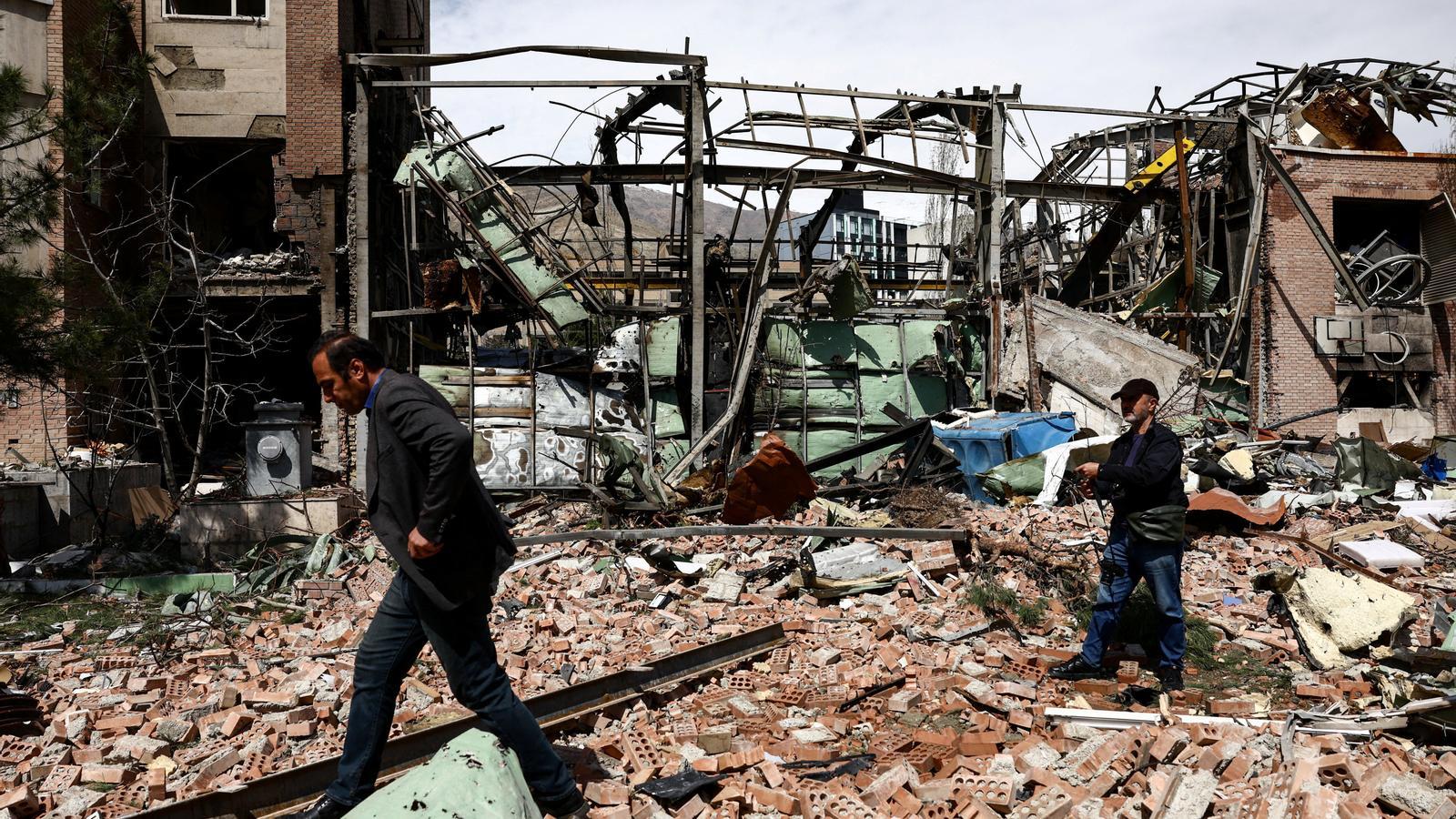
Iran reported this Saturday that it has suffered attacks against several petrochemical companies in the city of Mahshahr, in the southwest of the country, one of the main industrial centers. Israel has claimed responsibility for these bombings and has also said it has attacked steel plants used to manufacture basic materials for weapons. An Israeli official told Reuters that the army is prepared to attack Iranian energy facilities, awaiting the green light from Washington.
This Saturday there was also a bombing near the Bushehr nuclear power plant, in southwestern Iran, where a worker died. According to the Atomic Energy Organization of Iran, it is the fourth time an attack has occurred against this plant, although it has continued to operate normally. Nevertheless, it has warned that, due to the significant amounts of radioactive material, any serious damage could cause a nuclear accident of great magnitude.
Bushehr is Iran's only operational nuclear power plant and was built with the help of Russia. The International Atomic Energy Agency (IAEA), the international body responsible for overseeing the use of nuclear energy worldwide, has stated that "no increase in radiation levels has been recorded", but has recalled that nuclear power plants and nearby areas must never be attacked. Furthermore, it has called for maximum military restraint to avoid a nuclear accident.
The search for the pilot continues
Meanwhile, this Saturday the search operation for the American pilot missing yesterday when Iran shot down a combat aircraft, an F-15E, in the southwest of the country has continued. The Pentagon confirmed that they had managed to successfully rescue one of the crew members, but the other soldier remains missing. The pilots of these aircraft are normally equipped with a radio, and the ejection seats have a beacon that can assist in rescue missions. However, these operations carry many risks. Just yesterday, during the rescue operation, a UH-60 Black Hawk helicopter was hit by Iranian ground fire, but managed to fly to a safe location in Iraq, according to US and Israeli military officials.
The search operation is not being carried out by the United States alone, but also by Iran. The regime has offered a reward for anyone who captures the pilot alive. If he is eventually captured, he could provide Iran with an asset that could be used as a bargaining chip or leverage for Washington to make concessions.
In addition to the downed F-15E, another US military aircraft crashed this Friday near the Strait of Hormuz. Iran claimed it was them, but this has not been confirmed. In any case, both incidents highlight that Tehran continues to have the capacity to defend itself.
The war, which has now been ongoing for five weeks, is depleting the reserves of the United States' military arsenal. The Pentagon has ordered the transfer of almost its entire stock of JASSM-ER cruise missiles – capable of flying over 965 kilometers – to fight against Iran, which will require a massive diversion of stocks originally assigned to other regions, according to Bloomberg. To maintain the air campaign in the Middle East war, missiles that are currently stationed in the United States and other global facilities are being diverted to the bases of the US Central Command (Centcom) or to Fairford, in the United Kingdom.
After these movements, only about 425 JASSM-ER cruise missiles will remain available for the rest of the world, out of an inventory of 2,300 before the war.
