Trump celebrates the defeat of Sánchez: “It is great news”
The European institutions congratulate Núñez Feijóo, while Le Pen sees the triumph of Vox as a harbinger for the French elections
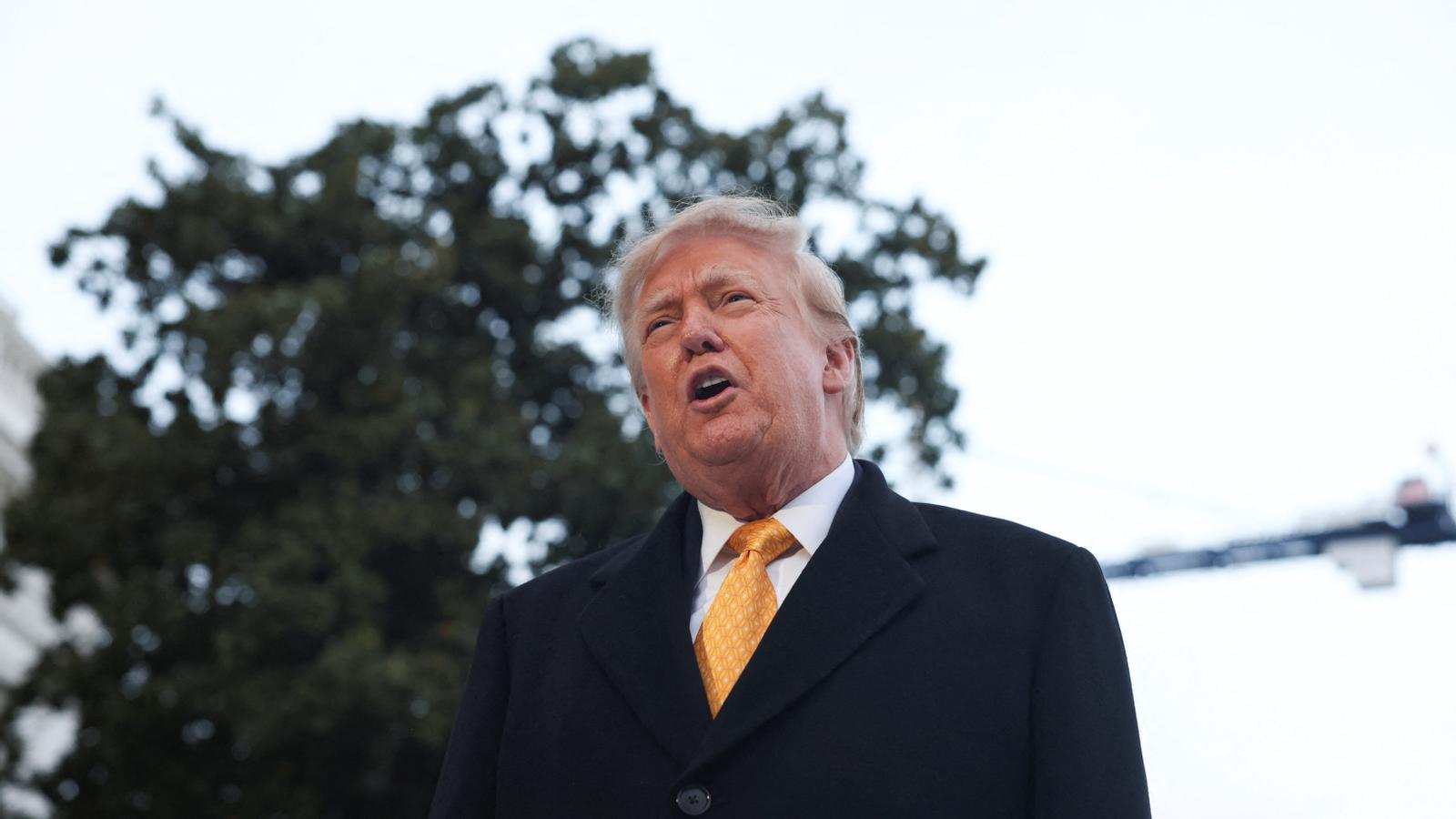

BarcelonaSome of the leaders of the international right and far-right have already publicly congratulated their partners, the PP and Vox, for the good results this Sunday in the Spanish general elections. One of the first to react was the President of the United States, Donald Trump, who, rather than congratulating the right-wing parties, instead openly showed his joy at the defeat of Pedro Sánchez, one of the politicians who has stood up to him most openly.
Before returning to the White House, when reporters asked him for a reaction, the Republican began by stating that “Spain was not doing very well” and asked the press for the result of the election. “Sánchez lost,” a reporter replied. “Oh, he lost? That’s a good thing; he had done a terrible job. He deserves to lose.” And he insisted: “Sánchez lost, eh? That is great news.”
Sánchez has chosen to carve out his own profile in foreign policy and has projected himself as a benchmark for the European and global left. The Spanish president gained international notoriety at the 2025 NATO summit, because he was the only one who positioned himself openly against reaching 5% of GDP in military spending, as Donald Trump demanded. This year, the confrontation with the President of the United States has intensified after the Spanish government denied the US the possibility of using Spanish airspace in the conflict with Iran.
Start of an electoral supercycle in Europe
The Spanish elections mark the beginning of a super-electoral cycle in the European Union, which could lead to a definitive shift to the right for most of the bloc. From today and over the next twelve months, the citizens of four of the five largest member states of the EU will decide the color of their governments. In addition to Spain, there will be crucial elections in France, Italy, and Poland. The only country among the so-called big five that does not have short-term elections is Germany.
The President of the European Commission, Ursula von der Leyen, has congratulated Alberto Núñez Feijóo, although she did not mention Vox's good result. The President of the European Parliament, Roberta Metsola, and the President of the European Council, António Costa, have done the same. “Together we will work to strengthen the competitiveness and independence of Europe,” said Von der Leyen, and she advocated for “building a stronger European defense” and for “defending the values that are at the heart of the European Union.” “A strong Spain makes a stronger Europe,” she wrote in Spanish.
French President Emmanuel Macron has also congratulated Feijóo and said that France is prepared to work together “for a stronger and more sovereign Europe, faithful to its values.” Furthermore, he thanked Pedro Sánchez “for these years together, his European commitment, and his work to foster friendship between France and Spain.”
Pedro Sánchez is the only social democrat left governing a major country in the community bloc. In the European Council, the European Union institution that represents member states, there are only three seats occupied by social democrats. The other two are the Dane Mette Frederiksen, who in areas such as immigration has adopted a stance much closer to the far right, and Robert Abela, the Prime Minister of Malta, a country of only half a million inhabitants. In this way, a Spanish government led by Núñez Feijóo with the support of Vox will consolidate the increasingly rightward turn of the community club.
In addition to openly confronting Trump, Sánchez has also become one of the most critical voices against Israel's offensive in Gaza and has recognized the Palestinian state. Thus, another notable reaction has been that of Israel's Foreign Minister, Gideon Sa’ar, who congratulated both Núñez Feijóo and Abascal “for the impressive victory and the great change they have brought to Spain.” “I believe we can now work together to restore the relations between Israel and Spain, which are important for both countries,” he said on X, and ended with a “Long live Spain!”
Furthermore, Sánchez has maintained a now marginal position in the EU bloc regarding immigration, defending the regularization of migrants and opposing the increasingly tough line of the Twenty-Seven. A government led by the PP will add a very important partner to the group of countries that are strictest on migration policies.
The Italian Prime Minister, Giorgia Meloni, has also reacted to the victory of Alberto Núñez Feijóo and Santiago Abascal, whom she described as “friends” and leaders of the “center-right.” The far-right leader applauded the record turnout, which she considered “a positive sign for all of Europe of democratic vitality and citizens' confidence in the value of political participation.” On behalf of the Italian government, the leader wished “the best of starts” to the PP and Vox with the “hope of working together for the benefit of the nations.”
These elections are read as a harbinger of what may end up happening in a few months in France, with a possible victory for Marine Le Pen. She herself has predicted her triumph in the upcoming French elections: “Every victory of our allies brings us closer to the moment when this project will become a majority within the very heart of the European institutions.” “These elections confirm that a patriotic wave is spreading across Europe,” she wrote on X.
Interest from international media
The Spanish elections have opened this Sunday the digital front pages of the main international media, with a prominent idea in many: the possibility that for the first time Spain could have far-right ministers since the end of Franco's dictatorship. European media such as the BBC, The Guardian, Politico, La Repubblica, Le Monde and Deutsche Welle have followed the day with live coverage, and also other major headlines outside the continent, such as The New York Times and Al-Jazeera. Economic media such as The Wall Street Journal and the Financial Times also highlight as the top news the triumph of the right wing.
“The Spanish PP will win the majority of seats and could bring the far right into government for the first time since Franco”, publishes the Reuters agency. “Far-right ministers are on the path to joining a Spanish government for the first time since the country's dictatorship ended in the seventies”, affirms The New York Times.
