The dead in Nepal are already approaching 600 and the missing exceed 1,900
Kathmandu warns of the risk of new floods from a lake formed as a result of the landslide with almost 3 million cubic meters of water
-
CAT -
CAST
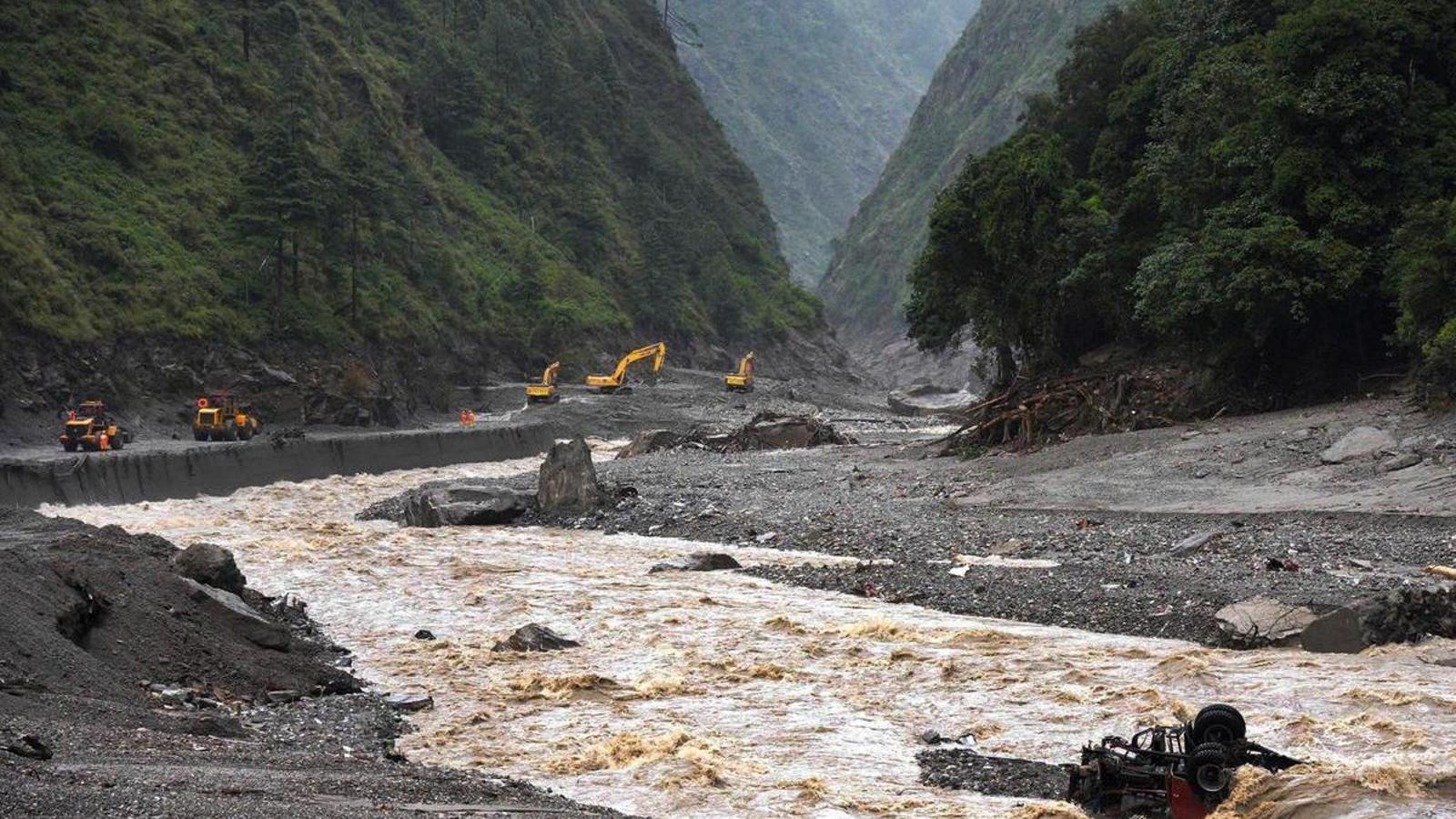
BarcelonaThe border between northern Nepal and southwestern Tibet holds its breath at the possibility of a new flood. Chinese authorities had to temporarily suspend rescue operations this Friday in the Tibetan county of Gyirong after a lake formed upstream by the large landslide began to overflow. The alarm, however, lasted relatively little: Chinese state media reported that the excess flow has stopped and that water levels have dropped slightly, so rescue teams have resumed activity.

If you want to investigate the chart in more detail, open the high-resolution version in another tabIn any case, the situation is still extremely delicate. The Xinhua agency reports that closed-circuit cameras are being installed around the lake to monitor its evolution over the next few hours. Authorities fear that a new rise could cause flooding in the lower valleys and have warned of the risk of landslides. Rescue operations, both in Nepal and Tibet, are also hampered by the rain and very unstable weather conditions.
In Nepal, the magnitude of the catastrophe has not stopped growing. Police once again raised on Friday, early in the afternoon, to 579 the number of deaths caused by Wednesday's floods and overflows. The number of injured reaches at least 1,473. The most affected districts are Rasuwa and Nuwakot, and most of the bodies recovered have been located in Chitwan, through which the Trishuli River flows before emptying into the Seti Gandaki.
In total, according to the International Federation of Red Cross and Red Crescent Societies (IFRC), it is estimated that 93,000 people have been directly affected by the impact of the floods. About 10,000 families may have lost their homes. For its part, the Nepalese government initially estimates the material damage caused by the floods at more than 1.3 billion dollars. The figure includes the destruction of roads, bridges, power lines, and communication infrastructures.

The number of missing persons in Nepal has soared to over 1,900, according to the latest data from the National Disaster Risk Reduction Authority (NDRRMA), released late on Friday. Specifically, 1,924 people are listed as missing, a figure that almost doubles previous tallies. The increase is mainly explained by the authorities now including over 900 workers from various hydroelectric projects who were not previously included in official counts. According to Shanti Mahat, spokesperson for the NDRRMA, the data is compiled from information provided by different sectors, and hydroelectric companies had not previously reported the number of workers who were unaccounted for. Sources in the sector place the number of workers initially reported missing in 13 affected projects at 933.
Among the missing are hundreds of foreigners. In this regard, one of the three Spanish citizens who were unaccounted for has been located, according to the latest bulletin from the Nepal Tourism Board, which provided no further details, reports the Efe agency. The whereabouts of the other two Spanish citizens are currently unknown.
To date, the Nepalese government has published a list of 575 citizens from 36 countries whose whereabouts are also unknown: 186 Indians, 65 Americans, 62 Ukrainians, 51 Malaysians, 33 Australians, and 33 Britons, among other nationalities. In total, the Nepalese army claims to have rescued approximately 900 people from the most affected areas, including 119 tourists. Three Spaniards remain missing, as confirmed this morning by the Spanish Ministry of Foreign Affairs, which is maintaining contact with local authorities to provide necessary consular assistance.
On the Chinese side of the border, the official toll has risen to five dead and 558 missing, although these figures may include people who also appear in other counts. Chinese authorities state that they have already evacuated 555 tourists.
On the other hand, China's President Xi Jinping conveyed his condolences this Friday to Nepal's President Ram Chandra Paudel for the deaths caused by the landslide and floods on the border between the two countries. Xi also offered China's support for the country's relief and reconstruction efforts. In the message, disseminated by Chinese state media, Xi highlighted the geographical ties between the two countries and stated that they "share a common destiny." The Chinese president expressed his conviction that the two peoples will be able to join forces to overcome the catastrophe and rebuild the affected areas.
A lake that has not stopped growing
The lake that has been created by the accumulation of mud and rocks after the brutal landslide is located in the Chinese part of the border between Nepal and Tibet. It is about 10 kilometers from the Gyirong border crossing and at an altitude of about 2,950 meters, almost 1,000 meters above the pass. The volume of retained water already exceeds two million cubic meters and could reach three million in the next two or three days.

It is believed that the landslide blocked the course of the river and created this natural barrier, which has been accumulating water until this Friday a first overflow occurred, albeit a slight one. A sudden break in the mud and rock dam could cause a new surge downstream and further aggravate the worst catastrophe Nepal has experienced in a decade.
Nepal's emergency authorities have asked the population to stay away from riverbanks and risk areas. Chinese teams are concentrated at the entrance to the town of Laojiang awaiting further instructions.
In addition, Nepal's meteorological authorities are monitoring two glaciers near the one that collapsed on Wednesday and caused the devastating floods, after images seemed to show cracks. Experts warn, however, that they do not necessarily indicate an imminent collapse. Both glaciers flow into the Lhende river, which overflowed after the collapse. Satellite images suggest that one of them could contain suspended ice masses, particularly dangerous because they are attached to very steep slopes.
All this further complicates rescue efforts, already extremely difficult due to the large amount of ice, rock, mud, and debris scattered throughout the area.
