Almost 400 dead and 1,500 missing in the brutal flood in Nepal and Tibet
Rescue teams are unable to access the most affected areas for now
-
CAT -
CAST
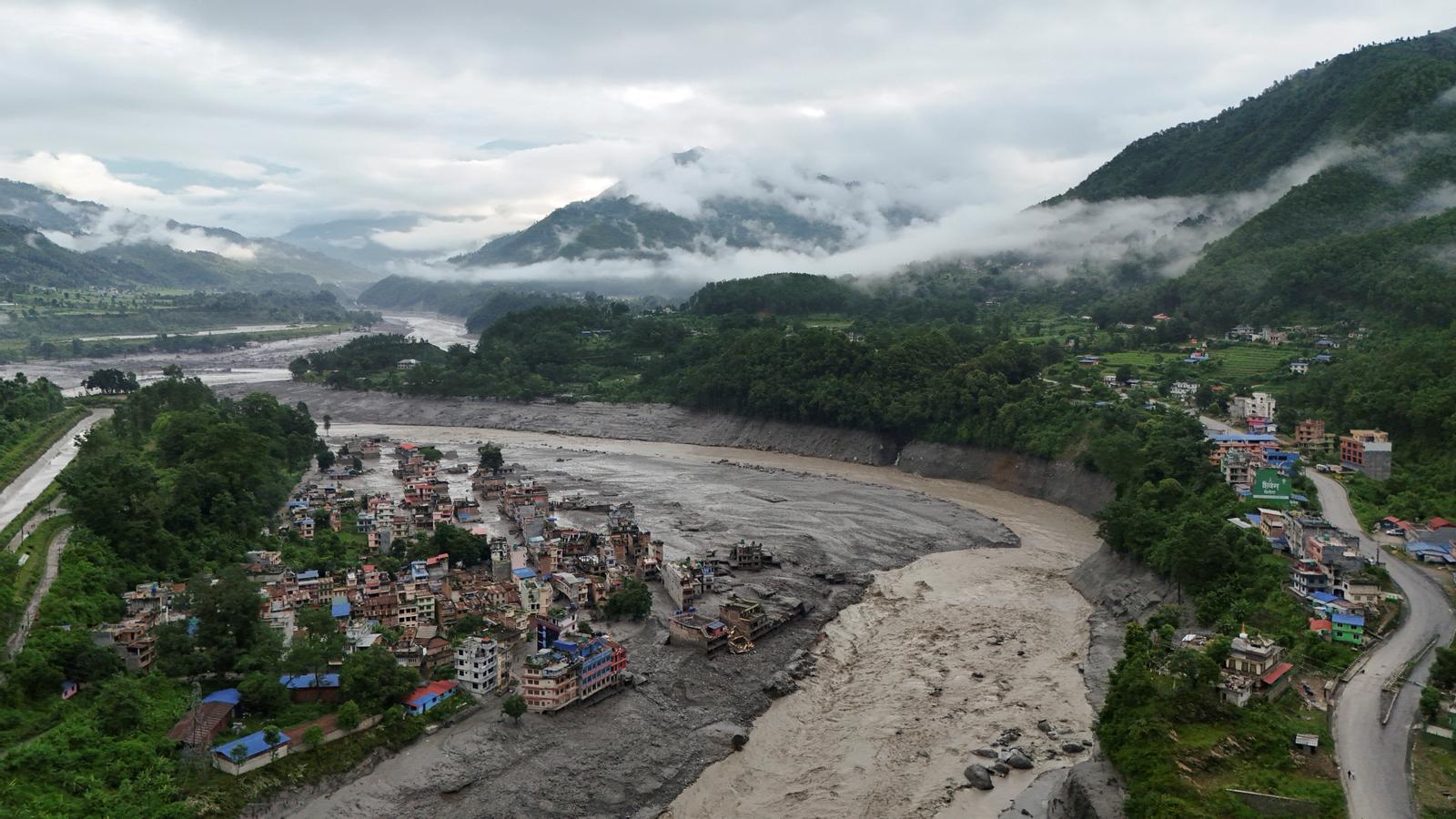
BarcelonaThe brutal floods on Wednesday at the border between Nepal and Tibet, which have buried entire villages, have left nearly 1,500 people missing, most of them tourists, according to authorities. The provisional death toll is 389 on the Nepalese side and three on the Tibetan side. Rescue teams, who have not yet been able to access the most affected areas, are working against the clock to locate the missing in this mountainous Himalayan region, very popular with hikers and pilgrims, including hundreds of citizens from India, the United States, the United Kingdom, Australia, and Canada.
Videos recorded by pedestrians and security cameras show a huge mass of water and mud rushing across the border as people try to flee. Overturned trucks and houses, roads, power plants, and bridges swept away by the water. China has warned that there could be "many victims" in Tibet. A large part of these victims were participating in a pilgrimage to Kailash Mansarovar, a high-altitude site in Tibet revered by Hindus and Buddhists, among others.
Almost 600 foreigners are among the 910 people missing in Nepal, according to police and tourism officials. Among them are 178 Indian citizens, 65 Americans, 35 Australians, 33 Britons, 25 Canadians, and 4 Spaniards, as confirmed by the Spanish government. Chinese state media have reported that at least 558 people are missing on the Tibetan side of the border, of whom at least 260 are foreigners. Nepal police have also explained that by late Wednesday, 165 bodies had been recovered.
Nepalese authorities have deployed several helicopters to search for survivors and have rescued at least 445 people alive—27 of them foreigners—in the last few hours. They have also dropped emergency supplies from the air to thousands of people who have been isolated in villages and valleys due to the damage caused by the flood.
While rescue teams are working at full speed, the worsening weather conditions and the difficulty of accessing the area portend complications in the rescue operations. The floods have left bridges and roads devastated, wide vehicles cannot travel on certain mountain roads, and many helicopters cannot land due to the steepness of the terrain. According to Chinese state broadcaster CCTV, "the area is characterized by high mountains and deep valleys with concentrated water catchment areas, so [continuous] rainfall would pose considerable uncertainty." Tibet's meteorological services predict that rain will continue for the next three days along the route between Gyirong port and Dingri airport, which may complicate rescue efforts.
Chinese Premier Li Qiang has traveled to the flood-affected area on behalf of Chinese President Xi Jinping himself, according to state agency Xinhua. He will lead rescue and relief efforts and visit emergency personnel and the relocated population.

The causes of the tragedy
The first information from the Nepalese authorities indicated that an earthquake could have caused the detachment of the lower part of a glacier and triggered the floods. But later, the United States Geological Survey (USGS) specified that in reality there had been no earthquake, but that what appeared to be a seismic movement of magnitude 4.4 was actually a tremor generated by the glacial rock and ice detachment itself. Similarly, the China Seismological Network Center has confirmed that the seismic phenomenon was caused by the collapse of the glacier against the surface and not by a tectonic earthquake.
A first study of satellite images from Planet Labs indicates that a landslide of ice and rock triggered a sediment-laden flood in the Lhende River, about 20 kilometers northeast of the Rasuwagadhi border crossing, between Nepal and China, according to Nepal's national disaster management authority. Experts warn that the risk of this type of phenomenon is exacerbated by the extreme orography of the Himalayas.
