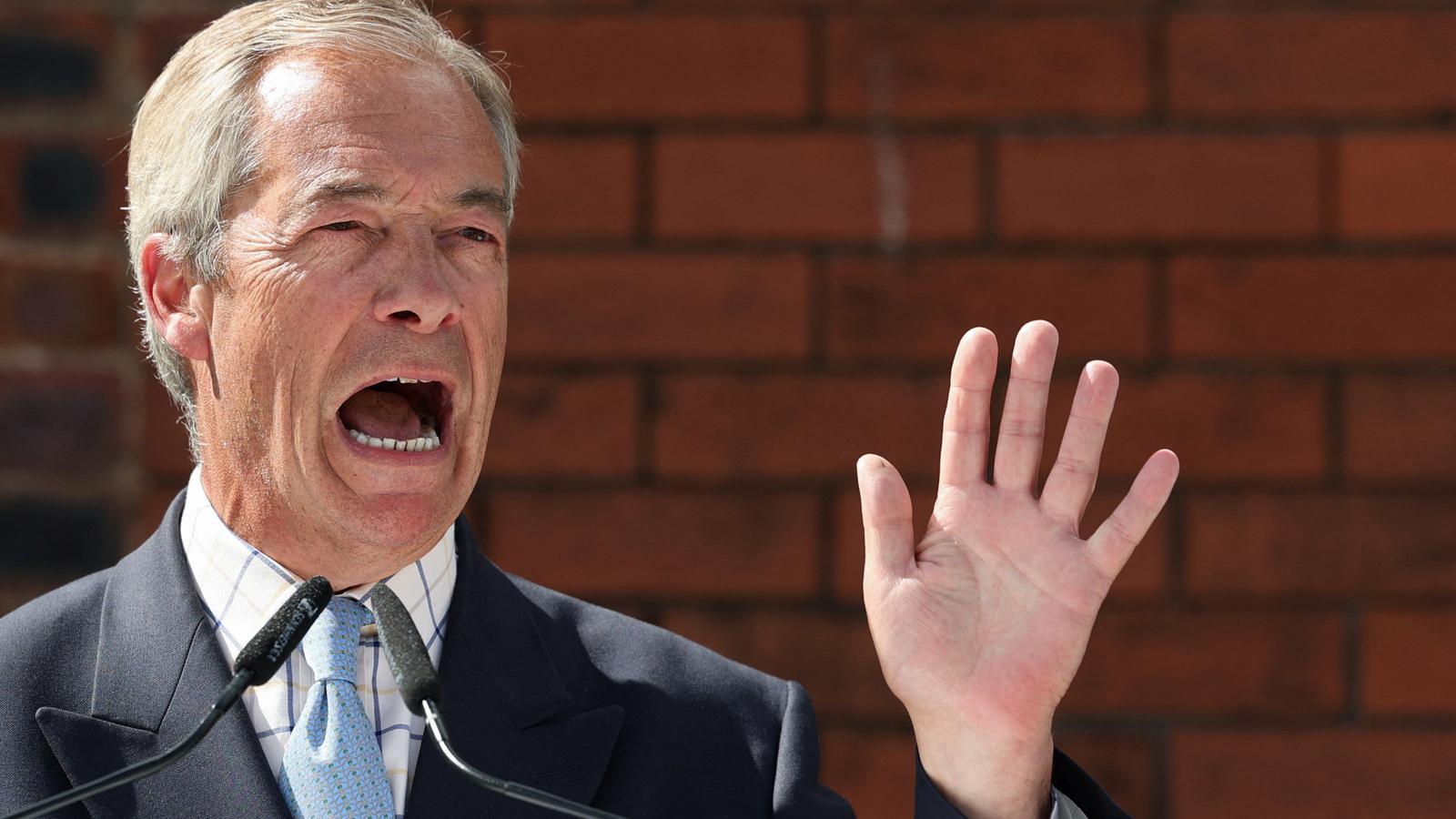
The ultra Nigel Farage fuels his rise with frustration caused by Brexit
The expectations of the far-right leader have been compromised following Burnham's victory, who emerges as a much more solid rival than Starmer

-
CAT -
CAST
LondonIn 2018, this correspondent travelled to Boston (Lincolnshire), 212 kilometres north-east of London. Two years after the referendum on membership of the European Union, ARA wanted to test whether the so-called capital of Brexit regretted a decision that was proving very difficult to implement and was causing a permanent political crisis in Westminster. No, on the contrary, Boston remained proud of its stance, at least according to the testimonies I was able to obtain.
Three years later, in October 2021, I returned, this time to check if, with Brexit already formalized, the population's opinion had changed. Not at all. On both occasions, I spoke, among others, with Anton Dani, a former member of the far-right UKIP party (Nigel Farage's party, now reformed as the Reform Party), who had been decisive during the referendum campaign.
Dani is French, born in Morocco (1965), and a naturalized British citizen. Between May 2019 and May 2021, he was mayor of Boston, the first of foreign origin in the town. Farage held him up as an example of integration. He recently closed Café de París, an establishment he ran in Market Place, the town's main square. He is a town councillor. In 2023, he was elected for the Conservative Party, although he is now affiliated with the Progressive Independents Boston group. In this case, by telephone, the question I asked him is more or less the same as on the previous two occasions: "Are you satisfied with Brexit, ten years later?" He says no. But he does not regret it.

The reasoning he uses – like many of his fellow citizens – is the same argument that Nigel Farage uses with great success, given his popularity levels: Brexit is not to blame. The blame lies with those who haven't known how to implement it. This explains why, despite the economic failure of the divorce – fall in GDP, investments, trade with the Union, exports, etc. – this populist politician has between 26% and 28% intention of vote for general elections, according to the averages of the May and June 2026 polls.
The fault lies with others
Paradoxically, neither his personality –seen as someone who is always angry– nor Farage's personal popularity ratings (minus 15 points), which are better than those of the acting prime minister, Keir Starmer (minus 44), correspond to his party's aforementioned voting intention. And this reinforces the idea that he has the absolute loyalty of his electorate –especially among men over 50, non-graduates, and Leave voters–, partly or thanks to the fact that he dominates the media agenda on immigration and national identity.
The researcher and political scientist Laura May comments in her study Breaking blame: uncovering third‑party strategies for contesting political blame in the Brexit referendum campaign that "the behaviour of Brexit voters shows that many Leave supporters do not interpret the poor economic results as a failure of the project itself, but as a direct consequence of its poor management by successive governments". As she documents in her analysis, voters have reassigned responsibility to the governments of Theresa May, Boris Johnson, and Rishi Sunak, rather than to the decision to leave the EU.
This framework –which separates a supposed pure Brexit from its flawed implementation– is exactly what Nigel Farage proclaims from his platforms: "Brexit is good, but politicians have betrayed it". Farage continues to capitalise on this narrative of "betrayal and incompetence of a political establishment that has failed them". This allows voters "to maintain their pro-Leave identity while blaming Westminster for the country's economic deterioration", says May.

The rise of the Reform Party takes place, explicitly, after the failure of Liz Truss (2022) as prime minister. With a tenure as short as it was disastrous, in her 49 days in government she almost managed to sink the economy British. An analysis by the Institute for Government places this moment in the political resurrection of Farage, who seemed to have fallen into obscurity after Boris Johnson's overwhelming victory in 2019, with the promise to "complete Brexit". His participation in the television program I'm a celebrity... Get me out of here! was decisive in bringing him back into the spotlight.
But above all, it is the discourse on immigration that gives wings to Farage; the same one that was very useful to him during the Brexit referendum campaign with the slogan "Take back control of our borders". As in the case of the economy, however, voters also forgave him that in 2023 net migration was registered at 944,000 people, a figure far from controlling anything. Especially when considering that in 2015, with the United Kingdom still in the EU, it was 332,000 people.
Deflated expectations?
And yet, analysts have strong doubts about Farage's chances of reaching Downing Street. His candidate's recent defeat in the Makerfield constituency in the by-election that won Andy Burnham – and which has led to Keir Starmer's resignation– demonstrates this. The party suffers from structural problems: it depends almost exclusively on Farage's leadership, lacks an ideological project and a solid program, and has placed the deregulation of cryptocurrencies among its main economic proposals. The fact that Farage personally received a donation of five million pounds from a magnate in the sector does him no favors at all.
On the other hand, as the analyst of The Independent David Maddox, the British electoral system and the tactical vote – which has also played out in Makerfield – "make it difficult for a good percentage of votes to translate into many seats". The selection of candidates who have made extremist or sexist statements, increasingly harsh rhetoric on immigration, and difficulties in attracting the female vote do not compensate, says Maddox, the erosion that the Conservative Party has suffered at the hands of the Reformist.
In all likelihood, on July 17th Burnham will become Prime Minister. Labour – which has largely adopted the Reform Party's discourse on immigration – will then have until spring 2029 to regain its electoral prospects. Burnham has warned that it is "the last chance" to win back the favour of a traditional electorate that has turned its back on them in the local elections of 2024 and 2025, and which surprisingly sees in Farage – a broker of the City and a millionaire – a rebel and a outsider of the system that will pull them out of the pit.
