"The most dangerous man in Germany" wants to make history
Ulrich Siegmund, candidate of the far-right AfD in Saxony-Anhalt, arrives as the great favorite to Sunday's elections
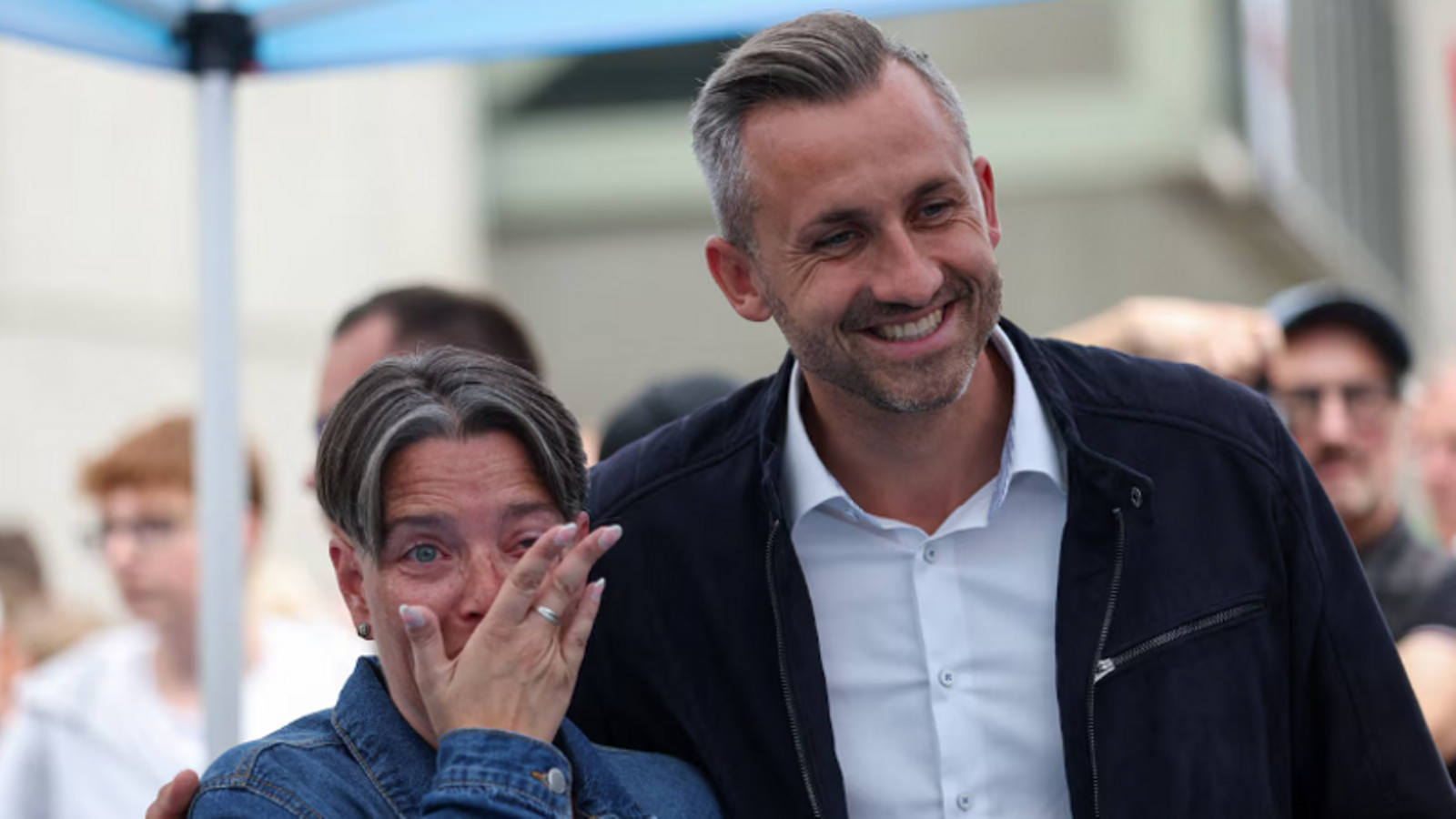
BarcelonaA charismatic 35-year-old man travels through the towns of a German state aboard a blue 1975 Simson, the legendary motorcycle of the former East Germany. At every stop, thousands of followers with his face printed on their shirts shout his name and queue up to get a photograph or an autograph before he gets back on the motorcycle and resumes his journey. What might seem like a rock star's tour is, in reality, the election campaign of Ulrich Siegmund, the politician who aspires to turn Saxony-Anhalt into the first German state governed by the far-right Alternative for Germany (AfD).
With his sights set on the regional elections on September 7th, Siegmund, born in Tangermünde just three weeks after reunification, travels through East Germany appealing to an idealized past. He visits factories, talks to workers, and serves draft beers. The AfD candidate does not fit the pattern of the traditional politician. He almost never gives long speeches, preferring conversation, the use of first names, and a smile. His power of persuasion is undeniable: he knows how to capture someone's attention and how to get them to listen to his mantra.
Perhaps having studied consumer psychology and having been a fragrance salesman has something to do with it. As Siegmund himself declared to the podcaster Ben Berndt, comparing politics to his time selling perfumes, "wherever it smells good, statistically people stay longer and interact more with the product." His communication strategy seems to bring this logic to the electoral field. Elegantly dressed, with a well-trimmed beard and a modern haircut, Siegmund turns rallies into pleasant informal meetings.
A friendly image for a radical discourse
Despite this harmless appearance, the German newspaper Der Spiegel went as far as to define him as “the most dangerous man in Germany”. A label that, far from intimidating him or costing him votes, Siegmund has known how to take advantage of to incorporate it into his campaign. "A special thanks to Der Spiegel", he said. The candidate is photographed smiling with copies of the magazine and his followers have not taken long to customize their t-shirts with the slogan.

Siegmund maintains a radical discourse even within the AfD itself. The party's regional branch in Saxony-Anhalt is classified as a far-right organization by the Regional Office for the Protection of the Constitution. The former perfume salesman considers immigration "one of society's greatest problems" and defends "remigration," a concept that proposes the expulsion of thousands of migrants, including "unassimilated" German citizens.
Before arriving at the far-right party, Siegmund briefly passed through Angela Merkel's CDU, a party he joined in 2008, at only 18 years old. Disappointed with the former chancellor's policies, in 2014 Siegmund made the jump to the AfD, just one year after the party's founding. In 2016 he won a seat in the Saxony-Anhalt regional parliament, where at first he went unnoticed, until he discovered the potential of a more radical discourse.
It was during the COVID-19 pandemic that his political figure began to consolidate. Through social media, mainly TikTok, Siegmund questioned the management of the crisis and pointed out institutions and the media. He now has more than half a million followers on Instagram and nearly 750,000 on TikTok, figures that directly rival those of the German chancellor, Friedrich Merz.
A team with neo-Nazi roots
What generates the most concern is his closest circle, especially relevant because the candidate claims to have "95% of his future government team" prepared, formed mainly by people he trusts. Key figures such as Patrick Harr, parliamentary spokesperson; Laurens Nothdurft, legal advisor, or Felix Willer, deputy, share a common past as former members of the Heimattreue Deutsche Jugend (HDJ), an openly neo-Nazi organization, banned in 2009 by the federal government.
The group, of an ultranationalist nature, organized children's camps inspired by the Hitler Youth, where classes were taught on "the study of race" and workshops were held to paint swastikas on faces. The presence of former HDJ members in Siegmund's inner circle reinforces doubts about to what extent the candidate's moderate image corresponds to the political project he intends to deploy if he reaches government.
In fact, Siegmund defends an education that reinforces a national vision of German history. He has questioned how schools manage the teaching of Nazism and has defended that it is necessary to address "all aspects, both negative and positive," to maintain "a positive relationship with our culture and with ourselves."
The litmus test for the 'Brandmauer'
Under the slogan "Everything is possible", the polls outline massive support for him, with voting intentions bordering on 43% for the AfD compared to 23% for the CDU of Prime Minister Sven Schulze. A victory that would be both overwhelming and insufficient: If Siegmund does not obtain more than 46%, he will not be able to govern alone, and he is aware that it will be difficult for him to reach agreements with other parties due to the cordon sanitaire on the far right, known in Germany as Brandmauer (firewall).

As pointed out in a conversation with ARA by Cidob international affairs analyst Héctor Sánchez Margalef, Siegmund may be the one to set this barrier in front of his first major test. According to the political scientist, the cordon sanitaire itself may have contributed to strengthening the AfD. Since 2017, he explains, the party's exclusion has fueled its image as “the only real alternative” to the rest of the political forces.
This puts Siegmund in a paradoxical position: not having enough votes to govern may end up being the best result for the party in the long term, as it would force the other parties to reach an understanding and would reinforce the AfD as the only alternative to the system. Even so, no scenario can be ruled out. Sánchez Margalef points out that within the CDU there are voices that assume the AfD will eventually be a governing alternative and that consider making pacts with them, or even entering a government with them, to try to “modulate and moderate” their points of view.
Be that as it may, the decision of the citizens of Saxony-Anhalt will have consequences beyond Germany. An entry of the AfD into a regional government, coinciding with the advance of far-right forces in other European countries, could contribute to breaking the taboos regarding their entry into national executives across the continent.
