The last churches of Kramatorsk
Dozens of faithful of the Family of God group resist in the Ukrainian locality and continue their activity despite the Russian attacks
-
CAT -
CAST
Kramatorsk (Ukraine)"We were born in war and we will die in war," says Natasha, accompanied by her husband, Leonidas, both eighty-three years old, on the fourth floor of an empty building in the center of Kramatorsk. Liena, a worker at one of the few grocery stores left in the neighborhood, tries to convince them to leave the city, that even living in a basement is a death sentence: "If the Russians arrive, they will throw a grenade and ask afterwards if there is anyone alive." The octogenarian couple lives trapped in the uncertainty of a meager pension, between the approach of a war front that is about nine kilometers away and the anxiety over daily shootings and the high-pitched sound of fiber-optic drones searching for vehicles to destroy. Despite this situation on the streets, every Sunday morning they attend the mass offered in an abandoned restaurant near their home, where about thirty people gather to pray and sing.
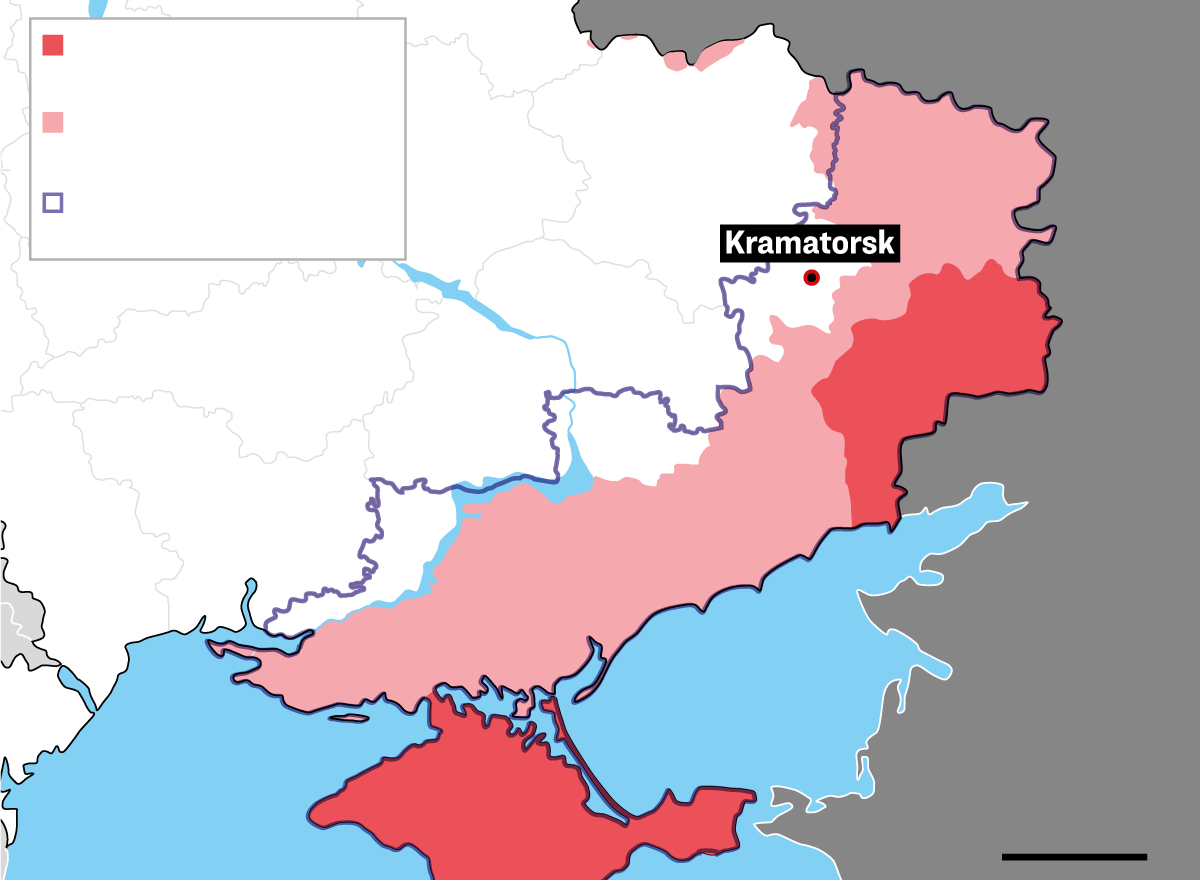
Territory occupied by
Russia before 2022
Territory occupied by
Russia currently
Territory claimed as
part of the Russian Federation
DONBAS
UKRAINE
RUSSIA
Sea of Azov
Crimea
100 km
Territory occupied by Russia before 2022
Territory occupied by Russia currently
Territory claimed as part of the Russian Federation
UKRAINE
DONBAS
RUSSIA
Sea of Azov
Crimea
100 km
Territory occupied by Russia before 2022
Territory occupied by Russia currently
Territory claimed as part of the Russian Federation
UKRAINE
DONBAS
RUSSIA
Sea of Azov
Crimea
100 km
"It was not easy to build unity and we did it around the figure of Jesus," says evangelical pastor Iura Ivakhnenko, leader of the Family of God community, which brings together just over 200 faithful. "Many Christian churches, such as Catholic, Orthodox, or Baptist and Pentecostal ones, closed their doors due to the dangerous situation and their devotees came here. We decided that our framework of faith would be Jesus, his love, mercy, and forgiveness." Iura, forty-eight years old, offers up to four services on Saturday and Sunday, and moves through different parts of the city, full of anti-drone nets and columns of smoke that sometimes emerge from the powerful explosions of guided bombs. "I have colleagues in Canada who have encouraged me to go there, or to Germany, but it is here and now where they need me, and I feel that I must bring the light of our Lord through this darkness."
Praying amidst the bombs
Iura moved his family some time ago due to the impossibility of living in Kramatorsk, and he organized his congregation in premises such as empty supermarkets or closed schools. In the capital of the Donetsk region, where the most intense fighting of the Ukraine war is taking place, only about a fifth of the population remains and evacuations of minors are mandatory. Kramatorsk and Sloviansk are the last stronghold that the Ukrainians are protecting from what is known as the Donbas belt of fortresses, and the Russian army has begun since before the summer the phase of leaving no stone unturned, which begins with the collapse of economic activity through attacks on businesses, the indiscriminate killing of civilians to force the population to leave and the devastation of buildings and industrial facilities to leave the towns in ruins and begin the infiltration of soldiers and urban combat.

"We are here and we believe in the miracle, but we also trust when God decides when we must leave. We take risks, but we must be wise. As the proverb says, trust in God, but don't make mistakes yourself," says the preacher originally from Dnipro. In the Russian-language services of the Family of God, they provide information about evacuation groups, the resources available from the community, such as a vehicle or financial aid, and, as Yura says, "here no one judges others if they make the decision to leave and abandon this place." The religious services of this community do not follow a formal liturgy: they sing songs with guitar, organ, and bass, attendees speak openly about their hardships, and hugs and donations of a package of pasta or a loaf of bread close their almost two-hour celebrations to the backdrop sound of explosions that make the wood-boarded windows tremble. A cross painted on the wall, some benches built with pallets, and a projector showing psalms are the tools that help its attendees find a kind of comfort and an accessible expression to the mystery of the probability of being wounded or dying any day.
Faith vs. drones
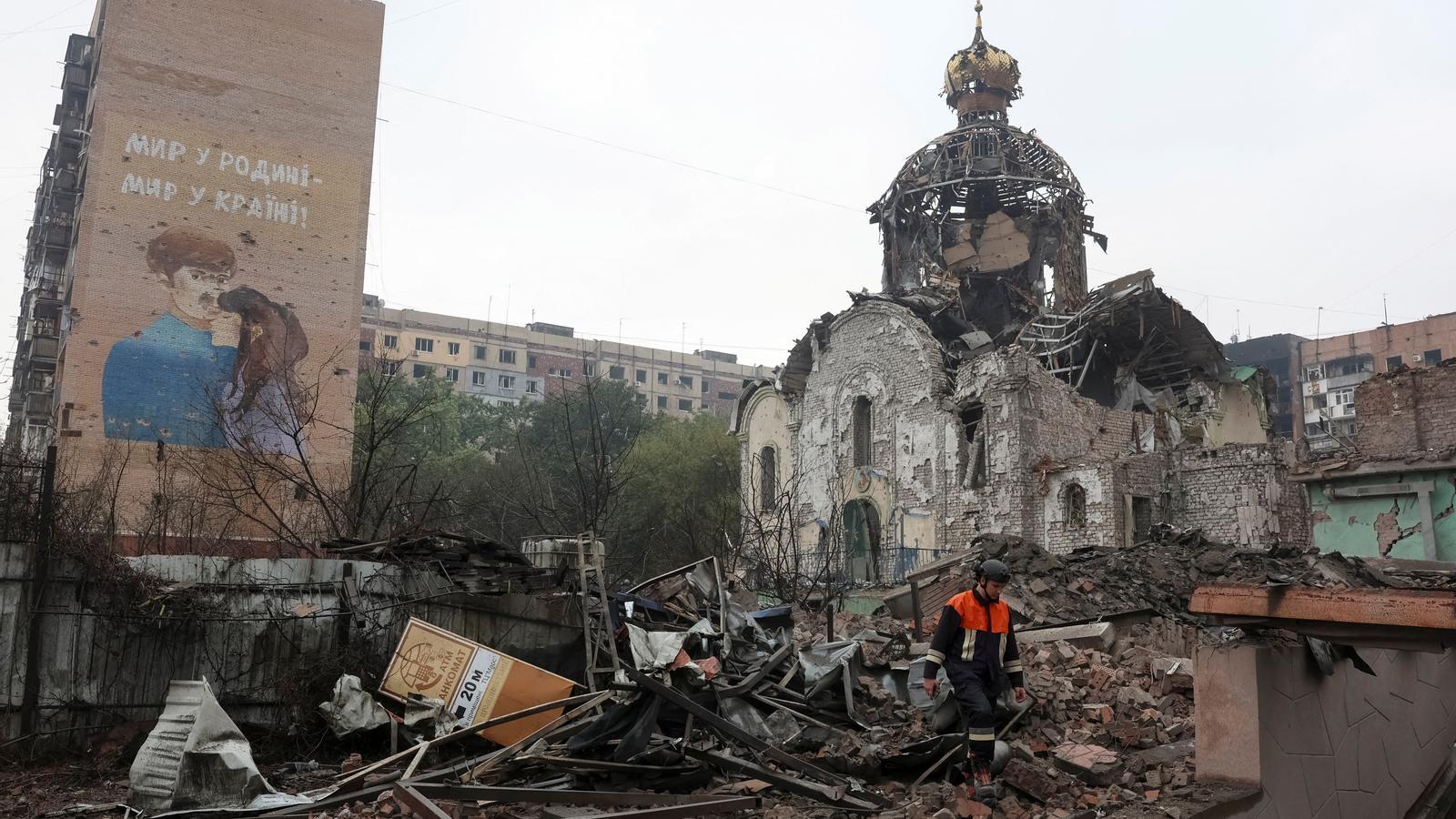
Orthodox churches linked to the Moscow Patriarchate in Kramatorsk have not been spared from Russian attacks, as is the case with the Temple of the Nativity of Saint John the Baptist, destroyed on September 22nd with a guided bomb.
The Religion on Fire project, which documents the destruction of religious spaces in Ukraine, has recorded since the beginning of the full-scale invasion on February 24, 2022, the severe or partial destruction of more than 800 places of worship, of which more than 400 are linked precisely to this Orthodox branch historically tied to Moscow. One of the most high-profile cases was the attack with Shahed drones and missiles on June 15th on the Kyiv Pechersk Lavra monastery—a state-owned complex whose religious management has formally passed into the hands of the nascent Orthodox Church of Ukraine, independent of Moscow—. The impact destroyed part of the roof of the Dormition Cathedral, listed as a World Heritage Site by UNESCO.
The Protestant pastor knows that, in the event of Russian domination, he would be a target, just as his colleagues who were murdered in the occupied territories have been. About 67 from various denominations, according to the International Religious Freedom Alliance. "In the Soviet era, official Orthodox priests were informants, collaborators with the secret services, and now they think that we do the same, but as spies for the West." Despite this threat, in his homilies there is room to pray for Russian soldiers, "because behind these robots, these drones, there is a person piloting it with a demon behind him whispering that it is okay to kill, and in our battle in the spiritual world, we pray that he can change and be saved."

