The Gaza doctor who didn't want to abandon his patients
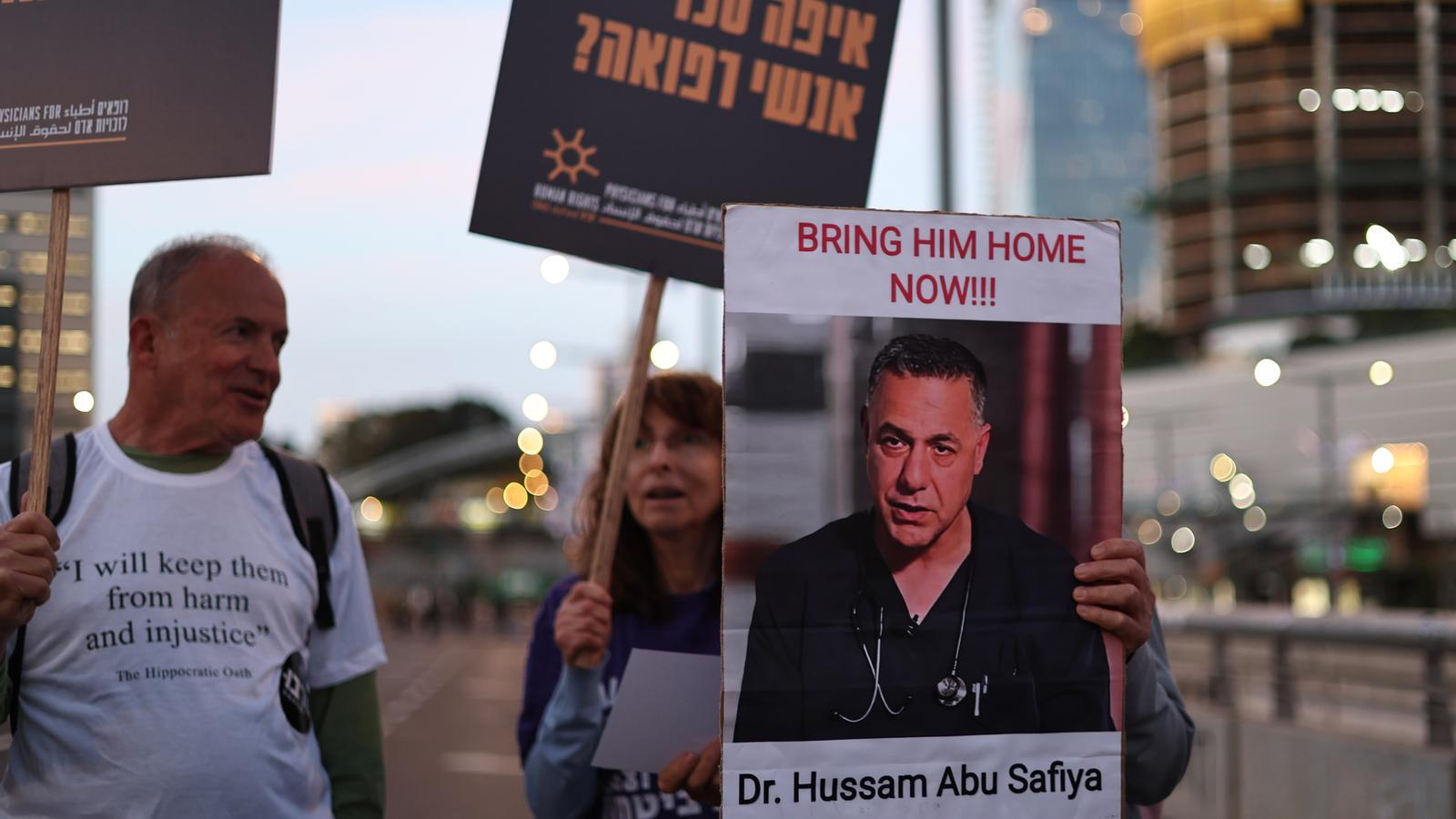
Hussam Abu Safiya, director of the Kamal Adwan hospital in Gaza, has been imprisoned in Israel without charges or trial for almost twenty months
-
CAT -
CAST
Barcelona"They brought me here to kill me. I don't think I'll get out alive." This is the last message that pediatrician Hussam Abu Safiya was able to convey through his lawyer from his captivity. He had recently been transferred to Rakefet, an Israeli underground prison where inmates never see the light of day. When lawyer Nasser Odeh visited him on July 2, he barely recognized him: his face was full of bruises, he had difficulty speaking and breathing, and he could barely stay seated. Several times he seemed on the verge of losing consciousness.
"The situation is very serious. He has no food or medication and is completely isolated," explains his son Ilyas, who lives in Kazakhstan with part of his family, in a video call with ARA. Information reaches them intermittently through lawyers. They cannot call him, write to him, or visit him. Each period of silence increases the fear that something has happened to him.
Abu Safiya, pediatrician and director of the Kamal Adwan hospital in the north of the Gaza Strip, was detained by the Israeli army on December 27, 2024, during the assault that put out of service the last major hospital still functioning in that area. For weeks, his figure had become a symbol of Palestinian health workers who continued to treat patients under bombardment, without electricity, fuel, medication, or sufficient personnel.
He had had several opportunities to leave Gaza, but he had refused. "He decided to stay with his patients," explains Shorouq Saleh Al-Rantisi, 32, who began working as a laboratory specialist at Kamal Adwan in 2019. "As a pediatrician, he could not abandon sick and injured children who had no one else to care for them."

Al-Rantisi worked by his side throughout the war, until the day of her arrest. As they did not have enough staff, she had to lend a hand in places outside her specialty: emergency, radiology, operating room, and obstetrics. Like many of her colleagues, she was a volunteer.
The last refuge of the north
Kamal Adwan had become the last refuge in northern Gaza, which the Israeli army was literally emptying. The rest of the hospitals had been evacuated or destroyed. Abu Safiya and his team were well aware that if they left, the people would be left helpless, without hope, and would eventually leave. The first major Israeli assault took place in December 2023. The troops then arrested its director, Ahmed Kahlout, along with dozens of professionals, and emptied and closed the hospital.
"Shortly after, Dr. Hussam called me and told me they wanted to reopen Kamal Adwan, and asked me to join them," explains his colleague. "He was the one who gave us the strength to keep working, he told us not to abandon our humanity for even a minute. He is not just a doctor: he is the conscience of Gaza and his detention is an attempt to silence humanity itself. The world cannot forget Kamal Adwan Hospital and the professionals who chose to stay."
Abu Safiya reopened the center and became its new director: they recovered the equipment that was still useful and relaunched the intensive care unit and the operating rooms. His commitment invited the population to have hope. The hospital was besieged for months and suffered several military incursions. Medical equipment, generators, water tanks, and oxygen facilities were damaged by Israeli fire. "Doctors and nurses have to treat the wounded while bombs fall around them, and patients have to be operated on without all the necessary equipment or without anesthesia. But leaving means letting them die."
Abu Safiya's case, he recalls, was more extreme because Israeli drones were literally pursuing him inside the hospital: on one occasion, one of these devices shot him in the left leg, while he was in the doctors' lounge. For months he received calls from Israeli commanders demanding that he surrender: from drones equipped with loudspeakers, Israeli soldiers called out his name.
During the Israeli military incursion into the hospital, his fifteen-year-old son Ibrahim died. He was buried near the center, and the few Palestinian journalists who survived in the northern Gaza Strip – where Israel continues to deny access to international press – captured images of the broken hero, weeping inconsolably as his colleagues embraced him.
Roofing and insulation
The young man has not seen his father since he was arrested on December 27, 2024. The Israeli army carried out the final attack on Kamal Adwan: dozens of tanks surrounded the hospital and called him over the loudspeakers. He was seen walking alone in a white gown through a destroyed street towards a column of tanks. He entered a tank and saluted the soldiers. They agreed on the terms of the evacuation. He stayed until the last patient and the last hospital worker left, like the captain who does not abandon a sinking ship.
Abu Safiya passed through several Israeli prisons. He has only been seen once, last June, when he appeared by video conference in a hearing of the Israeli Supreme Court, where he reported that more than five officials had assaulted him with batons and hammers. On June 24, he was transferred to Rakefet prison, a semi-underground construction from the 1980s designed to house heads of organized crime, which ended up being closed because it was considered inhumane. The Israeli Minister of National Security, the far-right Itamar Ben-Gvir, has ordered its reopening.
The Supreme Court of Israel has urged the government to respond to a petition demanding the release of Abu Safiya and thirteen other doctors from Gaza held without charge.
Israel denies that the pediatrician is being mistreated or that his life is in danger. The Hebrew state's Ministry of Foreign Affairs states that he is legally detained based on "concrete intelligence information" and calls him a "Hamas colonel," without providing evidence. No formal charges have been filed either. Israeli authorities have released a single image to link him to Hamas, showing Abu Safiya in a uniform of the Palestinian Authority's military medical services, an organization that operates in both Gaza and the West Bank and has no connection to Hamas or its armed wing.
