The EU celebrates Orbán's defeat: "Hungary has chosen Europe"
European leaders expect the Hungarian country to become a reliable ally again

-
CAT -
CAST
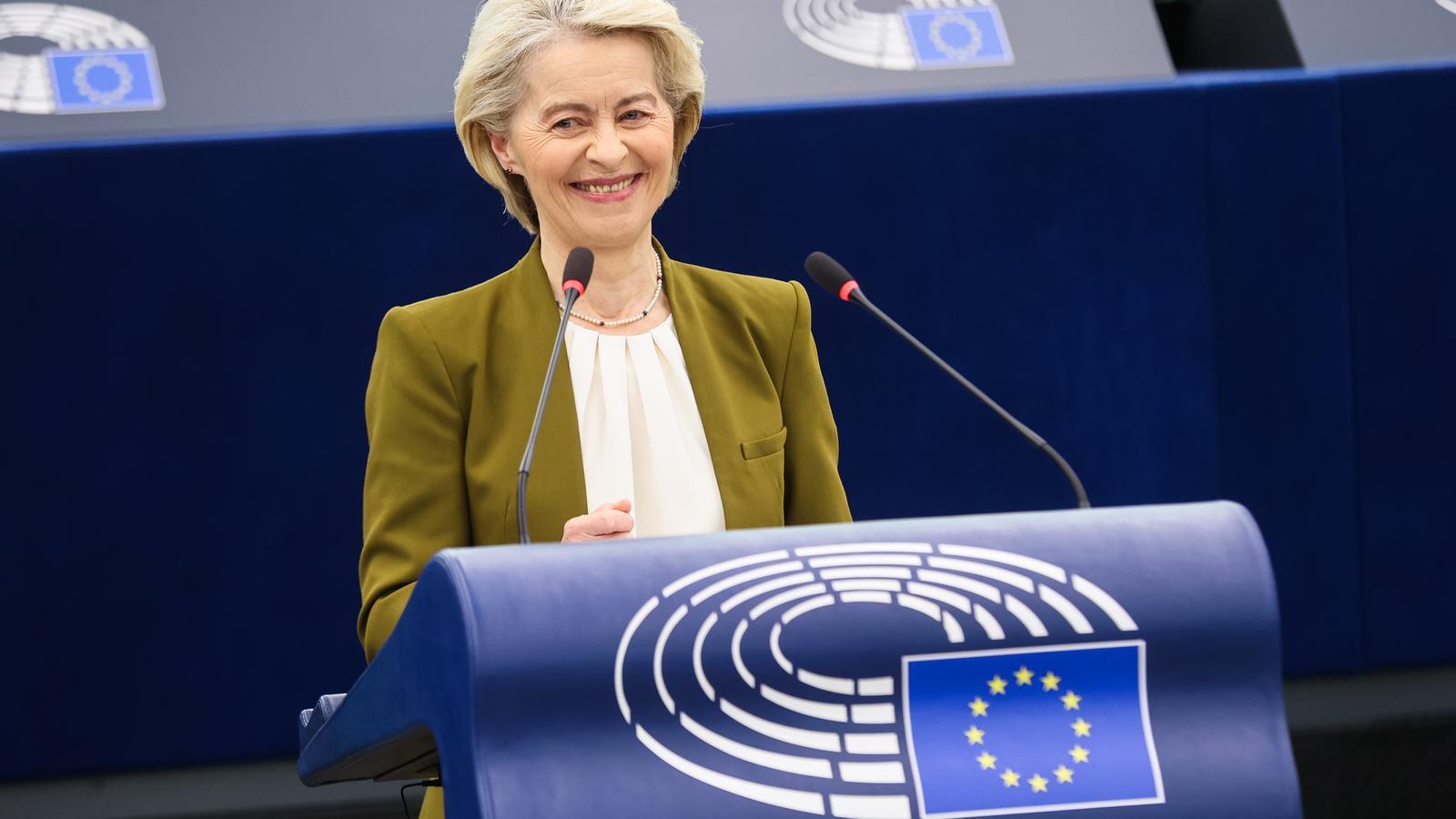
BrusselsThe European Union celebrates the defeat of Viktor Orbán and the victory of Péter Magyar. Community leaders and those from a good part of the member states took only a few minutes to react to the definitive results of the Hungarian elections. One of the most enthusiastic was the President of the European Commission herself, who tweeted unusually quickly and euphorically. "Hungary has chosen Europe. Europe has always chosen Hungary. A country claims its European path. The Union becomes stronger," wrote the German conservative.
Von der Leyen has also already called the winner of the elections, and the spokesperson for the Community executive, Paula Pinho, has assured that they have "agreed" to work in "close collaboration". "The Hungarian people have spoken and their will is clear," added the President of the European Council, António Costa. "In turn, the President of the European Parliament, Roberta Metsola, congratulated Magyar, who at this time is still a Member of the European Parliament, and highlighted that "Hungary's place is in the heart of Europe".
The reactions of the leaders of the two largest and most influential member states of the Community bloc, Germany and France, have also not been long in coming. The German Chancellor, Friedrich Merz, congratulated Magyar on the social network X and pointed out that he "looks forward to working collaboratively" with the winner of the Hungarian elections for "a strong, secure, and, above all, united Europe". In the same vein, the French President, Emmanuel Macron, said he has already congratulated Magyar and welcomed that the Hungarians have chosen the most pro-European option. "France celebrates this victory of democratic participation, for the commitment of the Hungarian people to the values of the European Union and for Hungary in Europe," the French leader pointed out on social media.
The President of the Spanish Government, Pedro Sánchez, has also celebrated the victory of Magyar, who has defeated one of the main far-right leaders in the European Union. "Today Europe and European values win. [...]. Looking forward to working together, Peter Magyar, for a better future for all Europeans," tweeted the socialist leader. Outside the EU, the British Prime Minister, Keir Starmer, has also celebrated the results. "It is a historic moment, not only for Hungary but for European democracy," he tweeted.

The leaders of the Eastern European countries, who feel most threatened by Russian expansionism and the collaborationism between Orbán and Putin, have also enthusiastically celebrated the defeat of the acting Hungarian Prime Minister. The Prime Minister of Sweden, Ulf Kristersson, has called Magyar's victory "historic" and pointed out that it is "a new chapter in Hungary's history." The Finnish Prime Minister, Petteri Orpo, has highlighted that he has "demonstrated" the "strong will to be an active player in the European Union and NATO." "It is an opportunity to once again be a constructive player in our common community of values and security. [...] I congratulate Péter Magyar and hope he does everything possible to restore common trust," he tweeted.
In the same vein, the Estonian Prime Minister, Kristen Michal, also said it is a "historic election" for a free and strong Hungary" within a "united" European Union and that, at the same time, it "rejects forces that ignore their interests," such as Russia. "I look forward to working with you [Peter Magyar] in favor of common European values and interests," added the Prime Minister of Latvia, Evika Silina.
The farewell of the black sheep
Orbán has become the main black sheep of the community club and has increasingly put more obstacles in the way of approving initiatives of all kinds that have broad consensus among the European Union as a whole, especially when it comes to helping Ukraine and sanctioning Russia. Not to go any further, at the moment, Orbán's government is blocking the shipment of the European Union's macro-loan to Kyiv for 90,000 million euros, even though the acting Hungarian prime minister had already given his initial approval. Furthermore, it is also not allowing the twentieth package of sanctions by the European club against Vladdimir Putin's regime to be processed.
In many respects, as is the case in foreign policy, European Union initiatives and regulations must be approved unanimously. In this way, the refusal of a single member state can block measures that have broad consensus, a situation that Orbán often exploits to achieve concessions and benefit Moscow. In fact, and as is customary, Orbán had made his Euroscepticism and animosity towards Brussels one of his main electoral horses.
European partners have followed the Hungarian elections very closely, especially considering that electoral polls have been pointing to an Orbán defeat for months. With the results of Sunday's elections, a change in relations between Budapest and Brussels is expected in European institutions, although a rather moderate optimism prevails. Magyar has shown himself willing to collaborate with the European Union, to fight against Hungary's endemic corruption and to reverse Orbán's authoritarian tendency, but on issues relating to Ukraine and cutting all ties with Russia, he has shown himself to be more ambiguous.
