The European Union's moderate optimism in Hungary despite Orbán's potential defeat
Polls predict an electoral defeat for the current Hungarian prime minister, but the main opposition has shown ambiguity regarding support for Ukraine

-
CAT -
CAST
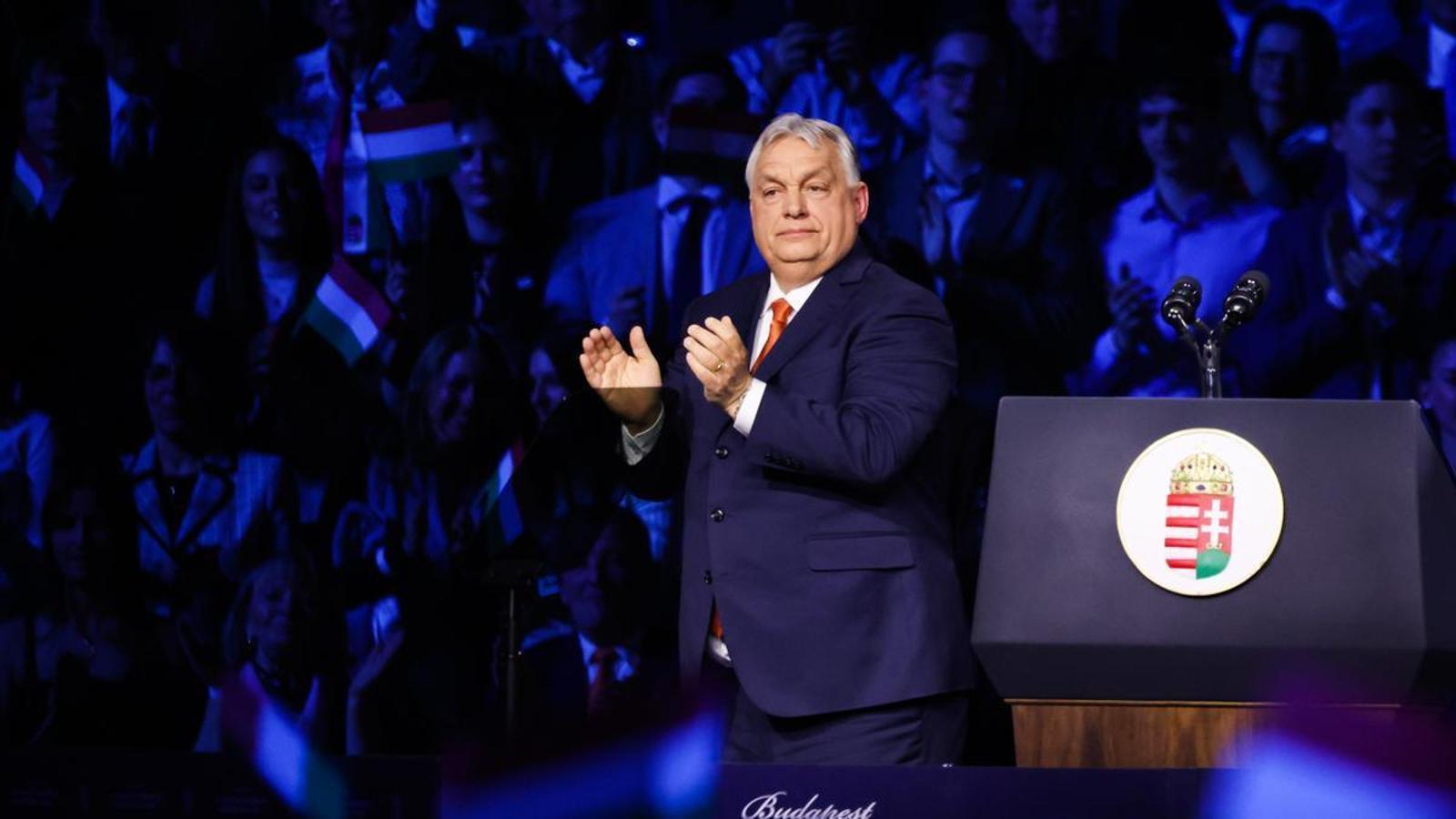
BrusselsViktor Orbán has become the Trojan horse and the eternal stumbling block for the European Union. He is the main ally of Vladimir Putin's regime – also of the Trump administration – and the great leader of the hardest and most Eurosceptic far-right in the community club. For this reason, in the European institutions, Orbán's electoral defeat, predicted by the polls, is eagerly awaited. However, optimism is moderate. Not only because obviously one does not want to claim victory until the electoral results arrive, but also due to the skepticism aroused by his main opponent, Péter Magyar, who leads the polls. Several diplomatic sources consulted by ARA doubt to what extent Magyar would restore European democratic standards in Hungary and, above all, whether he would break ties with Moscow to unequivocally rally behind Kyiv.
The sources are rather confident that a victory for Magyar would lead to a reduction in corruption and an improvement in social rights and respect for the rule of law in Hungary. However, they recall that Orbán's main opponent has shown himself to be ambiguous regarding the aid that the European Union allocates to Ukraine and the sanctions it applies against Russia. In this regard, they agree in pointing out that the current Hungarian prime minister has made a country to his liking and his Eurosceptic discourse has taken deep root among citizens, which is not at all easy to reverse.
Along the same lines, the expert from the Council of the EU on Foreign Affairs on the European Union's foreign policy and Hungary believes that Magyar intends to "restore cooperation" between Brussels and Budapest, and "would not constantly be blocking initiatives" of broad consensus among European partners. "He would align with the EU's rule of law, [...] but regarding Ukraine, for example, he has shown himself to be against an accelerated accession process and is very cautious when talking about the war," he points out in a conversation with ARA. He also notes that Magyar adapts to Hungarian public opinion, which is "quite skeptical" regarding European support for Kyiv.
In fact, the researcher on European policies for the think tank EPC Eric Maurice adds that Magyar himself has shown himself to be contrary to cutting the import of Russian fossil fuels by the European Union. As a Member of the European Parliament, moreover, he has often voted in the same way as the representatives of Orbán's party, Fidesz - Hungarian Civic Alliance. "He is very, very skeptical about supporting Ukraine; if he becomes prime minister, he will have to clarify his position," he tells ARA.

But all agree that a change of government would be a breath of fresh air for Hungary and could reverse Orbán's increasingly authoritarian and pro-Russian trend. "The current situation is really bad and the general feeling is that a change in Budapest would be positive, but we will have to see to what extent," points out a diplomat.
Orbán's precedent and unanimity
Orbán has been the first leader to completely break the unity of the European bloc and is constantly vetoing initiatives that have the absolute support of the rest of the European partners. The fact that in some areas, such as foreign policy, regulations must be processed unanimously, gives Budapest the power to veto, for example, aid to Ukraine or sanctions against Russia. In fact, at the moment, the Hungarian government is blocking the 90 billion euro macro-loan, which is key to Kyiv's financing after the abandonment of the United States, and the twentieth package of restrictions against Moscow.
Now, however, Hungary is no longer alone: countries like Slovakia and the Czech Republic have joined the dissent. Orbán has set a precedent and, even if he loses power, there are other leaders who constantly hinder the EU and it is feared that this club of black sheep will grow. In this context, there are increasingly more voices – including that of the President of the European Commission herself, Ursula von der Leyen – advocating for finding a way to end unanimity in some aspects, such as foreign policy, and thus defuse the will to stall the functioning of the European bloc, especially in the midst of the war in Ukraine and the growing international wave of the far-right.
