Political prisoners in Venezuela: "My husband has pancreatic cancer and is still behind bars"
Human rights associations denounce that the amnesty law approved by the National Assembly has remained in wet paper

-
CAT -
CAST
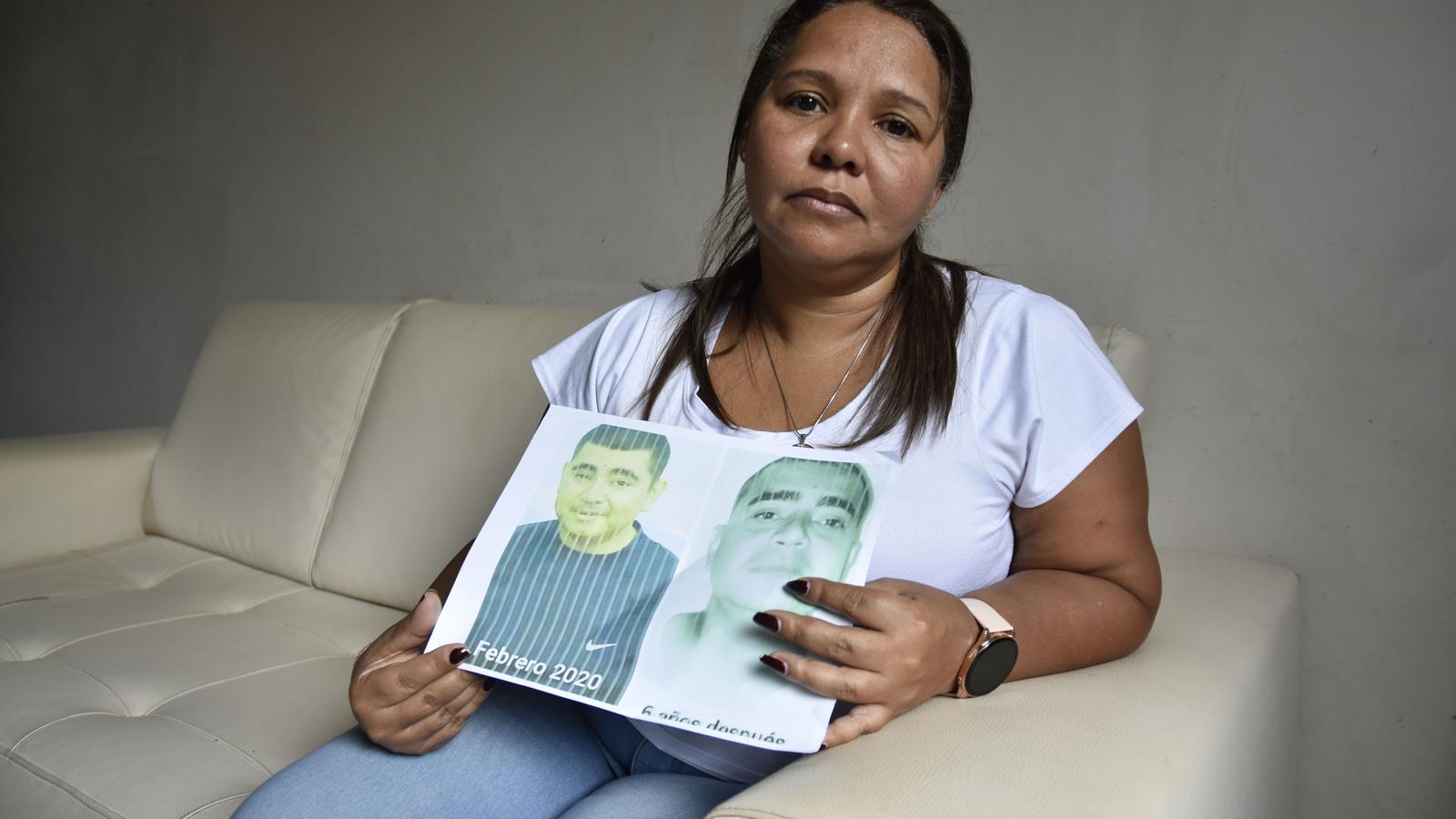
Caracas“He didn’t get out today either”, says Eglis Manaure, 50, resignedly, as she climbs the stairs leading to her home in a residential block in Guatire, a town about 50 kilometers from Caracas. She smiles and pretends to be normal, but her eyes betray her: she has a profoundly sad look. "I barely sleep. At one in the morning I'm already awake watching the news to see if they've released him,” she confesses. Her husband, Enrique Parada, was arrested more than six years ago, on April 20, 2020, and since then he has been in a prison more than 450 kilometers away, in the city of Maturín, in northeastern Venezuela. To get there, Eglis takes fourteen hours by bus and can only go every three or four months. She has to choose between paying the cost of the ticket or covering the medicines he needs. Her economy doesn't allow for anything else. The man, 45, has pancreatic cancer.
On February 19, the Venezuelan National Assembly approved an amnesty lawOn February 19, the National Assembly of Venezuela approved an amnesty law that was intended to be a turning point, a before and after. Or at least that's how they sold it. Instead, the coordinator of the Venezuelan human rights association Justice, Encounter and Forgiveness (JEP), Martha Tineo, assures that the legislative text has remained on paper. It is true that a total of 721 political prisoners were released, but the majority remain under precautionary measures. This means they cannot leave the country, talk to the press, and must appear before the courts regularly. And even worse: they can be imprisoned again at any time. "Only 110 people have been definitively released from prison," says this human rights defender.
Without official data
According to this organization, at least 665 political prisoners remain in prison, to which must be added many other cases that have emerged in recent months. "Reprisals extend to the entire family group. They may be looking for one family member and detain another if they cannot locate the one they are looking for," explains Tineo. That is why many remain silent. Others remain silent out of fear of rejection. The result is that no one knows for certain how many political prisoners remain behind bars, and the Venezuelan government has also not published an official list of those it is holding prisoner or those it has released.
“Many people distanced themselves from me when they arrested my husband”, says Eglis, who has seen family and friends turn their backs on her as if she had the plague. And this, despite the fact that her husband has been in provisional detention all these years, without a final sentence. He is accused of being involved in a plot to kidnap the Minister of the Interior, Diosdado Cabello. The United Nations Human Rights Council has extensively documented the widespread and systematic use of arbitrary detention in Venezuela as a tool of repression.
Just five days ago, Enrique Parada was sentenced to 26 years in prison, but the sentence is not yet final. “When my child found out, he cried non-stop, he wet the bed, he didn't want to eat...”, explains Eglis with an afflicted voice, referring to her 8-year-old son Mauricio, who desperately awaits his father's return. The sentence is for the entire family.

Emirlendris Benítez Rosales's family is also devastated. This middle-aged woman used to sell clothes and shoes until she was arrested on August 5, 2018, accused of participating, a day earlier, in an attempted drone assassination against Nicolás Maduro and other public officials in Caracas. Since then, she has been behind bars and sentenced to 30 years in prison, even though before her arrest she had no idea what an assassination was, let alone a drone. Her crime was being a co-pilot in a car that was acting as a taxi, carrying two strangers who were supposedly involved in the attack. The United Nations Working Group on Arbitrary Detention has requested her immediate release, as has Amnesty International. So far, without consequences.
“They tore off her toenails with a hammer, put her head in a plastic bag with insecticide, hit her against the wall, kept her isolated for 33 days…”, says Melania Leal Rosales, listing what they did to her sister when they arrested her. As a consequence of all this, Emirlendris has been confined to a wheelchair: she has fibromyalgia, a herniated disc, a dislocated shoulder… “I ask God for justice to be done”, says her mother, Gladis María Rosales, who suddenly kneels on the ground as she pleads looking at the sky. The family is especially humble. They live in a shack on the side of a hill on the outskirts of Caracas.
Blows and rats
Williams Dávila is a recognized politician: he was governor of the Venezuelan state of Mérida, vice-minister in the eighties and senator in the nineties. Despite this, he was also arrested and beaten. He was arrested on August 8, 2024, for his participation in a peaceful rally in Caracas to demand the freedom of political prisoners. Uniformed men with balaclavas assaulted him, hit him on the head, injured his leg, and locked him in a cell with rats; the wound became infected, and in prison, he suffered septicemia, pneumonia, a gastric ulcer, and hemorrhoids. He is now one of the few political prisoners who has been granted total freedom under the amnesty law, after being released with precautionary measures on July 18, after more than eleven months in prison. The criminal proceedings have been archived.
“[José Luis Rodríguez] Zapatero contacted my son to tell him that the Venezuelan government was willing to let me leave the country on the condition that I never return, but I refused,” says the politician. He trusts in change. Just five months ago, it would have been impossible for him to be released or allowed to participate in electoral events, he assures. That is why he is now willing to return to the political arena.
