Peru looks to the future through the rearview mirror: a choice for the return to two opposing pasts
The political heir of the dictator Fujimori and the successor of the left-wing former president Castillo are fighting for the second round
-
CAT -
CAST
BarcelonaIn an election, what is usual is that parties look to the future. It is also not strange to look to the present if what is sought is to renew the presidency or a majority in Parliament. In certain contexts, some formations, for the future, seek to evoke the past. What is less common is that citizens arrive at the polling station and find that the two options they have to vote evoke different pasts in their country's history, however different they may be. This is the scenario that Peru finds itself in this Sunday, which is celebrating the second round of presidential elections.
Peruvians have to choose between the political space of former president Alberto Fujimori and that of former president Pedro Castillo, two figures that the two candidates facing each other in the second round claim without hesitation. Even though Fujimori ended up being a dictator and was convicted of crimes against humanity, the presidential candidate Keiko Fujimori, daughter and political heir of who led Peru between 1990 and 2000, often evokes the figure of her father. Beyond some clarifications, she embraces the former president's legacy almost uncritically. "She has no difficulty claiming the figure of Alberto Fujimori because, despite everything, many people in Peru argue that that was a period of stability and growth," points out Salvador Martí, professor of political science at the University of Girona specializing in Latin America. Ideologically, Fujimori fits with the far-right political program of figures such as Nayib Bukele, Javier Milei, or Jair Bolsonaro.
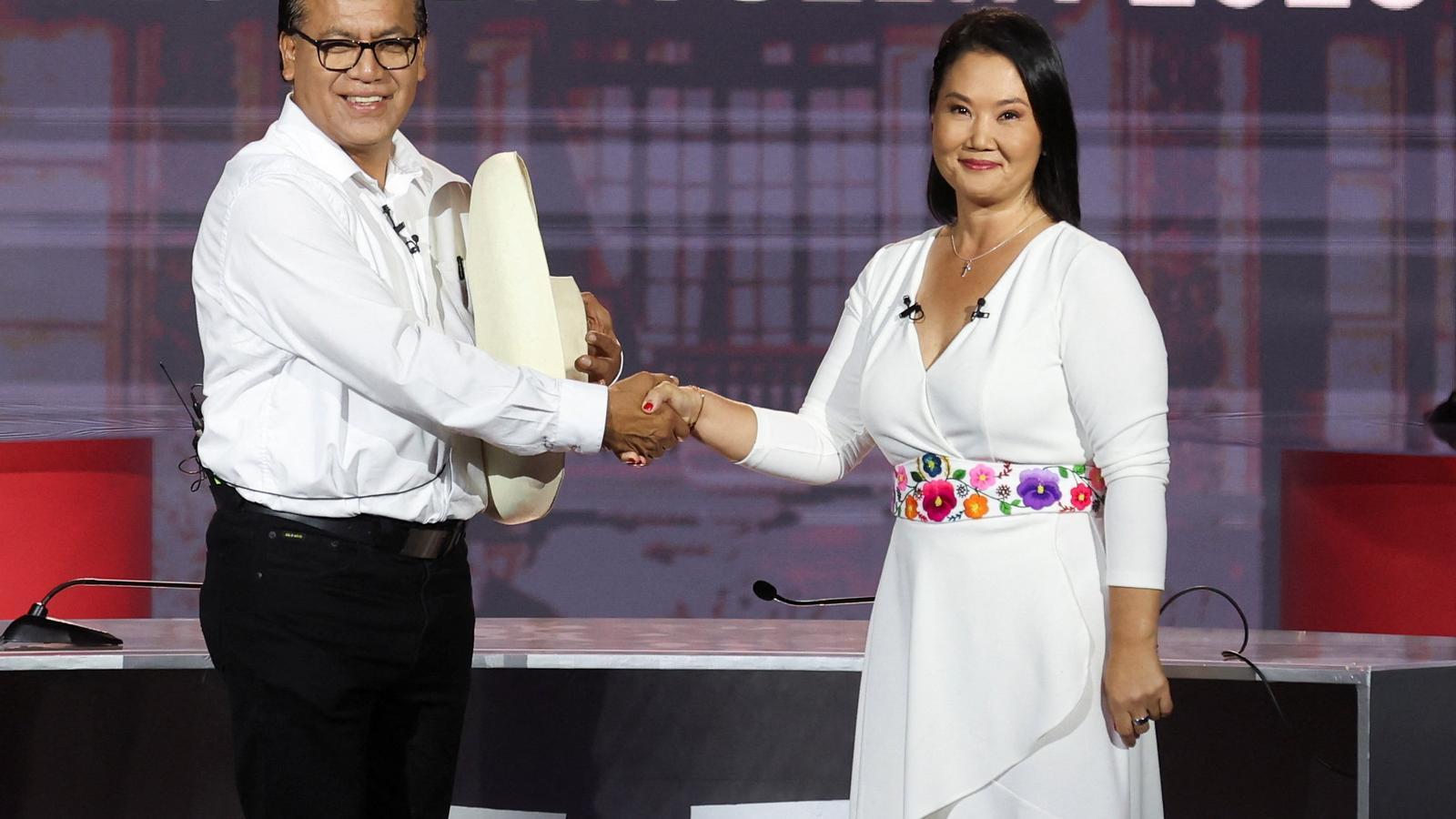
It is the fourth time Keiko Fujimori is running in the elections. This time Roberto Sánchez is her rival. He also evokes the figure of a former president, in this case Pedro Castillo, of a contrary political stripe, who governed the country between July 2021 – after Keiko Fujimori won the popular vote – and December 2022. He currently claims to be the "kidnapped president" of Peru, after in 2022 he himself dissolved Parliament and established a state of exception to break the blockade that the legislature imposed on any measure he intended to promote. At the time of the self-coup, the de facto powers did not side with him and he ended up imprisoned. The left considers that Castillo, who has become a symbol for the most impoverished sectors of the country, especially for indigenous peoples, was expelled from power by the elites currently represented by Fujimori, the face of extreme neoliberalism and authoritarian right in Peru.
"We can say that Sánchez's party is left-wing because it has a discourse of social justice and inclusion of marginalized sectors, but it is not at all ideological," portrays Ana Ayuso, senior researcher for Latin America at Cidob. "In fact, there are even those who question whether it is a left-wing party," adds Martí. Rodrigo Gil, political scientist at the Institute of Peruvian Studies, defines Sánchez's party as "a left-wing that poses a frontal criticism of the capital's centralism." "It is based on Castillo's personalism. Sánchez emulates him even physically, using a hat like the one the former president used," details Gil. In fact, the link between the candidate and the former president is so close that Sánchez has announced that he will spend election night visiting the prison where Castillo is imprisoned.
A disillusioned population
The duel between conservative circles and the electoral resistance and revolt of impoverished and forgotten sectors would awaken passions in practically any context. But despite the confrontation and polarization between two opposing political camps, the electoral campaign has not yielded major headlines. "The candidates have not mobilized great illusions, fears, or expectations, which reflects the country's mood in recent years," illustrates Gil.
Peru has had eight presidents in ten years, and this instability has caused a large part of the population to disconnect from politics. Furthermore, although macroeconomic data remain stable, the majority of citizens do not see an improvement in their material conditions in a country where 70% of the population lives from informal work. Concern about insecurity caused by criminal organizations, often related to drug trafficking, has been one of the major issues that have loomed over the campaign, but the issue has long occupied the country's political agenda and proposals to address it are alternating – with more or less success in their implementation – depending on who occupies the presidency and controls Congress, where Fujimorism carries great weight.

Most polls point to a slight advantage for the right-wing candidate, which has been increasing as the weeks have passed. But forecasts in the country have a rather wide margin of error. At this point, all consulted experts agree in assuring that it is complicated to predict who will win the elections. The global reactionary wave may benefit Fujimori, but Sánchez has moderated his discourse in recent days and has presented a new government plan, different from the one he had put on the table at the beginning of the campaign, with which he tries to convince the anti-Fujimori voter that with a proposal like the previous one, much more focused on strengthening the role of the state, perhaps they would not vote for him. It will be this electorate, especially made up of what is known as the middle class, that will tip the balance.
