Trump announces he is extending the ceasefire with Iran, but maintains the blockade in Hormuz
The president says he is maintaining the truce to give the Iranians time to present a proposal for an agreement, despite Tehran not seeming at all willing to sit down and negotiate.
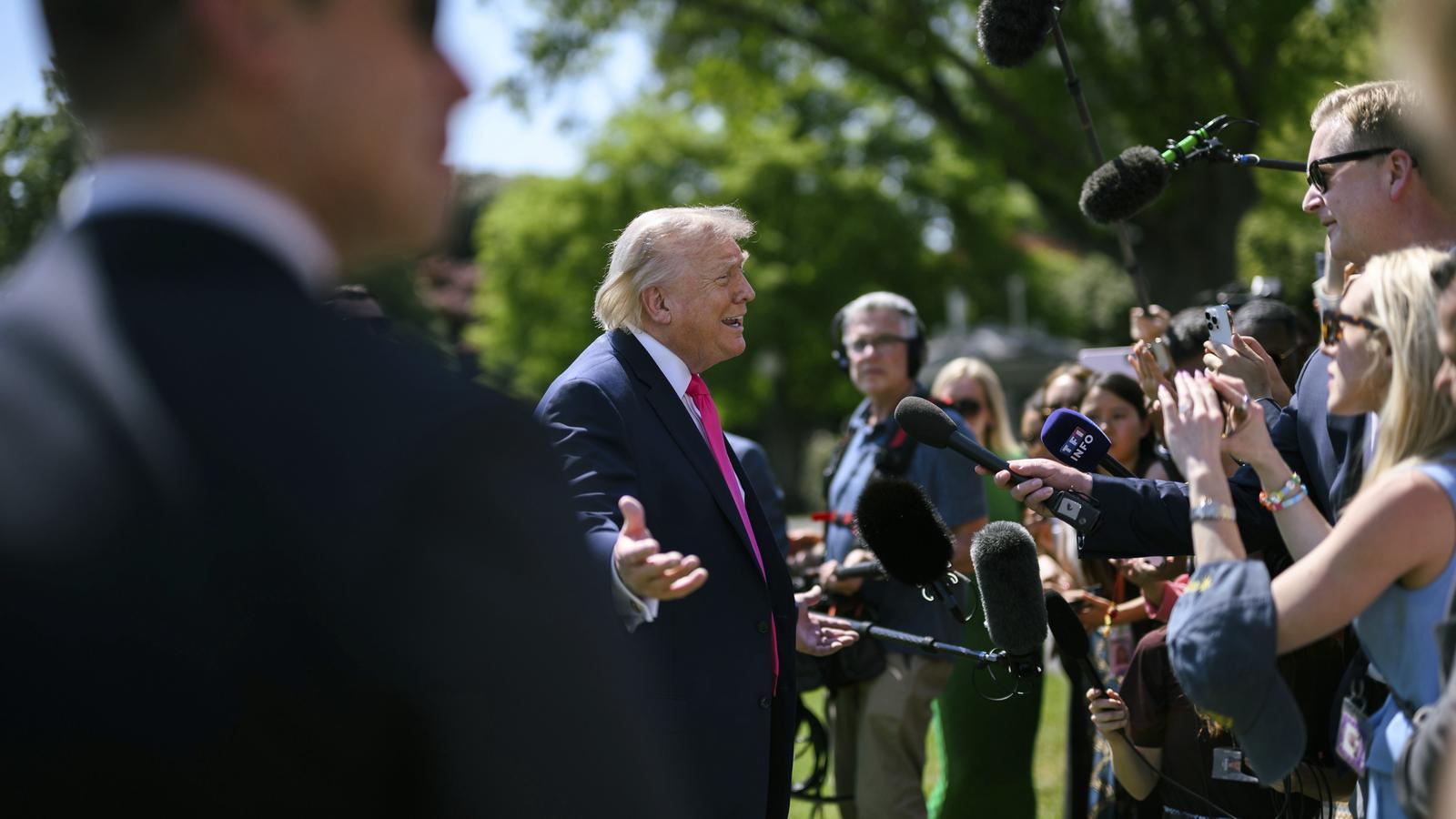

WashingtonAfter suspending Vice President JD Vance's trip to Islamabad, Donald Trump has announced that he is extending the ceasefire with Iran at the request of Pakistani Marshal Asim Munir and Pakistan's Prime Minister Shehbaz Sharif. Once again, Pakistan comes to the rescue of the Republican. The US president assures in a message on Truth Social that he will maintain the truce until Iranian leaders "can present a unified [agreement] proposal," as "Iran's government is severely fractured." Even so, Trump assures that he will maintain the naval blockade in the Strait of Hormuz. The ayatollahs have been demanding that the Americans lift the military cordon as a condition for being able to sit down to negotiate again.
"I have ordered our military forces to continue the blockade and, in all other respects, to remain ready and capable; likewise, I will extend the ceasefire until they present their proposal and the talks conclude, one way or another," Trump wrote this Tuesday. Iran, in a first reaction through an advisor to the speaker of the Iranian parliament, has assured that the extension of the ceasefire "means nothing." "The defeated party cannot dictate terms," the advisor emphasized, who considers that this new move by Trump could be "a tactic to buy time for a surprise attack." For now, Pakistan has not confirmed whether Iran has accepted the extension of the truce.
In the last few hours, Iranian forces had shown themselves to be particularly belligerent in the face of the siege. Before Trump's new turn, Iranian Foreign Minister Abbas Araghchi said in a post on X that "the blockade of Iranian ports is an act of war and, therefore, a violation of the ceasefire." "Boarding a commercial vessel and taking its crew hostage is an even more serious violation. Iran knows how to neutralize restrictions, how to defend its interests, and how to resist intimidation," he wrote, referring to the recent interceptions of Iranian vessels by the marines.
The White House had already suspended Vance's trip to Islamabad this morning, when the ayatollahs had not yet confirmed whether they would attend the round of talks. The main reason why Vance's departure would have been postponed is that the White House wants guarantees that a solid agreement can be reached in the new round of talks.
The decision to indefinitely extend the truce comes after a morning of frenetic meetings at the White House. Apart from Vance, the other two strongmen of the negotiating team, special envoy Steve Witkoff and the president's son-in-law, Jared Kushner, also attended. This morning their flight from Miami was also diverted to Washington, instead of Europe, where they were supposed to stopover to go to Pakistan.
Trump's announcement, despite dispelling fears that the US would resume attacks against Iran, does not clarify the overall picture. Especially since it remains to be seen whether the Iranians decide to buy the extension of the truce and do not resume attacks on the rest of the Gulf. Tehran's willingness to sit down and negotiate remains an unknown. Whether extending the ceasefire with the US blockade is more beneficial to them than resuming hostilities is a question only they know.
In the last few hours, uncertainty surrounding the talks and the ceasefire had reached grotesque levels. There wasn't even a clear time for when the truce was supposed to expire. Trump had told Bloomberg on Monday that the truce expired on Wednesday night, Washington time. But on Tuesday morning, Pakistan's Minister of Information and Broadcasting, Attaulah Tarar, said the end time was 4:50 am in Washington (1:50 pm on Wednesday in Catalonia). In parallel, Iranian state television speaks of 3:30 am on Wednesday, Tehran time, which would be 2:00 am in Catalonia. Amidst this jumble of times and time zones, it was notable how the US president was the one giving the most oxygen to the truce. The ayatollahs, on the other hand, are the ones shortening it the most, although they are actually sticking to the time the pause began on April 7.
Once again, Trump proves that his words are carried away by the wind. This morning he reiterated in an interview with CNBC that he was not considering extending the truce and that he was "ready" to resume fighting. Despite Tehran's entrenchment, Trump continued to insist that he believed the US would achieve "a great deal".
The first –and for now only– meeting in Islamabad lasted more than 20 hours, ending without any understanding. Iranian sources leaked to the media that one of the major points of contention was the Strait of Hormuz. The ayatollahs demand to be recognized as the main actor controlling the passage. From the American side, the focus was placed on the nuclear issue. When Vance appeared to announce that he was returning to Washington without an agreement, he emphasized the inability of the Iranians to yield on the nuclear program issue.
Last week, Trump asserted that the U.S. had agreed with Iran to recover "nuclear dust" buried in the ruins of Fordow, Natanz, and Isfahan, which were bombed in June 2025. The term "nuclear dust" is the concept Trump uses to refer to enriched uranium in the hands of the Iranians, which is considered one of the main security concerns for the U.S. The announcement that Americans will be able to recover these remains has not been confirmed by Iran.
The blockade in the Strait of Hormuz continues
Blockade continues in the Strait of HormuzThis Tuesday at dawn, the United States army boarded a sanctioned oil tanker in the Indian Ocean, 600 kilometers off the coast of Sri Lanka. It is the oil tanker M/T Tifani, and the operation is part of Washington's efforts to choke Iran by seizing sanctioned vessels that, according to the White House's version, "provide material support to Iran". The operation was carried out on the high seas. Regarding this matter, the Pentagon reiterated in a statement that international waters "are not a refuge for sanctioned ships". "The Department of War will continue to deny illicit actors and their ships freedom of maneuver in the maritime domain," Washington concluded.
