One year of Merz at the head of Germany: a bitter anniversary
Its first year in government has been marked by its strong unpopularity, constant tensions within the coalition, the rise of the far-right and its confrontation with Trump
-
CAT -
CAST
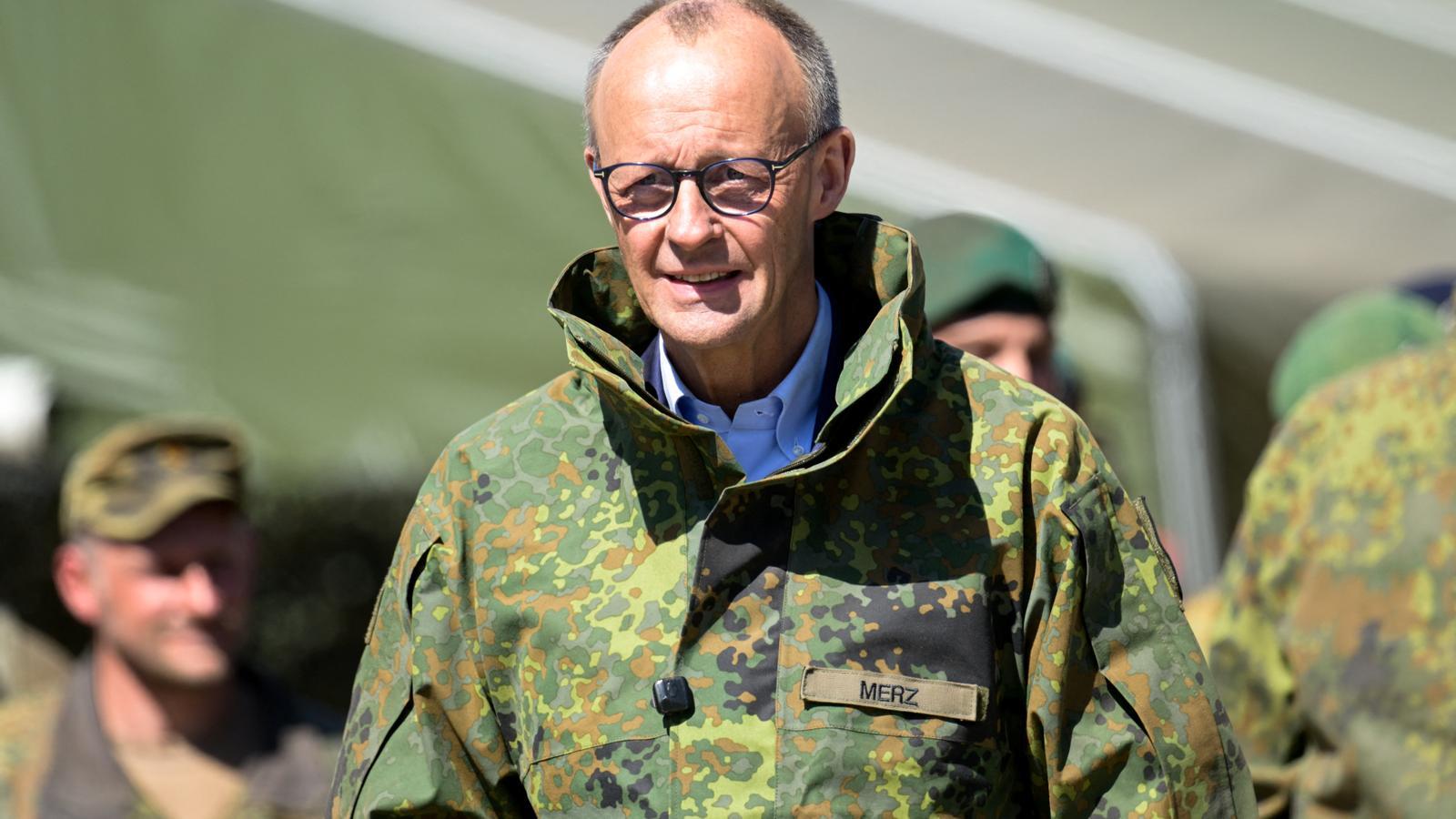
BerlinGerman Chancellor Friedrich Merz marks his first year at the head of the federal government this Wednesday. More than a celebration, it will be a bitter anniversary. His first year in the Chancellery has been marked by his strong unpopularity, constant tensions within the governing coalition with the Social Democrats, criticism of his own party, the rise of the far-right, and his confrontation with US President Donald Trump. Added to this is a slight slowdown in the German economy due to the war in Iran and the announcement of welfare state cuts.
withdraw 5,000 US soldiers from bases in GermanyIn foreign policy, Merz blows out the candle of his first anniversary in power at odds with Trump over the war against Iran. Merz, considered a convinced Atlanticist, has seen relations between Berlin and Washington deteriorate. In response to the chancellor's strong criticism, Trump has ordered the withdrawal of "5,000 US soldiers from bases in Germany.
Domestically, the Christian Democrat leader is a very unpopular chancellor. Only 21% of Germans are satisfied with his work, eight percentage points less than in March. All this is reflected in the voting intention polls. The conservative bloc (CDU-CSU) is falling in the polls, while the Social Democrats of the SPD are at historic lows and the far-right is gaining more and more support and is nipping at the heels of Merz's party.
If elections for the Bundestag – the lower house of the German Parliament – were held this Sunday, the CDU-CSU would get 26% of the votes; the far-right Alternative for Germany (AfD), 25%; the Greens, 14%; the SPD, 12%; and The Left (far-left), 10%. The other parties would not obtain parliamentary representation because they would not exceed the threshold of 5% of the necessary votes, according to the same survey.
"Friedrich Merz demonstrates to the public that the CDU, under his leadership, has long been in a struggle for political survival," opined far-right leader Alice Weidel. "The rapid fall in popularity ratings proves it: the damage Merz has inflicted on his party by coercively linking himself to the anti-economic agenda of the SPD is devastating," added the AfD leader, who considered that the social democrats "impose tax increases and Merz loses control."
When a German journalist asked Merz in a television interview on Sunday what advice he would have given himself a year ago when he took office, the chancellor replied: “Be patient!”.
Merz needs a lot of patience these days to deal not only with the tensions between Christian Democrats and Social Democrats in the coalition, but also with the growing discontent in his own ranks. Many conservative politicians are frustrated with the SPD, whom they accuse of obstructing reforms they want to push through quickly.
Tensions with coalition partners
"This is no way to run the Chancellery," proclaimed the head of the SPD parliamentary group, Matthias Miersch, referring to Merz, irritated by certain controversial statements from the "impulsive" Chancellor. "In economic policy, for example, there is still a lot to do," opined the former Minister-President of the federal state of Hesse, the conservative Roland Koch.
One year after coming to power, the Chancellor is demanding more willingness to compromise from the SPD. Merz refuses to govern with the support of the far-right, "but that should not lead the SPD to think it can do whatever it wants with us." The Chancellor believes he has been "very patient" with his coalition partners so far. Nevertheless, "compromises are not a one-way street. Both of us have to make them," he demanded of the Social Democrats.
Merz, however, is trying to downplay the tensions within the coalition and his own party. Successes "are quickly overlooked," while internal disputes are amplified and publicly debated, the Chancellor opined.
The German press has reported in recent weeks on shouting matches and fundamental disagreements over reforms within the government. The Minister of Social Affairs, the Social Democrat Bärbel Bas, described the Chancellor's cuts in the social sector as "cynical and despicable" at a May 1st rally.
Merz admitted in an interview with the magazine Spiegel that they have not managed expectations well after his arrival in power. "You can't expect quick successes overnight. Successes will only come with time. Politics in a democracy doesn't work like a delivery service, where you place an online order and everything is delivered instantly," he argued.
And he stated that the Social Democratic Chancellor Gerhard Schröder "had to contend with strong resistance" when he launched his controversial Agenda 2010 reforms, but "he was not attacked as much as I am being." "I'm not complaining, but that's how it is," Merz stated to Spiegel.
All this could take a toll on both governing parties in the September regional elections. The far-right could achieve an absolute majority in the Saxony-Anhalt elections, and in Mecklenburg-Western Pomerania, it could become the most voted party.

