Nigel Farage steps down as MP to return with a 'plebiscite' between him and the Westminster establishment
The ultra leader seeks the support of the "people" in the face of what he considers a "discredit campaign" while he is investigated for financial irregularities

-
CAT -
CAST
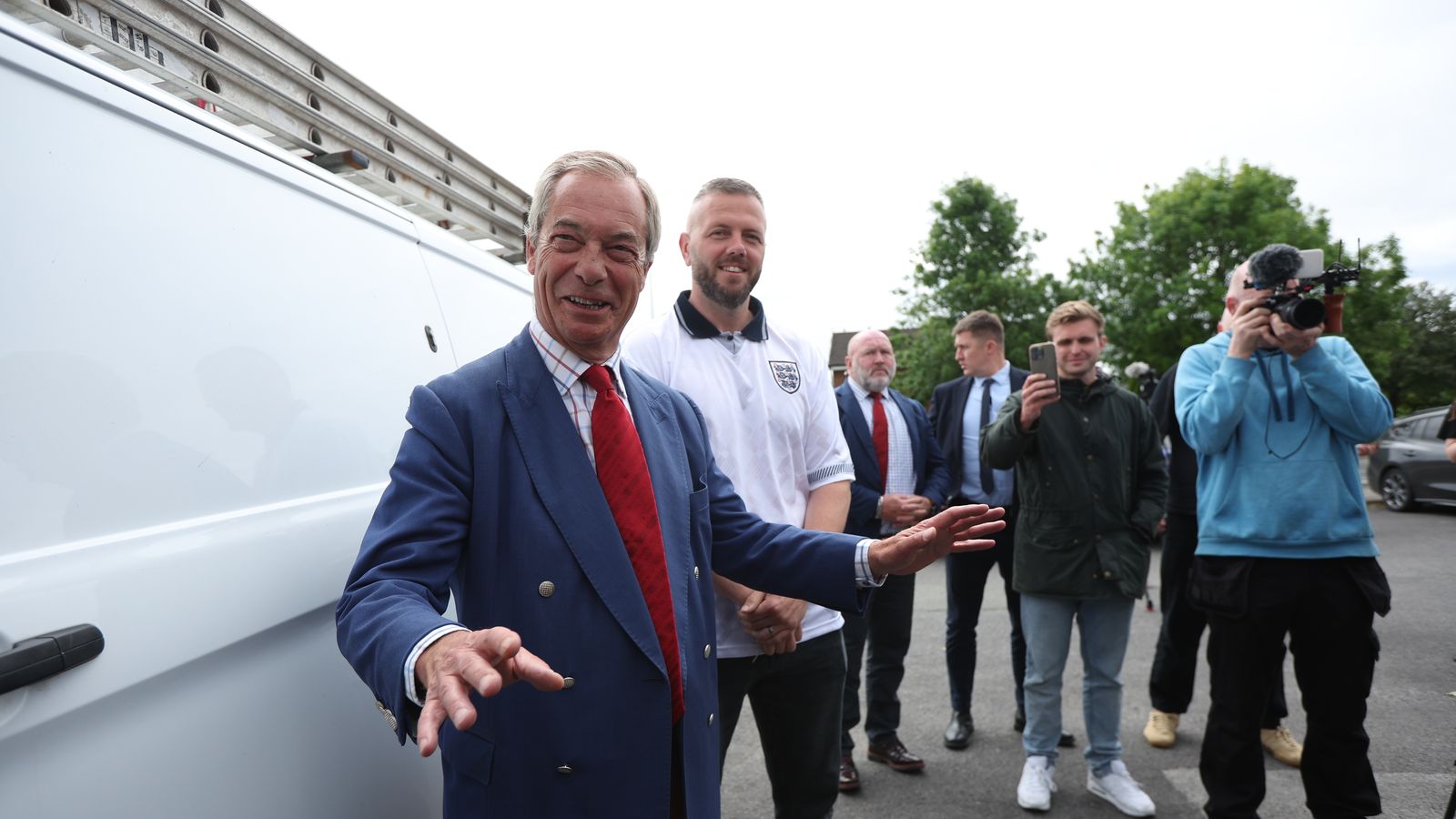
LondonIn a typical populist move, Nigel Farage, the leader of the Reform Party, announced this midday that he is resigning as a Member of Parliament for Clacton-on-Sea, a decision that will trigger a by-election in which he has already confirmed he will stand again as a candidate. Farage justified the move by stating that he wants the voters, not the Westminster "establishment", to judge his conduct after the controversy generated in recent weeks by parliamentary investigations into his finances.
Farage's maneuver is interpreted as a preemptive strike, for reasons including the fact that the parliamentary committee investigating him could have ended up suspending him as an MP, which would have nevertheless triggered a by-election. The ongoing investigation is now suspended and would only resume if he wins the seat again.
However, late this afternoon, the situation took a turn after the parties that Farage labels as establishment – Conservative, Labour, Liberal Democrat, the Greens, and also the far-right party Restore Britain – announced, one after another, that they would not contest the by-election. Furthermore, the Liberal Democrats have asked the House of Commons to block his resignation from the seat until the parliamentary committee investigating him has made its decision. The ploy of a politician playing with the marked cards of Trumpism could have been neutralized and ended up becoming a painful own goal.
In a combative, no-questions-asked press conference where he employed his usual demagoguery, the far-right politician insisted that he has not broken any laws or misused money, while also denouncing that both the media and his political adversaries have launched a campaign to discredit him. According to him, the ongoing parliamentary investigations into his economic interests, including a "personal gift" of five million pounds he received before becoming an MP, have become a "political tool" to curb the rise of the Reform Party.
Thus, the far-right leader has presented the upcoming partial election that his resignation provokes as a plebiscite between "the people and the establishment". Once again, Farage claims to represent a people from whom he is very distant, since the time he was a stockbroker in the City of London in the nineties, during which he founded his fortune. "If I win, the voters win; if I lose, they win," he stated, assuring that he is running again to maintain "the political revolution" initiated by his party, and that ten years ago, as leader of the United Kingdom Independence Party, provoked the Brexit referendum and the country's exit from the European Union.
During a speech of about fifteen minutes, Farage mixed the defense of his personal situation with a harsh attack against the Labour government, the conservatives, the media, and institutions. He assured that the rules on parliamentary standards are used "selectively" against him and claimed the right of politicians to have businesses and assets, arguing that business experience is precisely what the British government lacks.
The last straw
Farage has also dedicated a significant part of his speech to denouncing the threats he claims to have suffered for more than two decades in the world of politics, since he arrived at the European Parliament in 1999. Roughly speaking, Farage has paid back with the same hatred he has sown, with migrants as the primary recipients of his attacks. Presenting himself only as a victim, and not as the cause, he has recounted physical assaults, attacks on his home, and death threats. And he has explained that a significant part of the financial resources he has received are needed to ensure his personal security on a permanent basis, given the lack of protection offered by the Ministry of the Interior. The last straw, according to him, has been the publication by The Times this weekend of a photograph of the house where his daughter lives, which he considers a serious violation of his family's privacy. That is why he submits himself to the verdict of the polls in Clacton, in southeast England, where he won in 2024 with 46% of the votes.
Furthermore, Farage has accused the government of wanting to alter electoral and party financing rules to hinder the growth of his party, which is in fact a limited company of which he himself is the main shareholder. Farage has denounced, among other measures, the changes in the voting system for some elections, the reduction of the voting age to 16, and reforms on political donations, which he considers to be specifically aimed against his party.
Despite assuring that he had considered abandoning politics and moving to the United States to resume his professional activity, Farage has concluded that he prefers the chosen path. "I will not let Sky News or its like decide my future," he stated, before formally announcing his resignation from his seat and his intention to compete again in the next by-election he himself is causing.
The announcement comes after months of scrutiny over the aforementioned gift valued at five million pounds that he received from cryptocurrency entrepreneur and billionaire Christopher Harborne, who resides in Thailand. Parliamentary authorities are now investigating whether Farage should have formally declared this aid when he entered the House of Commons after the 2024 general election. Harborne is also one of Reform UK's main donors.
The controversy intensified last weekend. An investigation published by the Sunday Times has denounced another financial donation that the populist and far-right leader would have received, but not declared, from George Cottrell, a financier, regular collaborator of Farage, who was convicted in the United States for electronic fraud and who served a short prison sentence in 2017.
Leadership under criticism
Beyond Farage's deep dives against the British media and traditional parties, the fact is that in recent months voices from the Reform Party itself have shown their disagreement over his leadership style. Farage's rise to the top of the polls has also highlighted the party's internal weaknesses. Several internal voices question whether the party is ready to become a real governing alternative and, above all, whether Nigel Farage has the will to assume the demands that aspiring to be prime minister would entail.
The criticisms are not focused so much on Farage's political ability – considered by many of his allies one of the most effective politicians in the United Kingdom in recent decades – as on his way of leading the Reform Party. Among the reproaches are the lack of regular meetings with MPs – there are eight of them – the absence of a chief of staff, a very weak structure for selecting candidates, and the tendency for some team members to act on their own in matters considered key.
These shortcomings have become more visible after some recent setbacks, such as electoral results lower than expected in the Makerfield by-election in the Makerfield by-election and the competition from new forces to its right, in addition to the aforementioned investigations into his personal finances. All of this has fueled the perception that Reform UK's momentum may have stalled.
