Journey to the largest municipality in Catalonia
Geoparc Orígens is an extraordinary territory that tells us where we come from: it speaks to us from the formation of the Pyrenees to today

-
CAT -
CAST
"Tremp is the largest municipality in Catalonia," Xavier Boixadós, a guide for this town, assures me, so as soon as we see each other, he says almost before telling me: "Did you manage to park easily?" I am taken aback. I thought I had ventured into the most depopulated, emptiest Catalonia. He immediately explains it to me: "Larger in surface area, not in number of people. It has 300 square kilometers, more than Barcelona." Tremp has been adding abandoned or semi-abandoned villages, and that's why it has been growing. Many of these villages are built on high ground – defense was the number one element for settling there.
Tremp is the main center of the territory Geoparc Mundial Unesco Orígens, recognized for the exceptional value of its geological heritage.The Geopark tells us about how these lands have evolved from the formation of the Pyrenees to the present day through geology, but also through other elements of nature (such as karst lakes), dinosaur footprints, and the traces of humanity – Romanesque. It also tells us about the use of natural resources, such as the salt from Gerri de la Sal, and the gorges, which allowed the installation of several dams, pharaonic hydroelectric works that illuminated Catalonia. "The wild water of the Pyrenees stopped by a mass of concrete in the middle of the Tremp basin is the perfect contrast between nature and human ingenuity," says Xavier Boixadós from Tremp, referring to the Sant Antoni reservoir, located a little above Tremp, as we walk through the center of the capital of Pallars Jussà. The walk is interrupted from time to time by neighbors who not only greet him but also give us fragments of their memory and tell us things that no one has ever written down.
We meet a woman on the street. I fantasize about the idea that she is an actress. But no, she is not. She is Pili from Canons. We meet her in the small square that bears her name. It is Plaça del Forn, but a squadron that renames public spaces with popular names has covered the official name with a paper that says "Plaça de la Pili de Canons". Pili is very well known because she had a grocery store. Xavier's grandmother used to go there to buy cream on Sundays. Pili walks slowly. Tremp beats bradycardiacally. We are far from the bustle of big cities. For example: the basilica of Mare de Déu de Valldeflors, built on a Romanesque church, did not "touch the sky" until 1909, when the bell tower was finished.
"We would pile up wooden boxes that had been emptied of fruit, without telling our parents, and we would climb to the prison window, and give the prisoners some pieces of fruit; they were very grateful," Pili explains to us. Other houses humiliated them by making them go out naked on the balcony. "If you don't undress, we'll kill you," they told them. The prisoners were in the old hospital for the poor, a 16th-century building that still stands and faces the square. Before being a prison, it assisted the sick, orphans, and pilgrims – they were housed and fed for three nights. Now it is the Tremp court.
As we walk, Xavier highlights the importance Tremp historically had – and still partly has today – as a logistics center. From here, merchandise was loaded towards the Pyrenees. There were eight tanneries, which made leather for the harnesses of pack animals, before automobiles arrived.
We finish the visit at the Epicentre, Geopark Visitor Centre, a large dissemination space, which consists of different floors and is full of interesting audiovisuals, one of which requires wearing 3D glasses. It is also the headquarters of the Pallars Jussà Regional Tourism Office. A lot of resources have been poured in here! One of the audiovisuals gives details of the asteroid that impacted Earth in the Caribbean region and caused the extinction of the dinosaurs. It was 10 kilometers in diameter. The collision was devastating. In the impact zone, it caused enormous tsunamis, with waves up to 300 kilometers inland and earthquakes of magnitude 10 on the Richter scale, within a radius of 1,800 kilometers. The entire planet suffered the aftermath. The warming of the atmosphere was immediate.
Chance, small size, and the fact that some could take refuge, waiting for better times underwater or underground, allowed some animals to survive.
It took the planet up to 10 million years to recover its diversity. And the power vacuum left by the great reptiles and dinosaurs was filled by mammals. From the scarce 20 mammal families of the Cretaceous period, they became 90 by the end of the Paleocene.
Currently, there are few Paleocene fossil sites in the world that can give us clues about what the inhabitants of Earth were like then. One of them is the Fontllonga site, located in Camarasa. Fossilized remains of a mammal have been found there, the oldest in Europe. It was an animal similar to a squirrel, but it is not an ancestor. Like the dinosaurs, it eventually became extinct.

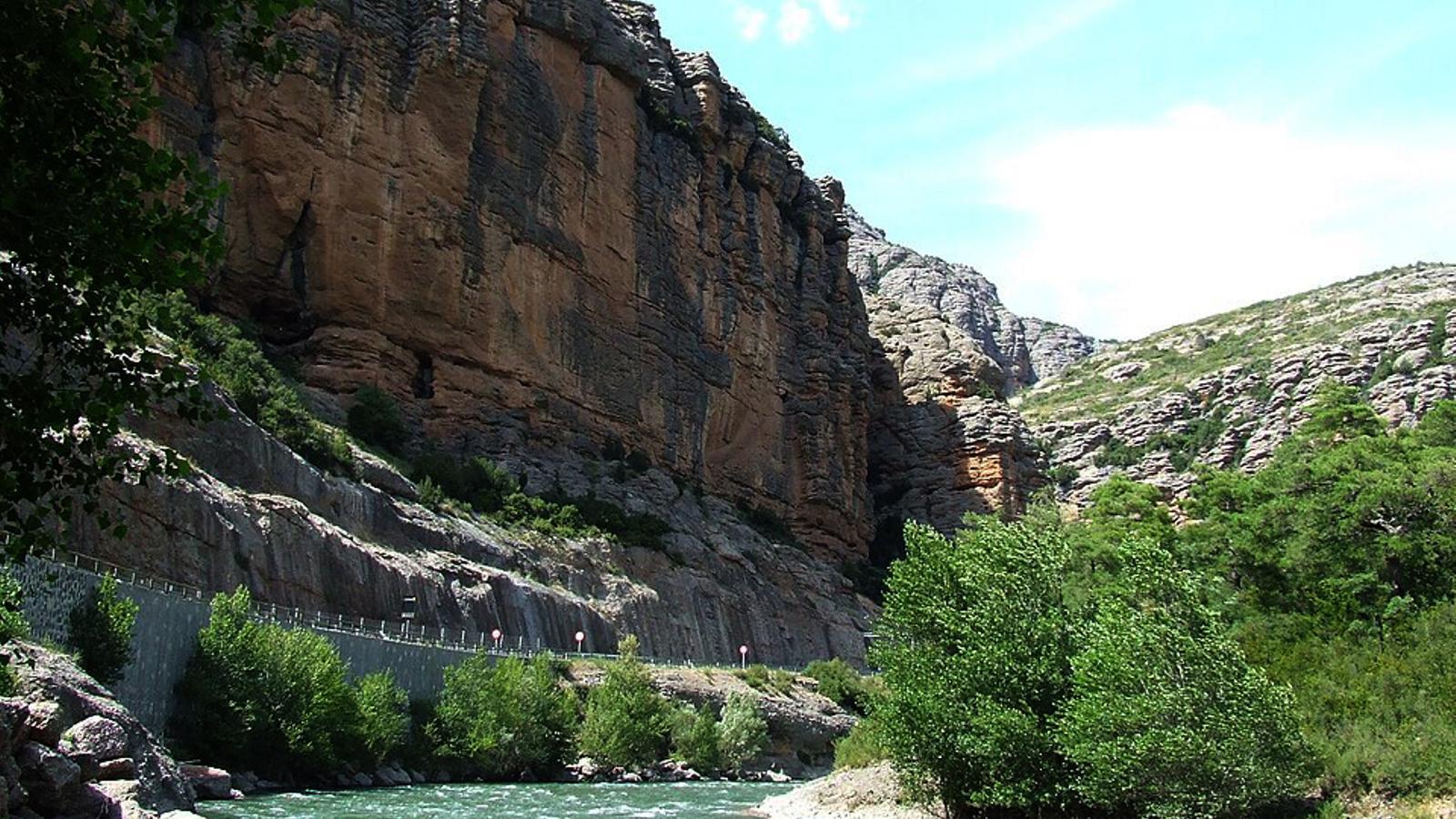
The Sagrada Família was born in PallarsLittle is known about Tremp being the largest municipality in Catalonia. It is also little known that the Sagrada Família, Gaudí's masterpiece, was the idea of Josep Manyanet from Tremp, a priest, educator, and founder of the congregations of the Sons and Daughters of the Sagrada Família, which currently have schools around the world. It is said – though it has not been possible to verify – that the silver of the Collegats gorge – "our geological Sistine Chapel", in the words of Xavier Boixadós – inspired Gaudí for the Sagrada Família. It is a spectacular formation of calcareous tuff through which water trickles and which, when it freezes in winter, takes on very unique shapes.
Manyanet was the ninth child of a family from Tremp – five died from illness – he was orphaned of his father, and his home could not care for him much. "I will teach you to write and read," the priest of the church told him, which was a stone's throw from the house. This was decisive for his training. Xavier explains it to me at the Casal Manyanet, where Josep Manyanet was born. This space traces, with a pile of objects from the time, his impressive trajectory. There are no lack of fossils from the area, among which the Turritella trempina.

