Israel intensifies bombings in Lebanon before a new round of negotiations
Trump calls Tehran's response "garbage" and warns that the truce is in "critical condition"

-
CAT -
CAST
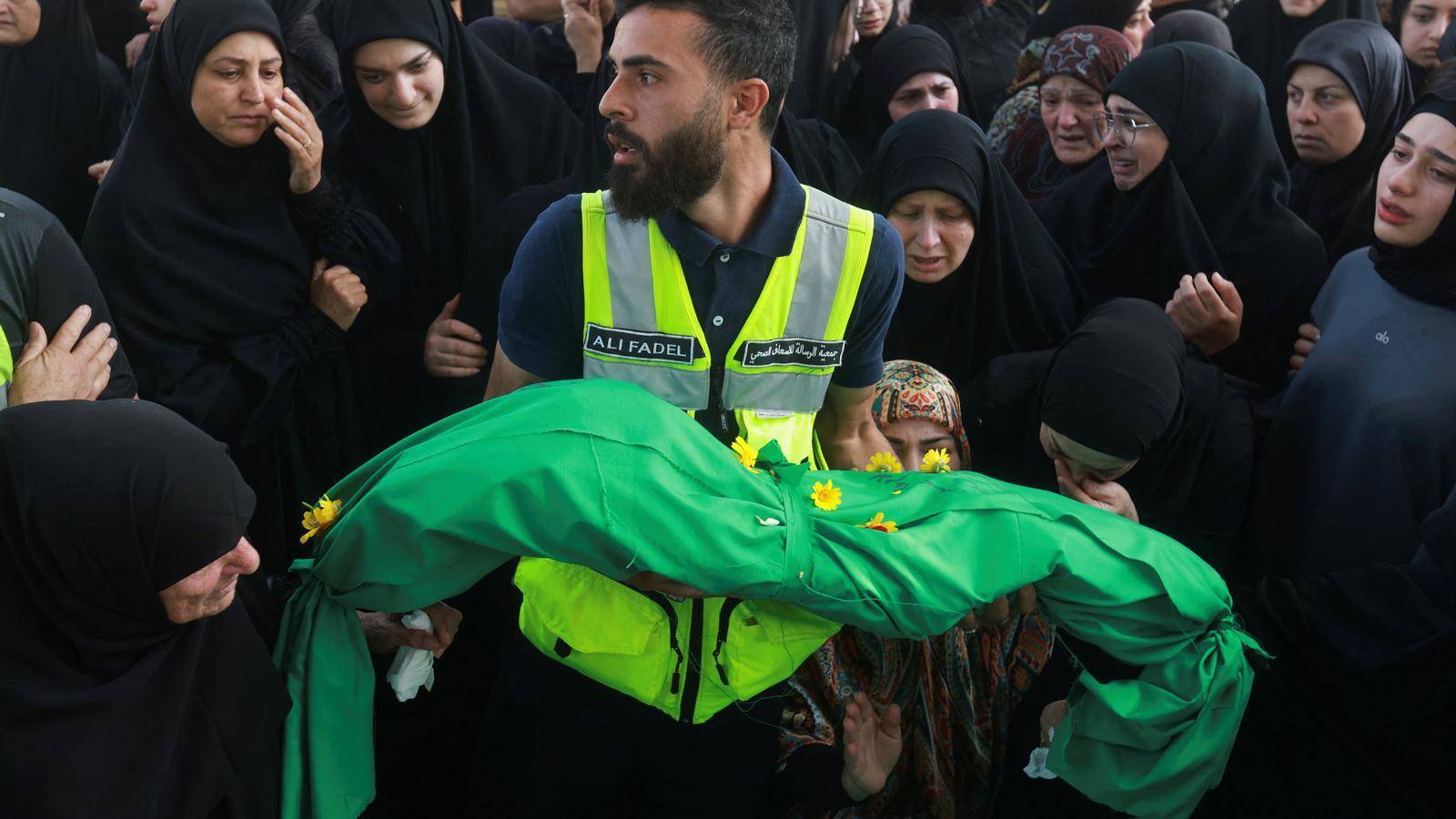
BeirutThe truce announced on April 17 between Israel and Lebanon was supposed to be a pause on one of the most unstable fronts in the Middle East. Less than a month later, the ceasefire is barely surviving diplomatic statements. Since the weekend, Israeli bombings have left around a hundred dead in southern Lebanon, according to provisional figures from the country's Ministry of Health. The total death toll since March 2nd until this Monday is 2,869 dead and 8,730 injured. Since the truce was declared, more than 400 fatalities have been recorded.
In the south of the country, violence is concentrated in a strip of hills and rural towns near the Israeli border. It is an elevated and strategic geography, which has become one of the main targets of Israeli bombings. These are not isolated points, but a continuous space where topography conditions both surveillance and the movement capacity of forces on the ground.
The bombings have also extended to areas where civilian life was trying to continue despite the war. Among the latest fatalities are two young people participating in a humanitarian aid operation in Zibdin. In Nabatieh, another attack affected a Lebanese army vehicle and an ambulance while they were accompanying repairs to electrical infrastructure. In the town of Toul, members of rescue teams were injured after several consecutive bombings in the same area.
Ambulances, municipal workers, electrical technicians, and rescuers appear recurrently among the victims, along with civilians who have not abandoned their villages. The pattern of attacks reinforces the perception that the truce has not stopped the war, but rather displaced it towards a more diffuse and constant form.
In parallel, Hezbollah maintains its capacity for military pressure on the Israeli forces deployed in southern Lebanon. In recent days, the group has used kamikaze drones and fiber-optic guided systems, a technology that reduces the effectiveness of conventional electronic interception. One of these attacks killed an Israeli soldier and injured others in the south of the country. Although limited in scale, these incidents reinforce the logic of action-reaction that maintains the escalation, even under the formal framework of the truce.
Israel is not only responding to attacks, but is advancing in the consolidation of a new territorial security configuration. Military sources acknowledge preparations to expand ground operations in southern Lebanon, especially in areas that are part of a de facto control strip beyond the so-called “yellow line”. The operational objective is to neutralize Hezbollah's capabilities in the elevated areas that dominate the Litani Valley and to secure a deeper security perimeter within Lebanese territory.
Trump belittles Iran's response
In this context, diplomacy is trying to advance in parallel. A new round of direct talks between Lebanese and Israeli delegations under US mediation is scheduled in Washington for May 14 and 15. Beirut seeks to extend the truce, achieve an Israeli withdrawal, and guarantee the return of those displaced from the south. Israel, on the other hand, conditions any progress on a verifiable timetable for Hezbollah's disarmament and a structural reconfiguration of the security apparatus on the border.
The regional backdrop adds an additional layer of uncertainty. On Sunday night, US President Donald Trump called the Iranian response to Washington's latest proposal to reduce regional tensions “totally unacceptable”, after a conversation with Benjamin Netanyahu. This Monday he added that the ceasefire in Iran is “critical” because the text from the ayatollah regime is, according to him, ‘stupid’.
Tehran sent a response on Sunday to Washington's proposal to negotiate an end to the armed conflict. The text, according to Iranian media, emphasizes putting an end to the war with guarantees that there will be no new attacks. Tehran also calls for an end to US economic sanctions.
When asked about the ceasefire situation, Trump replied: “I would call it weaker, right now, after reading that garbage that they sent us. I haven’t even finished reading it,” he said, contemptuously referring to the Iranian response. Nevertheless, in his usual vein of contradictions, Trump also said that it is ‘very possible’ that an agreement with Iran will be reached. “I have had a deal with them four or five times, and then they change their minds,” he said, and called the Iranian leaders ‘dishonorable’.
According to sources cited in the international press, what Washington considers unacceptable is Tehran's refusal to accept stricter limits on its network of regional allies and its indirect military influence in scenarios such as Lebanon, Gaza, and Yemen. Trump also considers it “inacceptable” that the Iranians do not mention “that they will not seek to obtain nuclear weapons”.
The US president's frontal rejection fuels concern about a new escalation of the conflict, after targeted attacks between Iran and the United States in the Strait of Hormuz were reactivated last week. between Iran and the United States in the Strait of Hormuz.
If the dialogue with Iran deteriorates, the escalation in southern Lebanon could worsen. Hezbollah continues to be an integrated actor in this regional architecture of influence, a fact that turns this front into an indirect extension of much broader negotiations.
The result is a truce that is neither breaking nor consolidating. It has not stopped the war, but it has transformed it, and it is now less frontal, more dispersed, and sustained by drones, artillery, partial occupation, and constant pressure on the civilian population. On the ground, the dominant feeling is not of an end, but of a conflict that has ceased to be declared in order to continue happening.

