US and Israel attack Iran and declare the supreme leader dead
Trump justifies the operation as necessary for security, and the big question in Tehran is whether the regime will survive.

-
CAT -
CAST
Washington/BarcelonaOf all the possibilities, Donald Trump has opted for the highest and riskiest gamble: launching a joint attack against Iran in the early hours of Saturday. Fifteen hours after the first missiles were fired at Tehran, the US president is already claiming the prize: "Khamenei, one of the worst people in history, is dead." The US president announced this in a post on Truth Social after his close ally, Benjamin Netanyahu, had already declared the supreme leader of the ayatollahs dead among the hundreds of victims of the bombings. Meanwhile, the official version from the ayatollahs is that the leader is still alive.

“He was unable to evade our intelligence and our highly sophisticated tracking system, and, working closely with Israel, there was nothing else he, or any of the other leaders who were also killed, could do. This is the only great opportunity for the Iranians to take back their country,” Trump proclaimed. Besides Khamenei, the Israeli military also announced the deaths of seven other high-ranking regime officials, including Defense Minister Aziz Nasirzadeh and Revolutionary Guard commander Mohamed Pakpour. It remains unclear who killed Khamenei, whether US or Israeli forces, but the operation points to close military and intelligence coordination and collaboration between the two countries.
Khamenei’s death confirms that the president is determined to go all in on this and that it will fulfill Netanyahu’s main objective: to end the regime. Israel has always considered the ayatollahs an existential threat. With Iran weakened, Tel Aviv is eyeing potential hegemony in the region. Trump asserted that members of the Revolutionary Guard, the military, and other security forces who help change the regime will be granted immunity. "This is the best opportunity for the Iranian people to take back their country. We hear that many members of the IRGC [Revolutionary Guard], the military, and other security and police forces no longer want to fight and are seeking immunity from us. As I said last night: 'Now they can have immunity; later they will only have death!' Hopefully, the IRGC and the police will peacefully integrate with Iranian patriots and work together as one to return the country to the greatness it deserves," he wrote.
However, despite stating that the transition "process" "should begin soon," he asserted that "the intense, precision bombing will continue, without interruption, throughout the week or for as long as it takes to achieve our objective of peace throughout the Middle East, and indeed, the world."

When asked by NBC who would replace Khamenei as leader of the country, Trump responded: "I don't know, but at some point I expect they'll call me for my opinion." He added: "I'm just being a little sarcastic when I say that." The US president has developed a taste for imperialism and is no longer content with simply asserting his control over Venezuela. From Iran, Foreign Minister Abbas Araghchi stated in an interview with NBC News that "there is no communication right now" between Washington and Tehran, but he also indicated that "if the Americans want to," they can contact the Iranian government. "We are certainly interested in a de-escalation," Araghchi asserted. He made this offer before Khamenei's condition was made public.
Eight months after the Twelve-Day War, Washington is once again igniting the Middle East and reviving the specter of the Iraq War. Instead of weapons of mass destruction that never existed, the US president now cites the threat of the creation of nuclear weapons, which Khamenei has repeatedly denied possessing. A premise that was even in the preamble to the nuclear agreement Trump withdrew from the program in 2015. But the tycoon justified it in an eight-minute video released after the operation: "This terrorist regime can never have a nuclear weapon."
As with the attack on Venezuela—which also took place early this morning almost two months ago—Trump followed all the movements of the operation from his Mar-a-Lago mansion, "along with all members of his national security team." The White House explained in a new statement that the president spoke with Netanyahu and that "before the attacks," Secretary of State Marco Rubio called the G-8 members. "He was able to speak with and explain the situation to seven of the eight members." It does not specify which eighth member was not notified or why.
Tabriz
mar Caspi
Urmia
Abyek
Teheran
Karaj
Qom
Kermanshah
Lorestan
Ilam
Khorramabad
Isfahan
Dezful
Babil
IRAN
IRAQ
Shiraz
Bandar
Abbas
Bushehr
Asaluyeh
Minab
Chabahar
Konarak
golf d’Oman
Teheran
IRAN
IRAQ
Teheran
IRAN
IRAQ
The massive deployment of the aircraft carriers USS Abraham Lincoln and Gerald Ford, along with dozens of destroyers and fighter jets, culminated in an attack at 8:10 a.m. local time. The Israeli government confirmed it shortly afterward and alerted its population to a possible Iranian response. "A missile and drone attack against the State of Israel and its civilian population is expected in the immediate future," the Defense Ministry said in a statement, announcing that a state of emergency had been declared nationwide. Shortly afterward, Iran launched several attacks against Israel and US military bases in the region.
For months, the possibility of a coordinated US-Israeli attack against Iran had been discussed, and it materialized with bombings at various locations across the country. The operation included the bombing of several locations where some leaders of the Iranian regime were meeting. The attack comes after US and Iranian delegations, mediated by Oman, met in Geneva on Thursday to a third round of negotiations Regarding Iran's nuclear program. Although subsequent statements seemed positive, the day after the meeting at the US embassy in Israel, he urged his citizens to leave the country immediately on Friday, foreshadowing a possible attack in the following hours, as ultimately occurred.
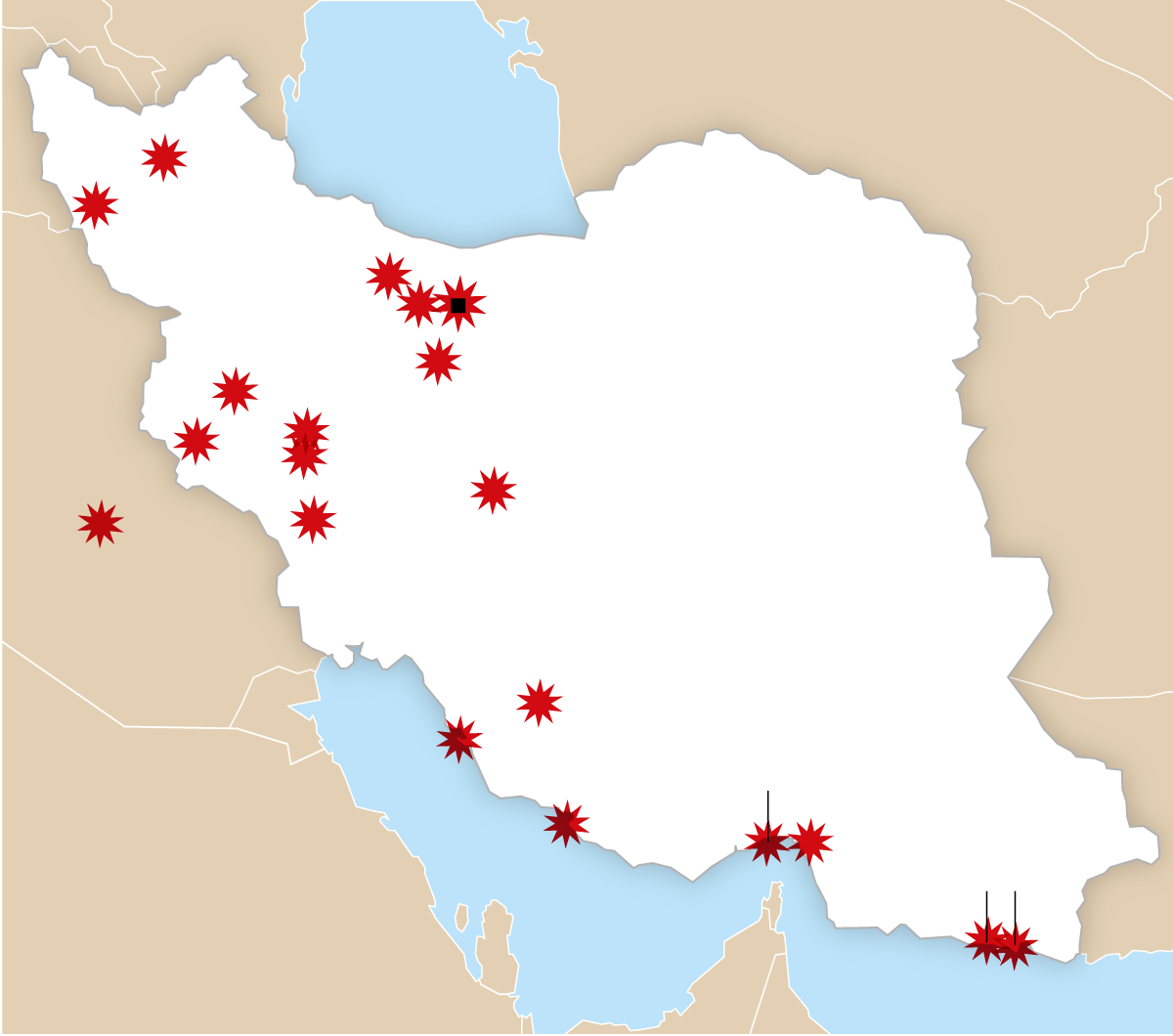
The toll of the regime change that Trump is already proclaiming has resulted in more than 200 dead and 747 wounded, according to the Red Crescent count. According to preliminary reports, the deadliest attack occurred at a primary school in Minab, in the south of the country, leaving at least 85 dead. In total, bombings have been reported in 24 Iranian provinces, but the operation remains active and, as Washington and Tel Aviv have confirmed, is expected to continue for several more days.
As an Israeli official explained to Reuters, the date for launching the attack was decided weeks ago. Just yesterday, Trump said he had not yet decided whether to order the attack.He insisted he did not want to use military force, but added, "Sometimes it is necessary." Israel has dubbed the operation Lion's Roar. The US has dubbed it "Epic Fury."

Netanyahu's pressure on Trump
To justify the operation, Trump has gone back to the 1979 attack on the US embassy in Tehran, and even to the present day with the Hamas attack of October 7, 2023. "And it was the proxy from Iran, who launched a monstrous attack on October 7th against Israel. [...] While taking twelve of our citizens hostage. It was brutal, something the world had never seen before."
Despite the parallels, Iran is not Venezuela, and unlike last summer's bombing, there are many reasons why the attack will not be a short war. We may lose the lives of brave American heroes and we may have casualties. This happens often, but we do it not for now, but for the future, and it is a noble mission." This idea is practically taboo for any president, and Trump had not considered it in any previous campaign. He always assured that there would be no American casualties.
The Netanyahu's emergency trip to Washington three weeks ago It seems he did achieve his objectives. The US president, who at that time seemed optimistic and content with an agreement only on the nuclear program, now also speaks of annihilating Iran's ballistic missile industry; one of Tel Aviv's priorities, and one that Netanyahu wanted Trump to adopt as his own. "We will destroy their missiles and raze their missile industry to the ground. It will be totally annihilated, again," the Republican said in his speech.

