Iran responds to the Israeli and US attack with the threat of a regional war
France, Germany, and the United Kingdom align themselves with Washington, while Gulf countries threaten to retaliate.


-
CAT -
CAST
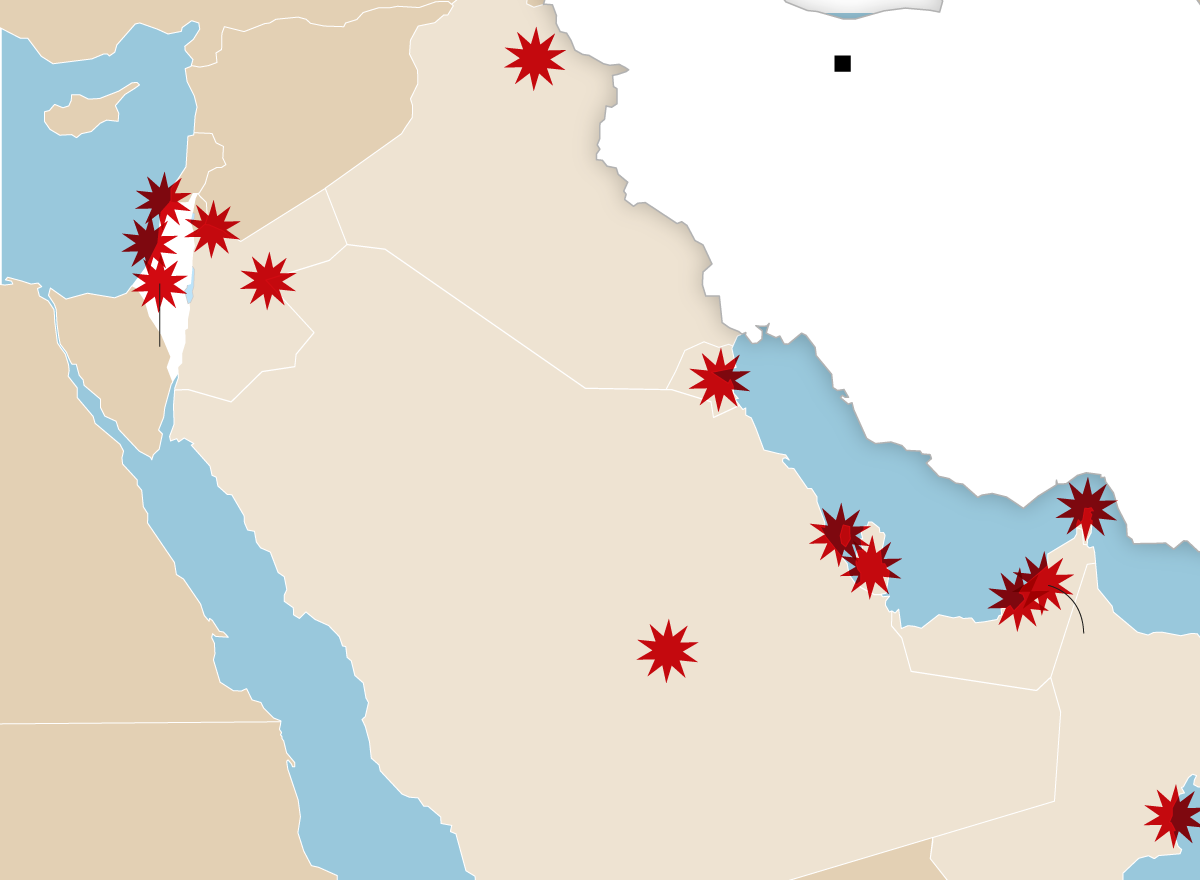
BarcelonaThe Iranian regime has shown it has the capacity to continue fighting after Israel and the United States killed one of its own on Saturday. Supreme Leader Ali Khameneiwho ruled with an iron fist for 36 years. Besides initiating the succession process with an interim government, the Islamic Republic has responded with several waves of attacks against Israel, resulting in nine deaths, and six Gulf countries: Saudi Arabia, the UAE, Bahrain, Qatar, and Kuwait, where three US soldiers were killed. Tehran says it will continue the attacks. Washington and Tel Aviv have again struck Tehran and other Iranian cities and have vowed to continue their attacks. The escalation threatens to trigger a regional war.
Teheran
Aeroport d’Irbil
SÍRIA
XIPRE
Haifa
IRAQ
IRAN
ISRAEL
Betxèmeix
JORDÀNIA
Aeroport internacional
de Kuwait
KUWAIT
BAHRAIN
Base naval de la
Cinquena Flota
QATAR
Base aèria
Al-Udeid
ARÀBIA SAUDITA
Atac en
un hotel
de Dubai
EAU
mar Roig
OMAN
ISRAEL
IRAQ
IRAN
JORDÀNIA
KUWAIT
BAHRAIN
QATAR
EAU
OMAN
ARÀBIA SAUDITA
ISRAEL
IRAQ
IRAN
JORDÀNIA
KUWAIT
BAHRAIN
QATAR
EAU
OMAN
ARÀBIA SAUDITA
The tolls are difficult to verify because all sides want to maximize their hits and minimize their damage. The Israeli air force claims to have dropped more than 1,200 bombs on 24 of Iran's 31 provinces in its joint offensive with the United States. Iran's Revolutionary Guard Corps, for its part, claims to have launched attacks against Israel and 27 bases in the Middle East where US troops are deployed in eight countries in the region: Bahrain, Iraq, Jordan, Kuwait, Oman, Qatar, the United Arab Emirates, and Iraq. Most of these attacks have been intercepted.
The latest toll from the Iranian Red Crescent, as of Sunday morning, is 201 dead and 747 wounded, a figure that will fall short after the Israeli and US bombings throughout the day. The toll from Saturday's attack on the girls' school in Minab, in southeastern Iran, has risen to 153 dead and 95 wounded.
Israel's June attack on Iran ended after twelve days due to the damage caused by Iranian missiles in Israel, but it set the stage for the offensive launched this weekend. Tehran's military capabilities are weakened, but Tel Aviv's sophisticated air defense system, the famous Iron Dome, is not impregnable. Nine Israelis were killed in the city of Bechemeix, near Jerusalem, when an Iranian missile struck a public air-raid shelter located in a synagogue. An additional 40 were wounded by artillery fire. Netanyahu has vowed to continue airstrikes on Tehran in the coming days and declared that the Israeli military has not yet used "its full force" against Iran. "I have given instructions to continue the campaign. Our forces are now striking the heart of Tehran with great intensity, and that will only intensify in the coming days," he said in a video message. According to Iranian media, one of Sunday's attacks in Tehran struck the headquarters of state radio and television.
Trump says the bombing will continue
For his part, Donald Trump has warned that "the intense bombing will continue, without interruption, throughout the week or for as long as it takes to achieve our goal of peace throughout the Middle East, and indeed, the entire world," whatever he means by that. Washington estimates that the war could last up to four weeks. After the first casualties among American military personnel, Trump must decide whether to continue the escalation or back down and negotiate with what remains of the Iranian leadership, with a Venezuelan-style exit strategy. Tonight he made a statement to this effect: "They want to talk, and I have agreed to talk, so I will talk to them." In another interview, he defended the operation against Iran, saying it is progressing "faster" than anticipated.
The Iranian theocracy has opted for a headlong rush with attacks against all neighboring Arab countries allied with the United States, and it is unlikely that it can sustain this strategy for an extended period. Their attacks have not been limited to US bases; some Iranian missiles have struck hotels in Dubai and Bahrain, and Kuwait International Airport.
France, Germany, and the UK affirmed that they will take measures to defend their interests and those of their allies in the region, "including by authorizing defensive action" to "destroy Iran's ability to launch missiles and drones." In a statement, Paris, Berlin, and London stated that they have agreed to "work together with the US and allies in the region." The three states expressed their "dismay" at Iran's "indiscriminate and disproportionate" attacks, "including those that did not participate in the initial US and Israeli military operations."
The dilemma of the petromonarchies
The Gulf petro-monarchies also face a dilemma. Their oasis of peace and prosperity in a region ablaze has been abruptly caught in the crossfire. The most feared scenario—being drawn into the war between Tel Aviv, Tehran, and Washington—has become a reality. Tehran has struck without warning, unlike the attack on the US base at Al Udeid in Qatar during the twelve-day war last June. Cornered by an existential threat following the death of the Supreme Leader, the Islamic Republic has opted to regionalize the conflict to pressure the Gulf states to urge Trump to end the war. A very risky move. Saudi Arabia, the United Arab Emirates, and Qatar have denounced a "flagrant violation of national sovereignty" and reserved the right to respond. Saudi Crown Prince Mohammed bin Salman has assured his Gulf neighbors that he will put "all his capabilities" at their service. Riyadh and Dubai have set aside their differences, which are being fought out on opposing sides in Yemen, Libya, and Sudan. And if this weren't enough, Trump has exposed them, because they had all defended the diplomatic route and urged him not to attack Iran. Oman was even mediating the talks between Washington and Tehran. To appease Iran, Tehran, Oman, and Jordan had denied the United States access to their airspace to attack the Islamic Republic. The Gulf monarchs face the difficult choice between continuing a dialogue that has shown its limitations or aligning themselves even more closely with the United States and Israel, at the risk of exposing themselves to further reprisals from an increasingly unpredictable neighbor. And Iran must gauge its strength to avoid turning a war against two enemies into a regional conflict against six or seven.
