A high school set on fire and clashes with the police: student protests grow in France, where there are already 2,000 detainees
The mobilizations put the French government against the ropes, which blames Mélenchon for the "urban violence"
-
CAT -
CAST
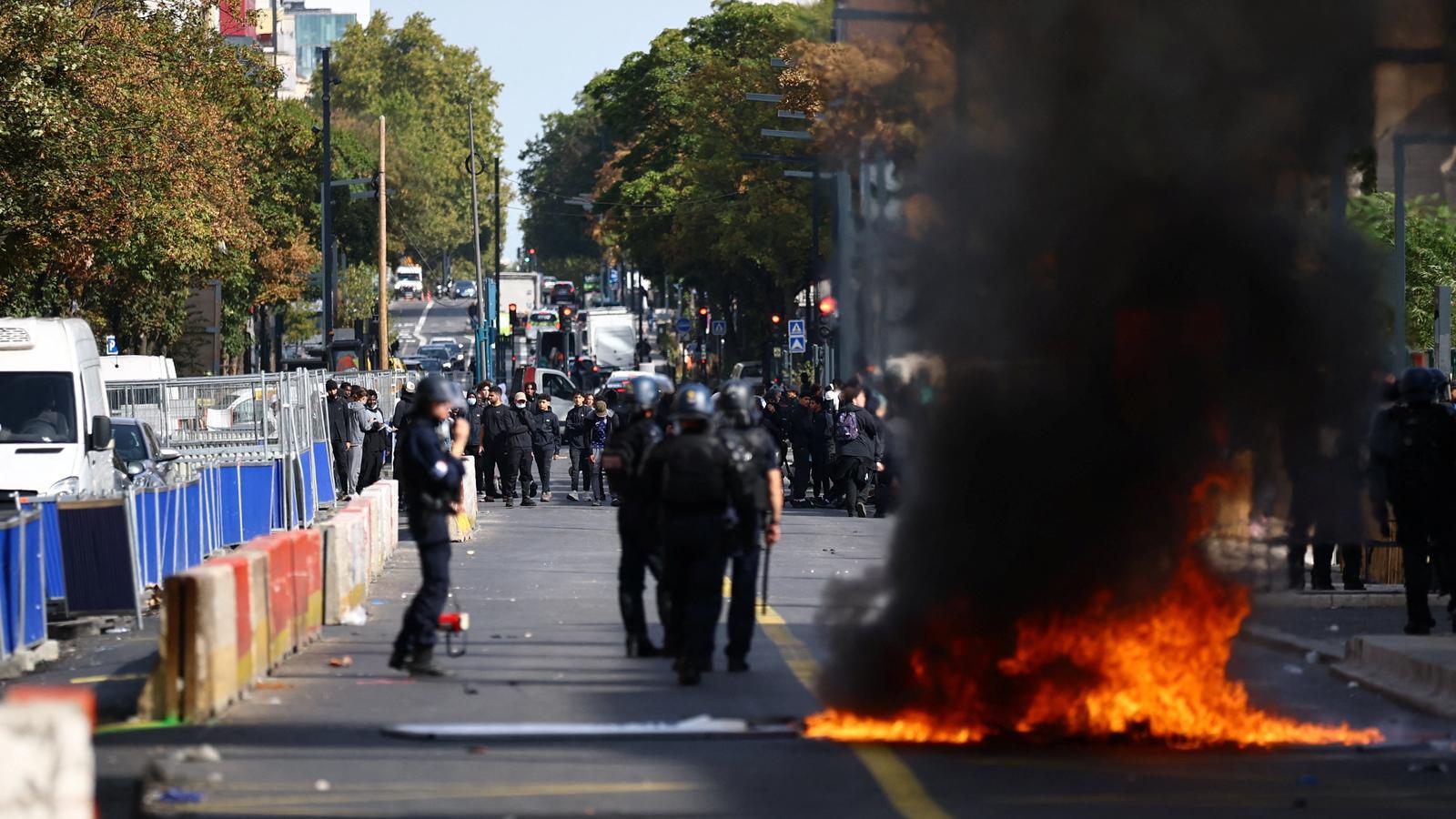
BarcelonaFrance is immersed in a student revolt that has intensified in recent days. What began a week ago with blockades on access to some high schools in the Paris region to protest against the lack of teachers and conditions in the centers has not only spread throughout the country, but has also led to clashes between students and the police on the streets of the country's main cities. There are already about 2,000 detainees, 1,800 in judicial custody, of whom 90% are minors, and hundreds injured. Among them, 305 police officers and at least 40 teachers, according to information from French authorities.
While the Ministry of Education intensifies talks this Friday with unions and the educational community, protests continue with students blocking access to educational centers. According to the Minister of Education, Édouard Geffray, just over 1,000 educational centers are "blocked or affected" by the mobilizations. "In principle, we do not have violent high school students or there are very few of them. What we have are people coming from outside who are looking to cause damage," said Geffray in a climate of great tension caused by the mobilizations. Among the students' demands are the need for more teachers, improving school conditions, or reversing cuts in scholarships and the elimination of university places.
In cities like Lyon, Lille, Paris, or the outskirts of the French capital, there has been burning of dumpsters and clashes between students and police. In Nantes, there was even an intentional fire at a high school, and in Marseille, the principal and vice-principal of a high school were sprayed with gasoline.

In a letter addressed to the staff of the high schools in the Île-de-France region, the president of the region, Valérie Pécresse, estimated on Thursday that the damages caused by the destruction resulting from the protests amounted to one million euros.
The government points to the "responsibility" of the parents
The French executive has mobilized to stop the protests, to which it has responded with a firm hand and riot police because it considers that they have acquired "characteristics of a situation of urban violence." The French Prime Minister, Sébastien Lecornu, has convened a crisis cabinet and the Minister of Justice, Gérald Darmanin, has called for forceful responses against the protesters.
Darmanin has demanded that the country's prosecutors general apply a "firm criminal response," according to some French media, and has reminded them of the civil liability of parents for damages caused by their children. "This is more useful than prison. Parents must fulfill their responsibilities. What are 15 and 16-year-olds doing attacking garages or the high school principal?", remarked the minister, who has claimed that parents must be held accountable for the actions of their children.
The Minister of Justice's position, however, finds reluctance within the executive itself. The Minister of Education, who is trying to appease the protests with various meetings this Friday with unions and the educational community, does not look favorably on holding parents responsible. "What must be guaranteed is that children do not continue on the streets because it is also dangerous for them," he indicated.
Macron and Lecornu blame Mélenchon
The tension over the wave of student protests has also moved to the political sphere, in a climate already of pre-campaign for the presidential elections scheduled for next year. And French President Emmanuel Macron and Lecornu have found a common enemy: Jean-Luc Mélenchon's party, La France Insoumise, on the left, whom they accuse of stirring up the protests.
Mélenchon, who will run as a candidate in the presidential elections, has supported the mobilizations and denounced the police charges against the protesters. "Nothing justifies violence and, in no way, should political leaders justify or incite this violence," Macron asserted. Lecornu has gone a step further and accused the leader of La France Insoumise of "urban violence" and of "legitimizing violence."
The pressure on Mélenchon's party also comes from the police: the Paris prefecture has issued a report to the judicial authorities in which it points to the mayor of Saint-Denis, Bally Bagayoko, of La France Insoumise, for alleged "provocation to commit a crime."
