Germany accuses Russia of the drone attack attempt on Leipzig airport
Europe, on alert for growing signs of hybrid warfare, points to Moscow for aerial incursions in the region
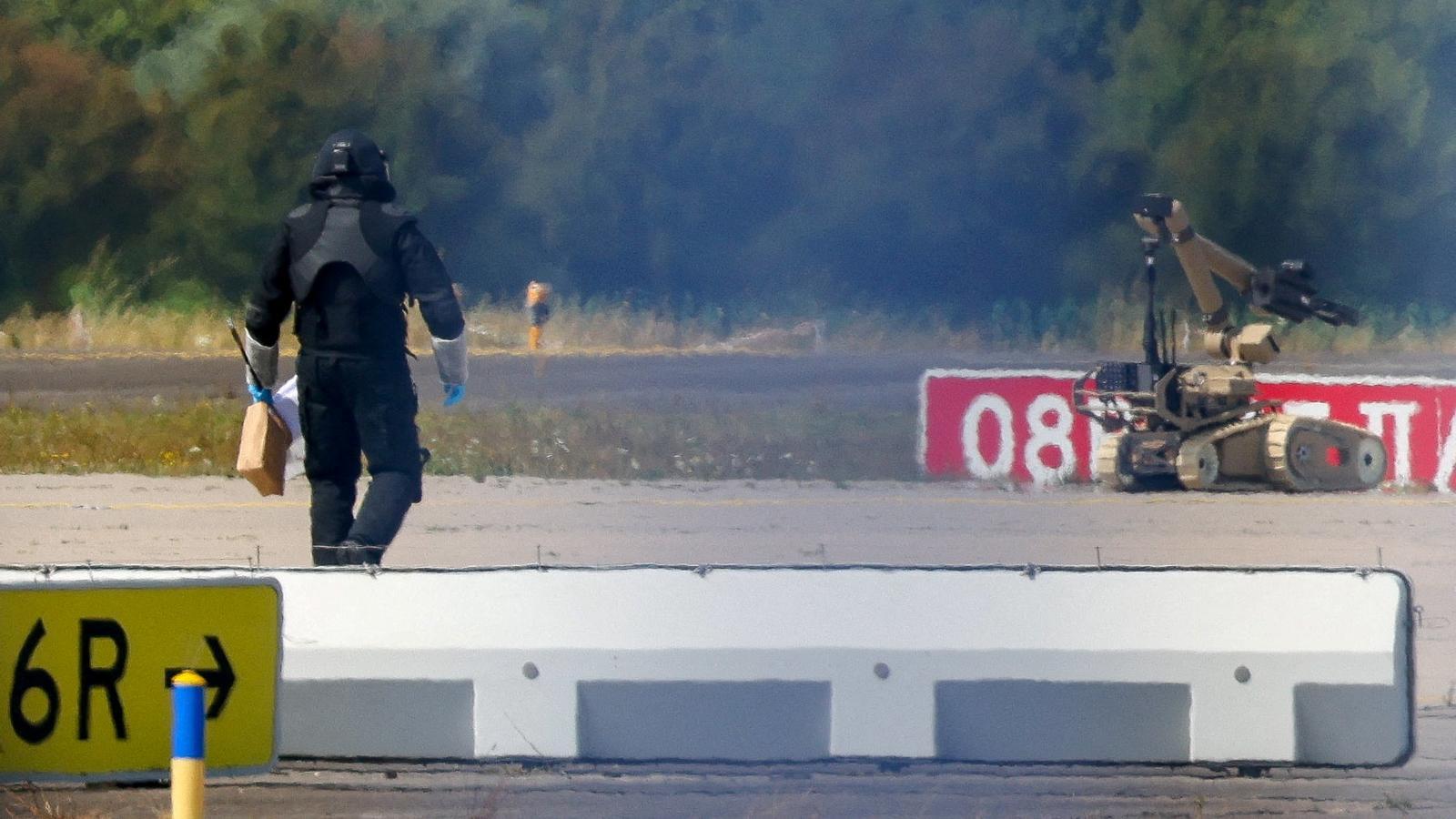

BarcelonaPoland, Estonia, Latvia, Sweden, Romania, Lithuania, and now Germany too. Incursions and drone threats in NATO territory have become more frequent in recent months and have intensified. In early August, a drone loaded with explosives impacted a Ukrainian cargo plane at Leipzig airport without exploding, in one of the most direct sabotage attempts recorded so far at a key NATO logistics center deep within European territory. After almost a month of investigations, this Tuesday, for the first time, the German government has directly held Russian intelligence services responsible for the incident.
The attempted attack, as the German Minister of the Interior, Alexander Dobrindt, assured, was carried out with a device that matches the model of Russian operations in Europe. And this has led them to conclude that "Russia is responsible for the hybrid attack perpetrated in Leipzig on August 4th." As the same minister had already hinted just after the incident, Berlin understands that the drone incursion is part of a broader Russian hybrid warfare campaign aimed at destabilizing Europe. "We are the daily target of hybrid warfare," Dobrindt said at the time. "Espionage, sabotage, cyberattacks, or covert operations by foreign powers aimed at destabilizing Germany or inflicting direct damage are a constant reality."
Until now, the Kremlin has shaken off responsibility, claiming there is no proof of its authorship. In fact, it described the alleged attack as a "manufactured provocation," and the Russian embassy in Berlin even expressed in a statement "its concern about a new wave of anti-Russian hysteria in Germany" due to accusations by some MPs.
The one in Leipzig is just one more in a long list of similar episodes, increasingly common, which serve as a reminder that Europe is not on the sidelines of the war in Ukraine. On several occasions, resources from the Atlantic alliance have had to be mobilized to intercept Russian fighter jets and intelligence aircraft (such as the Il-20 or Tu-22M3) over the Baltic Sea, flying without a transponder to avoid detection. In the east of the continent, several airspace violations in Poland and Romania by Russian drones have been recorded, which have had to be shot down by NATO fighters. At the end of May, an unmanned Russian aircraft deviated from its target in Ukraine and injured two people in the Romanian city of Galati, the first victims on Community territory.
The incursion of the drone loaded with explosives into German territory has been the last straw and has put European governments on alert. "[The incident in Leipzig] is a signal that we must consider the possibility of more direct and violent actions on our territory," assured Celine Berthon, director of the French counterintelligence agency DGSI, last week. Berthon warned at a business forum of a "meteoric" increase in hybrid threats – such as cyber penetrations and violent acts perpetrated by local intermediaries – in the defense and technology industries, and in strategic sectors such as energy and communications.
A coordinated European response
As interceptions of devices proliferate, European leaders are increasingly less hesitant to hold Vladimir Putin's regime responsible. Chancellor Friedrich Merz stated last week that his government will make "the perpetrators of hybrid attacks pay a price". According to information from the German newspaper Bild, diplomatic sanctions are on the table, such as summoning the Russian ambassador to the Ministry of Foreign Affairs and expelling Russian embassy employees from Germany and declaring them persona non grata.
However, at the same time, the chancellor has insisted that he is committed to a coordinated response with European and NATO partners, which should arrive "in the coming days". According to diplomatic sources cited by Politico, the plan currently under review – and which will be discussed this Tuesday and Wednesday in the Irish city of Wicklow at the informal meeting of EU Foreign Ministers – foresees massive sanctions against approximately 1,600 Russian actors, including 800 individuals and 800 companies. The debate on the use of frozen Russian assets is also expected to be reopened, although Belgium, the state where the seized funds are deposited, will first need to be convinced.
