Chavismo faces a test of fire at its weakest moment
The government of Delcy Rodríguez buys time for a hypothetical transition while Trump tries to demonstrate power
-
CAT -
CAST
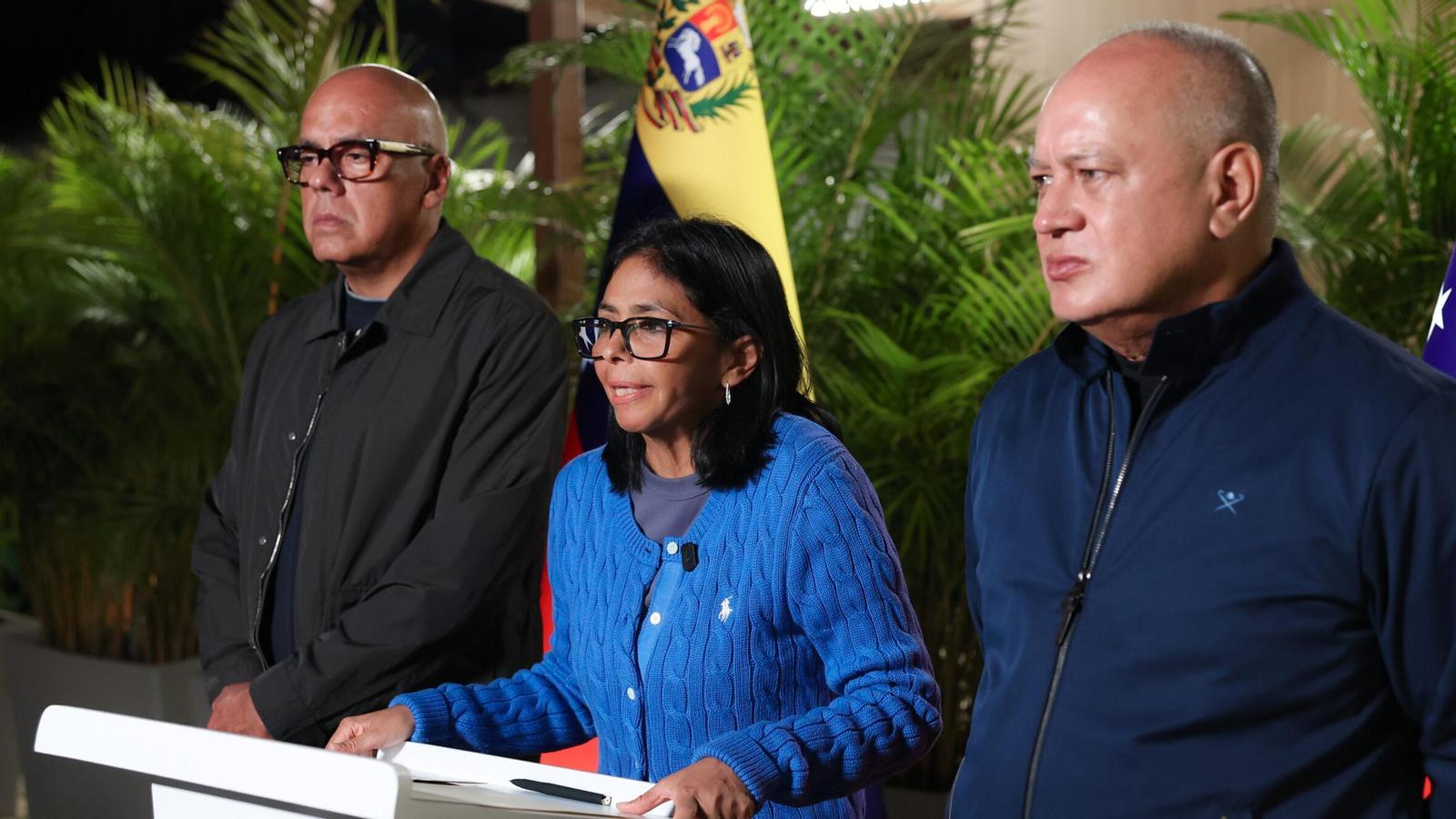
Barcelona"We have a central and essential objective: to save lives." A few hours after the double earthquake that shook northwestern Venezuela on Wednesday afternoon, Decly Rodríguez addressed the population in a video message surrounded by a dozen senior officials. The interim president tried to make the administration's work visible by showing an image of unity, and asked Venezuelans for the same: "United we will overcome this tragedy." At the most critical moment for Chavismo, practically co-opted by the intervention of the United States, the tragedy has added even more pressure to Delcy Rodríguez's government. But if the executive knows – and can – manage the response well, it can still have a card in its favor in a future negotiation for a political transition in the country.
In the early hours of Thursday, as soon as the extent of the catastrophe began to be known, the international community reacted by announcing the sending of aid. This also included countries politically opposed to Venezuela. "The broad international response is a relief for Delcy Rodríguez's government: creditors will surely not rush the executive with debts, aware of the situation, and the aid that arrives will serve to speed up rescue tasks and carry out reconstruction with resources that the country does not have," points out Anna Ayuso, senior researcher at Cidob for Latin America.
After the January attack, Trump had already made it clear that his imminent objective in Venezuela was not to achieve a political transition. Rejecting support for María Corina Machado and pushing back the horizon of elections in the country, Washington has focused on weaving alliances and reaching agreements with the Venezuelan administration so that the US private sector can exploit the country's natural resources. "If the premise of Trump and Rodríguez was that there is no rush for elections, the earthquake further reinforces this idea," argues Rafael Grasa, professor emeritus of international relations at the UAB. "Furthermore, in emergency cases, the government's political color usually takes a back seat," he recalls, pointing out that Rodríguez's executive may find it easier to justify to the opposition that it remains in power.
Trump seeks not to be left behind
The earthquake coincided in the same week with two notable developments in the country. On the one hand, the executive presented a restructuring of the external debt, until now completely opaque, two days before the double earthquake. On the other hand, the US designated the former president of the National Assembly Dionarah Figuera, from the opposition, to negotiate a transition in the country with the government. One of the main tasks attributed to her is to manage a transition for elections with Chavismo.
Donald Trump was thus trying to show his followers that the intervention in Venezuela continues. "Some sectors reproach the US president for the operation being stalled, and they want to see more results," points out Ayuso. "For Trump, Venezuela is his triumph and now, with the catastrophe, the narrative can get a bit complicated for him." Surely for this reason, Trump himself has stated that he wants to take charge of the situation in the country after the earthquakes. Washington has temporarily relaxed some sanctions on Caracas for transactions related to the earthquake. It has also announced aid of 150 million dollars and, like numerous countries, has deployed search and rescue teams on the ground.
However, even though Trump tries to position himself as someone who will help the country recover after the catastrophe, the one who will manage the resources on the ground, both national and foreign, is the Venezuelan government. Or, at least, it will be the visible face. "It is a test of fire for the government of Delcy Rodríguez. If she manages to coordinate the emergency services and reconstruction well, and has the capacity for the Americans to provide resources, it could be her salvation," notes Salvador Martí, a professor of political science at the University of Girona specializing in Latin America.
Prevention and response capacity
The challenge facing Rodríguez's executive is enormous, due to the magnitude of the catastrophe but also to the country's political and economic situation. Since Thursday, the focus has been on the poor condition of buildings and facilities. "The country's infrastructure has been deteriorating due to United States sanctions, but also due to internal mismanagement and corruption," points out Ayuso. While Martí emphasizes that the crisis Venezuela has been facing for years has played an important role, he also recalls: "When there is a natural disaster in Latin America, tragedies are usually quite devastating because in cities, which are very large and dense, the affluent neighborhoods are usually very well built, but in peripheral areas there is a lot of self-construction and informal housing".
It will be complicated to determine to what extent the magnitude of the tragedy was avoidable. In a country with a lower response capacity than its neighbors, Delcy Rodríguez's executive is playing to demonstrate that it knows how to manage and lead a crisis in an extremely complicated context. "During the last few months, the focus has been on reactivating the oil sector, but until there is legal certainty and time passes, it will be difficult for the rest of the economy to resume activity, and the earthquake represents a new setback for this," portrays Ayuso.
"The country is not only economically de-capitalized, but also humanly, without the labor of thousands of people who have left," he adds. And he insists that, with the United States intervention underway, some kind of political transition, sooner or later, will surely come. "The question is what it will be like," he concludes.
