Canada clings to the French language to defend itself from Trump
The trade war with the US becomes a war of attrition to defend the country's sovereignty

-
CAT -
CAST
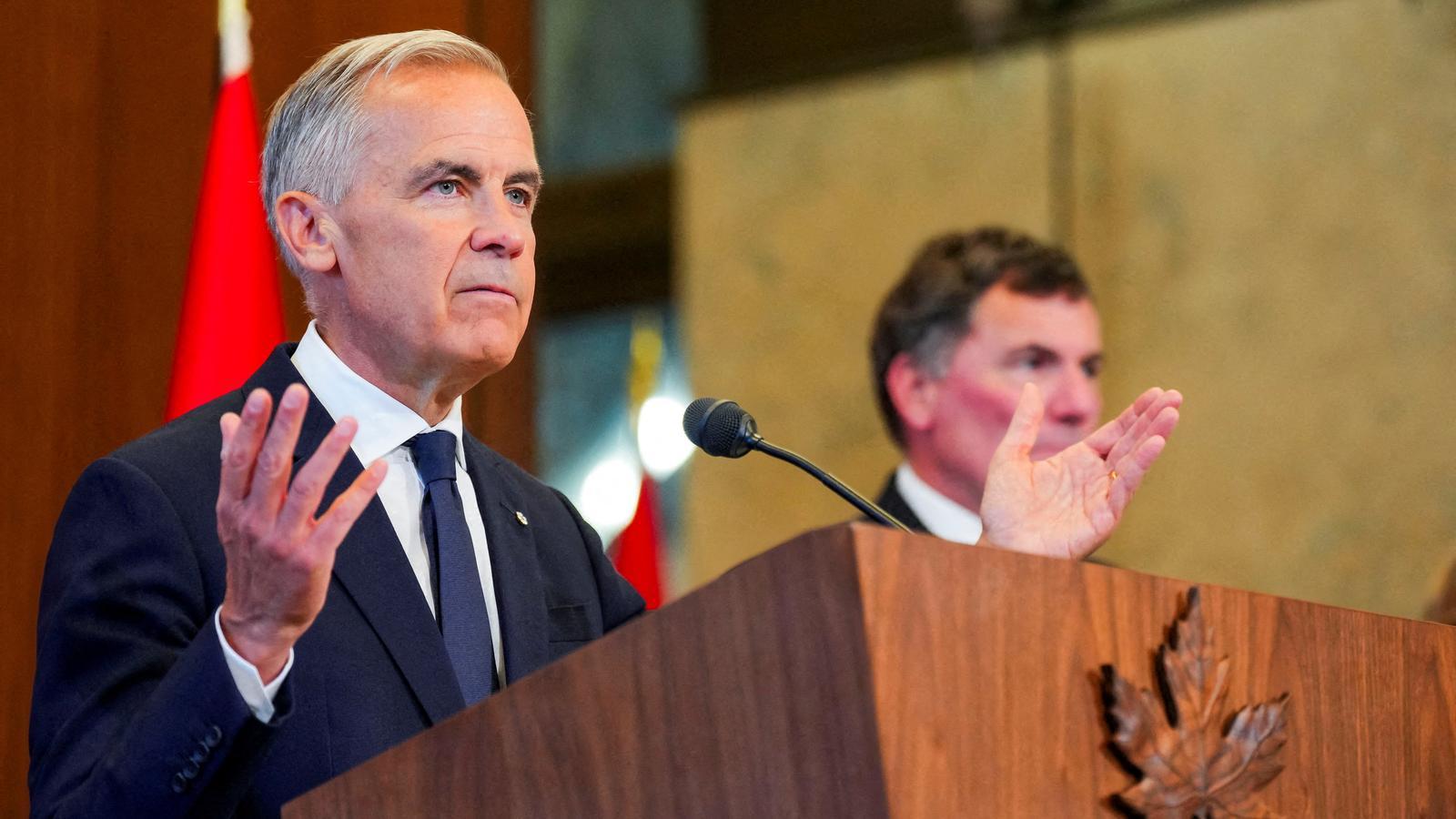
WashingtonCanada has embarked on a war of attrition with Donald Trump to mark the limits of his power. When last weekend the Canadian Prime Minister, Mark Carney, left the negotiating table stating that he was not willing "to compromise the country's sovereignty", it was already clear that the dimension of the conflict was not merely economic. After a tariff spiral in which Carney responded with 50% tariffs to the 50%% that Trump had applied on Saturday to Canadian products, the US president has gone a step further and signed an executive order this Thursday to rename Lake Ontario to Lake America.
Lake Ontario is the smallest of the five Great Lakes and forms the border between the homonymous Canadian province and the state of New York. The name change is very reminiscent of the magnate's decision to rename the Gulf of Mexico to "America's Gulf", and it evidences the imperialist aspirations of his second term.
The verbal attack on the lake, however, is not the only point that goes beyond the commercial relationship between the two neighbors. The French language has also become another front of symbolic dispute within a conflict that Carney has pointed to as part of a broader agenda to turn Canada into the 51st state, an idea that Trump has expressed on repeated occasions.
"The North American demands are not consistent with the relationship between two independent states, but rather pursue one of Donald Trump's declared objectives: to make Canada the 51st state," denounced the Canadian Prime Minister when addressing the nation on Saturday. Carney then criticized that, at the last minute, the US negotiators had added a series of conditions that directly interfered with Canadian sovereignty.
Washington sought to restrict Canada's right to sign trade agreements with other countries, a key element of Carney's strategy to reduce dependence on its increasingly unreliable southern neighbor. Furthermore, Carney also stated that the White House had tried to interfere with the use of the French language, which is the country's second official language and is spoken by one-fifth of the population, mostly in the province of Quebec.
Although Trump has denied that demands related to French have been made, the United States has always seen Canada's second language as a trade barrier. As it has the same status as English, products sold in Canada must be labeled in both languages. Since the dispute broke out, Carney has reinforced the use of French in his speeches and messages, both internal and towards the United States.
The vast majority of goods that Ottawa exports go to the North American market, 72% last year, which Trump has interpreted as exclusive dependence. The reality, however, is that the vulnerability is mutual: the 50% levy that the magnate has applied to Canadian products will directly affect the pockets of his voters, who are increasingly suffocated by the cost of living. Citizens who have been expressing their discomfort and disappointment for months with an administration that has not fulfilled its electoral promise to lower the price of groceries.
Wear-out strategy
Canada is aware of this, and that is why it has decided to engage in an open conflict with Trump, with a strategy not unlike that applied by the ayatollahs: it is not about winning, but about seeing who can withstand the damage the longest. The Canadian announcement to respond with 50% tariffs came on Tuesday, just after Trump threatened with another 50% levies, seeing that Carney was not backing down.
Ottawa has decided to stand up to the tycoon with a proportional response, tariffs of 50%, 25%, and 15% that will affect some 700 products starting September 8. The new levies on American goods are estimated at around $20 billion annually, exactly the same value as the US's on Canadian imports.
During the press conference to present the new tariffs, Canada's Minister of Industry, Mélanie Joly, said they had selected some of the taxed items precisely to harm the states that had voted for Trump. The minister refused to specify which ones, but assured that the list included household appliances and "food products".
Carney seems willing to maintain the tug-of-war and see where Trump's trade war limits lie. However, he has not yet brought out the heavy artillery. Many economists point out that the real capacity to harm Washington would be to impose tariffs on oil, natural gas, and electricity imported from the US. Polls suggest that this idea is gaining popularity among Canadians, while at the same time escalating tensions with the neighboring country.
