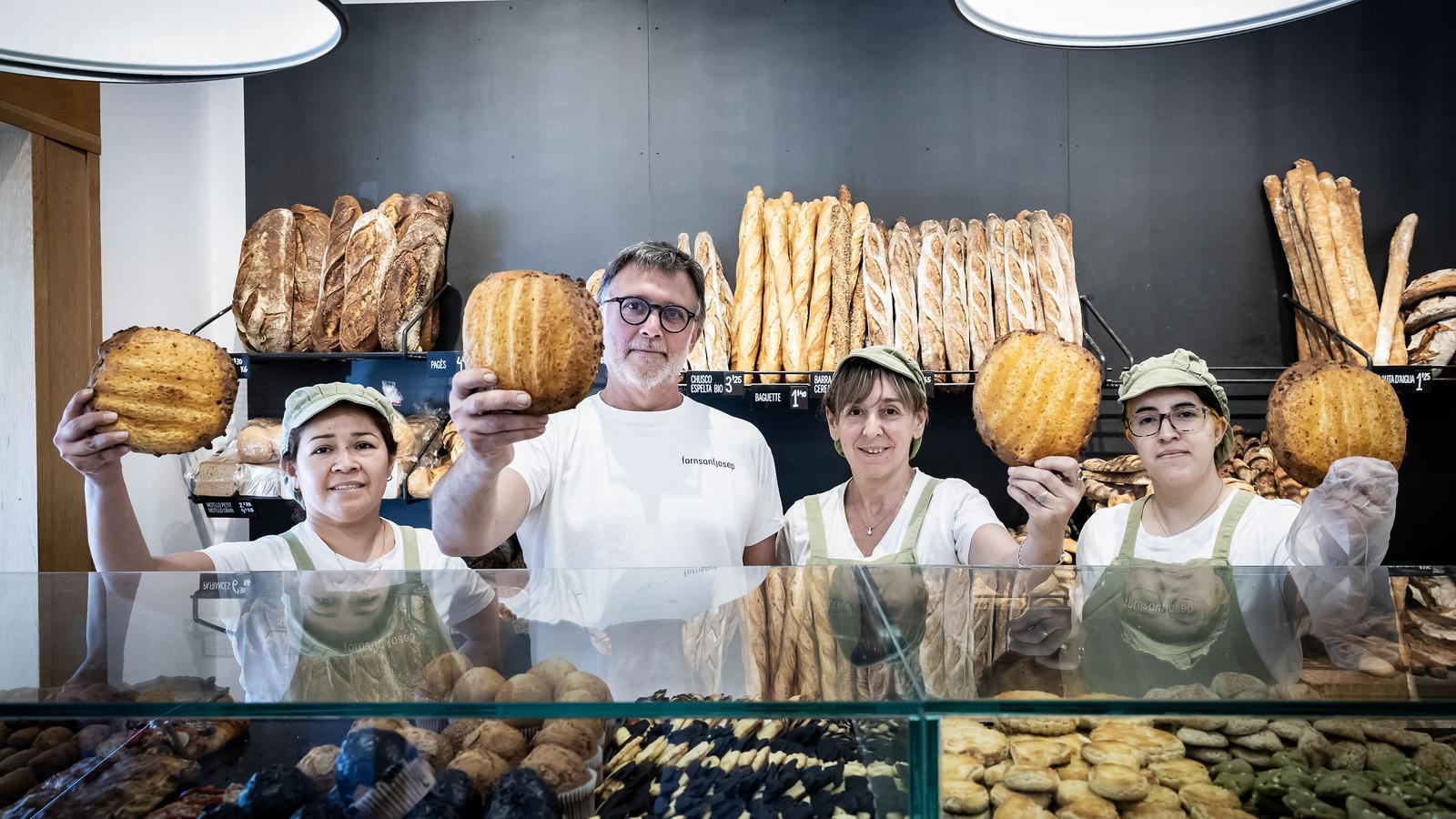
The best Sant Jordi bread, with five cheese bars and four sobrasada bars, is prepared at the centennial bakery Sant Josep in Barcelona
Located on Roger de Llúria street, it has won the contest organized by the Panàtics association, and plans to sell about a thousand along with the bread roses it also makes

-
CAT -
CAST
BarcelonaEmili Feliu (Barcelona, 1968) says that he follows to the letter the recipe written down by the baker Eduard Crespo, from the Balmes bakery, the creator of Sant Jordi bread. And with this recipe, and mastery, he has won, for the third time, the competition for the best Sant Jordi bread organized by the Panàtics association. "I have adapted the bread dough, because we prepare it with sourdough, the same one we use to make our breads," he explains on the first day of Sant Jordi week. As Sant Jordi is on Thursday, Emili has decided to dose the amount of Sant Jordi breads he will be making: Monday and Tuesday, about thirty; Wednesday, about two hundred, and Thursday, the big day, about eight hundred. He works with the intention of selling a thousand, which they sell for €28.50 per kilo. That is, it is a bread they sell by weight, which varies between two hundred and fifty and three hundred grams. Therefore, the price will be around six to seven euros.

El Sant Josep is a centuries-old bakery, inaugurated in 1913 by Emili's great-grandmother, Rosalia Mayor. "The establishment was already operating as a bakery when my great-grandmother took it over," she recalls. Rosalia lived in the Raval and, due to the intense work at the bakery, she would sleep there. When Emili's father was a teenager, the family acquired an apartment in the building, above the bakery, so they wouldn't spend all day there, but would still be very close. Today, Emili's mother, Lola Campà Vialcanet, lives there. In a family business, the closer you are, the better. This story, graphically compressed, is what the black and white photographs on the brick walls of the Sant Josep bakery show. Emili, as a child, is also depicted there. And the old bakery that used to be there, an architectural gem.
We return to the Sant Jordi breads. "We make it the same every year because that's how we learned to make it thanks to the courses promoted by the Gremi de Flequers." Eduard Crespo invented the recipe in 1988 following an assignment from the Gremi de Flequers of Barcelona, who asked him to create a creative bread related to the Diada de Sant Jordi. Thus, since then, the bread has three doughs that draw a senyera: sobrasada, cheese, and walnut, which are layered. The first, the cheese; then, the sobrasada; and, finally, the walnut. There will be cheese dough because it has to draw the five yellow stripes of the senyera; the sobrasada, four; and the walnut is used to fold the bread, so that the dried fruit frames the four corners of the Sant Jordi bread.
Mallorca Sobrasada
Regarding sobrasada and cheese, Emili explains that he uses the sausage made in Mallorca, and for the cheese, Emmental, which is exactly as written in the original recipe. I ask him if they have ever considered using a Catalan cheese with similar characteristics, such as Saüll de la Xiquella, a cooked paste cheese, which is the proposal made by the Associació Catalana de Ramaders Elaboradors de Formatge Artesà (ACREFA) and the Formatgem fair to promote Catalan cheeses. Or any other similar one, as at the Làctium fair there were up to two hundred and fifty.at the Làctium fair there were up to two hundred and fifty. "Georgina Crespo, heir to her father's recipe, should say so," comments Emili.
For the Sant Jordi festivities, the Sant Josep bakery will also prepare bread roses, an invention of Emili Feliu senior. It is a breadstick that ends with a yolk. "It is very laborious, but I do it in memory of my father," says Emili. The breadsticks, at three euros, and the Sant Jordi breads have made the festivity also pass through a bakery. "Besides the rose and the book, a bread; it's beautiful, and good for artisan bakeries, of course".
We continue with other breads, since we are here we try more. "The ones we sell the most are the traditional French baguette, €1.65; the French bread, two kilos, which can be bought in pieces; the crystal bread; the water flute, and all pastries in general". The flour they use is French, and they also use Corominas, from Banyoles, one of the most prestigious millers in the country. And a novelty: the sponge cake, which they have recovered recently, and which they also sell in pieces.
To finish, Sant Jordi bread, which is savory, can be eaten during the meal, as an accompaniment to dishes. "It is a savory bread, but everyone can eat it as they like best," says Emili. It can also be a morning or afternoon appetizer, or an original dessert, combined with jam, an idea especially thought for those who like the mix of flavors. Sant Jordi bread, the rose, and the books. The infallible triad of April 23rd.

