sasdasasasasaasasasa
Josep Grau: "There is more demand for white wines because people in their thirties and forties enter the wine world through whites, and not so much through heavy reds"
Winemaker
20/04/2026 - 08:40 h

-
CAT -
CAST
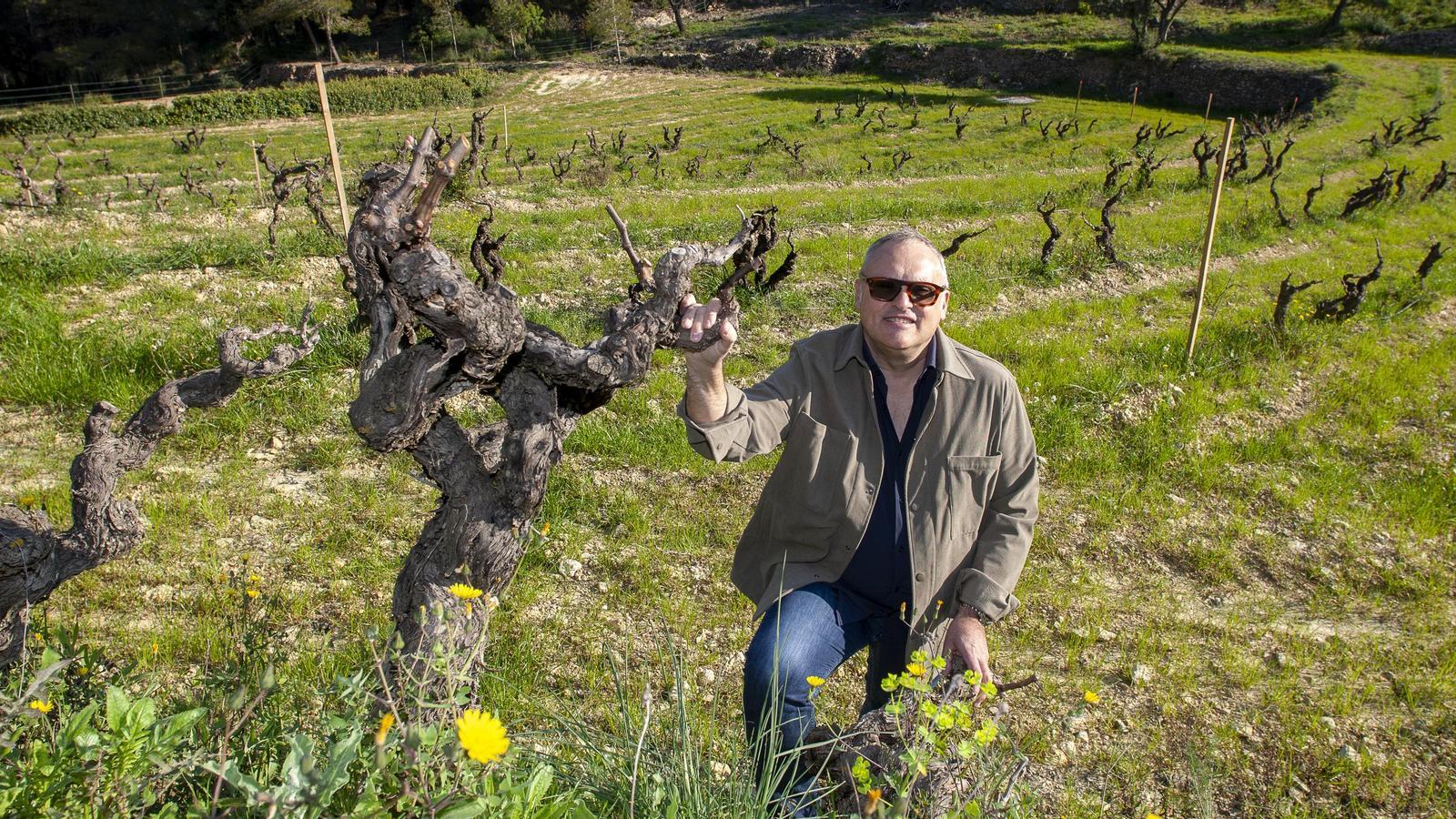
Barcelona/CapçanesI interview the winemaker Josep Grau (Barcelona, 1965) at Bar Milagros, where we taste two of his wines, the white Granit, made from white Garnacha, and the red La Florens, made from black Garnacha. We pair them with a dish of peas with sea cucumbers and the famous chickpeas with squid. We take the photos in one of the most prized vineyards, in El Pas de l’Estudiant, near Capçanes, where there are vines from 1907. Josep produces a total of eleven wines, which are four whites, six reds, and one rosé, most of them within the Montsant appellation and also within the DOQ Priorat. And this, after starting only 23 years ago, in 2003. He's been in Priorat for ten years. He decided to change his life when he was 50 because he wanted to achieve his dream, and today he says he has accomplished it. His wines sell for between 13, 20, and 60 euros. The most expensive is the Carenes, a white. In total, Josep Grau produces 135,000 bottles annually.

You have been a white wine producer for years. ¿Do you confirm that they are currently selling more than ever?
— You have been a white wine maker for years. Do you confirm that they are currently selling more than ever?
So why do you notice this increased demand for white wine?
— Because food has changed and the way to enjoy wines has also. People between thirty and forty years old enter wine through whites, and not so much through a heavy, tannic red. They like fluidity, and I think the red wines that are being made are moving towards fluidity, towards the Burgundy style.
You say fluency and not lightness, as I have sometimes heard it said.
— They are different words. I come from spending a few days in Burgundy, where I have drunk white wines with a lot of presence. All producers know that the market wants more refined wines, with more fruit. Despite this, wines should not only be fine, but they must also have substance. Whites must have crunchy substance.
You worked in the banking sector as a profession. When do you decide to make wine?
— You worked in the banking sector as a profession. When did you decide to make wine?
Vila Viniteca is behind the great wine stories of our country.
— I would tell you that a large part of Priorat's success is due to the relationship between Álvaro Palacios and Vila Viniteca. People with a great capacity for work met.
Pick up the thread of your twenty-seven years.
— From that tasting onwards, I did many others. I was an amateur. When I found a wine I liked, I would go see who made it. Then I encountered two situations: the wineries I knew had a large-scale economic project behind them, and the producers did it because the winery was family-owned, and they were the fifth, sixth, or seventh generation making wines. I projected myself into it and realized that I was neither in the first nor the second situation.
Do you give up?
— No. I signed up for oenology in Vilafranca del Penedès, a course at Incavi. There I met many sons of winemakers. I continued working in banking, and I combined it with the course. And at the same time, something happened that I emphasize: in 1993 I met the winemaker Enric Soler, who had a tasting workshop on Rambla de Catalunya, at the corner of Diputación. There I met with producers, I signed up for monographic courses, we went to visit the territory. I remember a visit to Priorat, with a stop for lunch at Hostal Sport in Falset. On this visit, I realized that wines could be made without resources. I understood that in Priorat, in Montsant, wines could be made, and in 2003 I bought a vineyard in Capçanes. That same year I made my first wine, which did not fall under any designation of origin. The label was put on by my four-year-old daughter. I made three hundred bottles, inside a house that was where they used to keep the mule. It had neither water nor electricity. That vineyard is where I now have the winery; it made me prove to myself that I could make a wine that I could drink.
From the 2003 milestone, we jump to 2013.
— In 2013, a wine of mine, Vespres, made with black grenache and cariñena, received a high rating in the magazine Wine & Spirits. I was still combining the two jobs, but the North American importer recommended that I dedicate myself exclusively to wine. By then, I was already dedicating my vacations to the harvest; one day a week, I spent it entirely in Priorat. Everything led me to set a personal deadline, turning fifty, and I met it. I had been working in banking since I was nineteen, I had worked in the stock market, but my passion was wine. The day after turning fifty, on February 3rd, my job was to make wines.
In the twenty-three years you have been making wines, you have managed to create eleven references.
— They have been emerging, and I have been doing it with personal coherence. When I made La Florens, in 2014, I made it as a single varietal with Grenache. At that time, there were no single varietal Grenache wines, apart from those made by the Capçanes cooperative.
Why did you bet on the DO Montsant, which this year celebrates twenty-five years since its creation, in 2001?
— Because I understood that the soil of the DO Montsant is much more interesting for the wines I wanted to make. They are lands that retain more water, and since I wanted to make fine, elegant Grenache wines, like those I had tasted in other parts of the world, then I decided. I start working La Florens, 100% Grenache. In fact, still today 80% of the grapes that enter the winery are Grenache.
You are one of the great defenders of the DO Montsant.
— It bothers me that DO Montsant is marketed as the little brother of DOQ Priorat. Traditionally, it has been thought that we are the cheap wines, close to DOQ Priorat. That is a mistake.
Let me tell you that I think you make very affordable wines for the great quality they have. I don't know if this happens in any other region of the world.
— When I decided on the price I wanted to set for my wines, I thought that I was not known in the wine world. Therefore, my wines had to defend themselves. This fact is both good and bad, because I don't think about what they will say about me; I dedicate myself to fulfilling my dream. And I maintain that in the same vineyard with the same grape, the resulting wine is different because it depends on the hand and dedication of the winemakers.
You understand the craft like an artisan.
— Yes, I am not interested in technology, and it is surely like that because I have not studied the degree in oenology. I do not have any advisor, I have my own knowledge, from the tastings, from the trips, from the course I took in Vilafranca.
You had exported all the wines you made.
— Not anymore. Now I export 60%. One day an importer asked me to recommend a restaurant in Barcelona where he could try my wines, and I realized there wasn't any. It couldn't be. In 2015 I invested the percentage, so that 40% stayed at home.
I'm picking up the thread about red wines. You make La Florens, el Pas de l'Estudiant, les Casetes, el Vespres. I repeat that they are very economically priced reds.
— Because we take Burgundy's prices as our reference. We have an obsession with Burgundy wines, and I don't understand it. We've traded Rioja-itis for Burgundy-itis. Here, good Burgundy wines don't reach us, but we drink them because we read the name on the label, in large print, and we think they must be good. The Burgundy wines that reach us are the leftovers, the ones nobody in Burgundy wants to drink, because the good ones are sent to countries that can afford them: they cost 2,000 euros, four figures or more.
If you made the La Florens wine in the DOQ Priorat, it would cost double the price it is now.
— Perhaps. And if it were from Burgundy, five times more. Despite that, I think that the designations of origin must face different challenges than they had until now; there are wines that do not belong to them and are very good. The designations of origin must defend the territory; Montsant does it. And currently I think that we must work on enhancing the area, and try to delimit its production.
To finish, I ask you about the history of the wine La Florens. How many bottles do you make?
— Twelve thousand. And when I did it, I tried it, I found my mother inside. She had her fine, elegant character, full of personality, authoritarian too, that when you have it inside, you want more. When you listen to a song, maybe we think of someone. When I tried La Florens, I found my mother. That's why I gave it this name: her name was Florentina.
Test
