Lola Palacios: "It makes me very angry that they say the wine crisis is because young people don't drink wine"
Álvaro Palacios Wines

-
CAT -
CAST
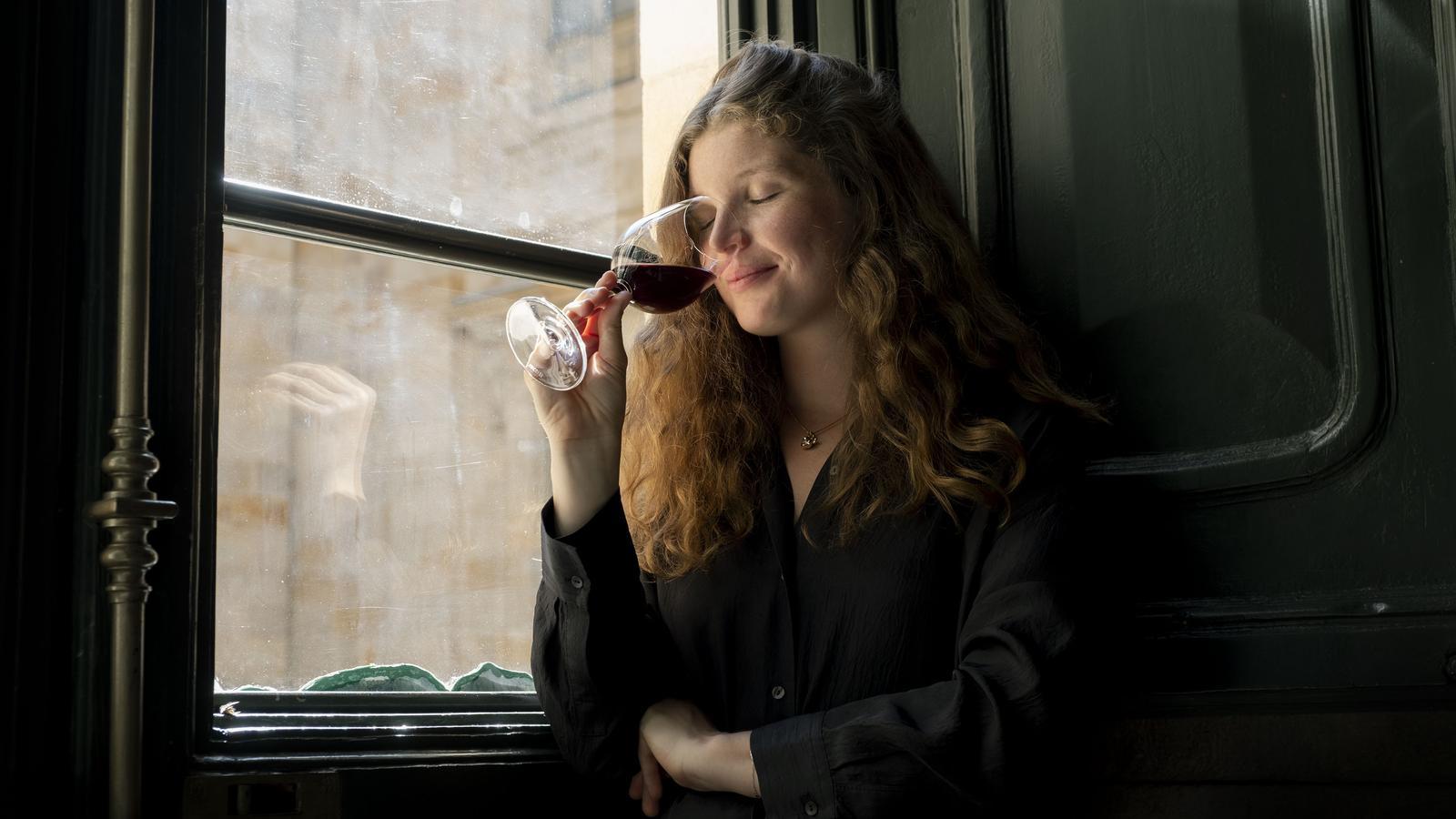
BarcelonaI interview the winemaker Lola Palacios (Alfaro, 1997) at La Llotja in Barcelona on Monday, June 8. She has come from Alfaro, in La Rioja, for the event organized by the distributor Vila Viniteca so that interested the public can taste (and buy) exclusively the wines of 2025. Last year she had to go home when she was arriving in Barcelona because her pregnancy caused her constant vomiting. This year, her daughter, Federica, is already eight months old, and she has been able to spend the whole day there. She says that never before today has she felt that women have superpowers, and Lola says it because she assures that she works more efficiently than ever in the three family wineries while taking care of her daughter with all her love. Lola is a passionate woman, she speaks quickly, in Catalan and Spanish, and she has very clear ideas.

Do you speak Catalan?
— I lived in Gratallops until I was eight years old. I still have very good friends in Priorat. I have a good friend in Falset, Unai, who has a restaurant with his mother, Kabbalah. The food is very good there and they have an incredible wine list; I recommend it to you, as well as the others in Priorat. My school in Falset was Antoni Vilanova. When I started talking, I only spoke Catalan. And in my family, my parents and my paternal grandfather, Grandpa José Palacios, understood me. Did you know he spoke Catalan? He had many Catalan friends, I know he learned it because, during the Civil War, he lived with some relatives in Barcelona. That's why the Alfaro winery is called J. Palacios, and the one in Bierzo, Descendientes de J. Palacios, in his honor. My grandfather loved speaking Catalan with me.
You work in the three family wineries, where your father is also present: the one in Alfaro, which belonged to your grandfather; the one in Bierzo, with your cousin, and the one in Gratallops.
— I am the sixth generation of winemakers and wine producers. The Alfaro winery was created in 1947 by my grandfather and grandmother; my father joined the grandparents' winery one hundred percent in 2000, when my grandfather died. My father decided in 1989 to settle in Priorat, and it went very well for him! My cousin Ricardo, my father's nephew, returned from France, where he had worked, and together with my father, we opened a winery in the DO Bierzo in 1999. And these are the three wineries where I work. We all do everything. We don't have distributed departments of who does what, like big companies do. We are all in the vineyard, we all do marketing, we all make the wines. We export our wines to ninety countries.
You have a prodigious background, if I may say so. You studied viticulture and oenology at the universities of Bordeaux and Dijon, France. You did marketing and communication at IE University in Madrid. And then you did internships at the Domaine de la Romanée-Conti, Clos de Tart, and Domaine Prieuré wineries in Burgundy.
— We all trained in France, and we worked there. We know that France is the cradle of great wine, but that did not close my mind to discovering what lay beyond. So I went to Napa, to the Promontory winery, for six months. Both my father and I believed that we also had to learn about the vineyard and the wine made on the other side of the world, that we should not limit ourselves to learning from France.
You may have a more complete education than your father's.
— He had a very great education: he studied in France and worked at Château Pétrus. I don't know if I could say I have more training than him or not, but I believe that everything my father and my cousin have achieved surpasses any great academic training. I have enormous respect for all their work and I even feel a certain pressure for the challenge ahead of me (always in a good way). However, he always tells me that, in reality, my training is much broader than his and that I have been acquiring it since I was very young.
What does he tell you about this that you are telling me now?
— He always tells me that everything I have drunk so far, he didn't start drinking until many years later. He assures me that this fact alone, having drunk incredible wines in his youth, is already a great learning experience. I don't compare myself to my father, because what he is, I will never be, and above all, I won't be because I will be it in my own way. Do you know that my first tooth fell out in the L'Ermita vineyard?
Explain it to me.
— Since I was little, I have run through the vineyards. The daily work we have in the mornings is walking through the vineyards. Neither my parents nor I do sports, because our sport is walking through the vineyard. Then, there in the L'Ermita del Priorat vineyard, while eating a piece of potato omelette, my first tooth fell out.
L’Ermita is one of your wines that costs four figures.
— Yes, l'Ermita is like the sister I never had. The capricious one of the [Riu] house. In summers, when school finished in the United States, where I studied high school, or in France, she would come home and work in the family vineyard. At night she would go out with my friends, and the next day she would be in the vineyard, because at home they let me go out partying if I worked like everyone else the next day. And I, as a proud daughter, did so. When San Fermín arrived in Pamplona, I went out every night, and I didn't miss a single morning at work. And the truth is, we have always loved working, in our family.
You were at the Domaine de la Romanée-Conti winery in Burgundy.
— Everyone thought I was going there because I am the daughter of whom I am. And no, excuse me, it was very difficult for me to be hired to work there, because they had the cellar full, because they personally choose the interns. So they told me no, that the only place they could take me was in the vineyard, and I said yes. I was harvesting. We started at five in the morning, and at four in the afternoon we went into the cellar to select the grapes. I also cleaned the cellar. And that's how one day the winemaker asked me if I wanted to stay to vinify. I was jumping for joy. I said yes, of course. Then I stayed until the end of the vinifications. That's when I understood what making wine means, the importance of the place. Four months passed and I haven't forgotten them. I remember the owner, Mr. Aubert de Villaine, 87 years old, who walked through the vineyards every morning. I congratulated him one morning, and he humbly told me that I shouldn't, because the merit belonged to the vineyards.

I interviewed your father a few months ago and he told me his dream was to see you making your wine.
— I think about it a lot. I am a mother, and since I have been, I have shed complexes. If I could have a daughter, why shouldn't I be able to make my own wine? Being a mother has changed my perspective on life; I feel more secure than ever. I know people will judge me no matter what I do. I have accepted it; I am calmer. Do you know that my father left home with nothing, and from scratch, he achieved everything he has?
Count on the support of your parents for whatever you do.
— I value it a lot. I want to make a very thoughtful wine. Not yet, because I have many things on my mind, but I don't want to rush. My father and I taste together, because I am particularly focused on winemaking. He decides more than I do, which is logical, because I am still learning. And I learn a lot from him.
And now what?
— I learn what I had never learned anywhere else, which is something very true, which is the philosophy he has about wine, about the vineyard, about what wine conveys.
What is this philosophy?
— Passion: it has a lot of passion. And it has taught me that the vineyard does not belong to us, but is a legacy that we must care for so that future generations can also enjoy it. At L'Ermita, where the hermitage of La Consolació is located, there is a 116-year-old vineyard that someone planted one day; well, now it is our turn to take care of it, to accompany it so that it continues.
Lola, you who are 28 years old can tell me if young people don't drink wine, what is it called.
— It makes me very angry that they say the wine crisis is because young people don't drink wine, we don't drink alcohol. This idea has become a single topic, and I say that if young people don't drink wine, it must be because of the education they have received from adults. Old people don't realize that they are constantly complaining and digging their own grave. Their negativity only drives people away from wine. I'm outside of this topic, because I think it's the old people who don't drink wine, who used to drink much more. Before, old people used to go from bar to bar to drink it, and now they don't. We need to stop these negative ideas and adapt to new times. We need to stop complaining and turn these arguments around.
And how can we turn them around?
— We must make wines with purity, with soul and with that magic that invites us to love wine and celebrate life with anyone; wines that call you, that captivate you and that make you enjoy the moment. We must show that wine is synonymous with enjoyment, inspiration and emotion. How lucky I am to have chosen this sector. Toasting is living!
