7 controversial gastronomic reflections: "It makes no sense to have prawns in a restaurant in Andorra or Puigcerdà"
A round table at the high mountain congress Andorra Taste revolves around gastronomic identity to distinguish authenticity from empty narrative
-
CAT -
CAST
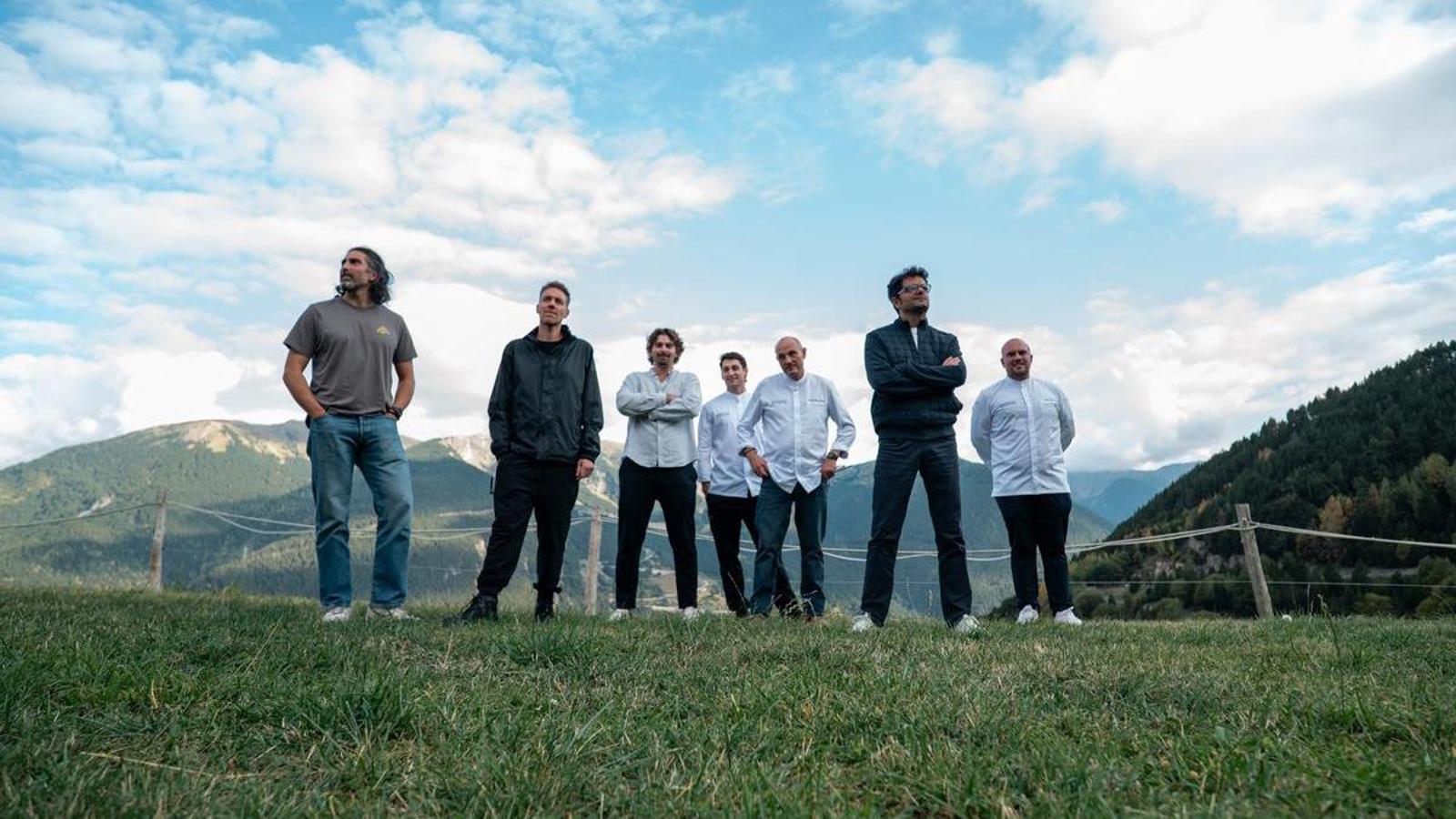
Canillo, AndorraAt the Andorra Taste congress, dedicated to high-mountain cuisine, a large group of chefs comes together to define what this cuisine made at altitude is. They ask themselves what territory is, what tradition means, and, ultimately, a space for debate is generated to help grow the gastronomy of the small country in the Pyrenees and of the chefs from other territories present. In a round table held at the idyllic Borda del Pi titled "From territory to identity" and moderated by Benjamin Lana, director of the congress, the chefs present made several statements that may be controversial. We review them in the form of a list:
Prawns mountain style
For Josep Maria Masó, a chef from Puigcerdà and owner of two restaurants in Barcelona, Tangana and Fonda Balmes, the location does make a difference. "I like working with fish, but I am from Puigcerdà. It is true that you need to provide an offer that makes the business work, but it makes no sense to have prawns in a restaurant in Andorra or Puigcerdà. Except if you have a gastronomic restaurant, where you don't need to have an expensive product, but you must have the best product".
"If you can't have the best, don't have it"
But if we talk about "the best product" it is not always easy. "Before, seven million oysters were produced in the Delta, and this year one has been produced", said Rafel Muria, chef of the restaurant Quatre Molins, in Cornudella de Montsant. The chefs warn that we are running out of goats, lambs, cows... But the product is the key to a good restaurant. Masó said it like this: "If you cannot have the best possible prawn, do not have it". And he finished with some advice: "A restaurant that I like a lot and that represents its land is Lera [in Castroverde de Campos]. There you eat dishes and products from there. Reaching what Luis Lera does is very difficult. You are in the middle of nowhere and there is meat and little else".
Those from Barcelona and the allioli
Regarding what the customer expects, Masó, the most veteran of the chefs present, is also clear about it. "You have to believe in what you do. I have two restaurants in Barcelona, but I am from here. When people from Barcelona come up to the Pyrenees, they look for lamb chops with an amazing garlic sauce. Where do you find that garlic sauce? Nowhere. And there is nothing healthier than garlic sauce. It seems that eating garlic sauce is something for the poor. Nutritionally, garlic sauce is perfect. My grandfather died at 100 years old and had garlic soup for dinner every night. When he was old, if one day he didn't eat it, there was a pouty mood".
Who decides what is traditional
What is the cuisine of a place? What we have been told it was? What appears in cookbooks? Can it change? These days in Andorra, squirrel rice has been talked about, but it is no longer eaten. Rafel Muria gives the example of frog legs. "In the south of Catalonia, it is said that frog legs are traditional. I have always seen them, even though I have never seen a frog". They talk about learning from other cultures but to bring it to one's own territory. "One always learns something, but then one must know how to filter it", says Masó. And he warns that many techniques are similar and that, sometimes, we are dazzled by things from outside that we already have. "Everyone talks about umami and garum is an umami!". It must be kept in mind that other territories sell themselves better. The key for the chef is to be faithful to the taste memory that is developed when you are young with home cooking. If they cook at home, of course.
The supermarket fried egg
Benjamín Lana states: "Before you went to the restaurant to eat fine things and now you go to restaurants to eat what you no longer eat at home". Would that explain the success of macaroni? "The basis of everything is at home and the big problem we have is that people don't cook. And they go to restaurants and eat very poorly", adds Masó. Lana explains an anecdote that is by no means light. Mercadona sold 25,000 fried eggs on the first day they put them on sale cooked and packaged. "If we don't know how to cook we will be in the hands of corporations. We are not aware that we are abandoning one of the most important learnings of the human being", warns Lana. We have been warned.
How to spot a fake
One thing that is worrying, and a lot, in a sector with as much supply as the restaurant industry is how to separate the wheat from the chaff. How can we distinguish when a kitchen has identity and when it only has a narrative? How to discover the fakes? According to Masó, if a dish has feeling, it shows. "There are dishes that say nothing". For Rafel Muria, "things fall by their own weight; when there is identity, it is felt". For Joël Sala, chef at Borda del Pi, it is something that is detected quickly. Muria admits that when he started at the restaurant, at 23 years old, he did not have an identity. "The food was good, but there was no line. I found the way during covid because we stopped. During the second lockdown, I didn't close, we worked every day. We thought. We cleaned. We ate together. That is where what we were doing started to make sense", he says. For Lana, whoever does not have authenticity "will fall".
The client, the master and lord
"It bothers me when they say 'hello, guys' to us in a restaurant," says Masó, who recalls that a restaurant is kitchen and dining room. And that the dining room is the side that is being lost. And it has been forgotten that restaurants must be hospitable. "When you go to a table you must feel like the master and lord. We restaurateurs must convey that we want to make them happy. The problem that exists is that the dining room is increasingly difficult because there are no people. Muria adds that there are people who "only scroll", who "come to work for two days and that's it" and that if you have four resumes, three do not even answer if you call them.
