A Catalan expedition sets out to rescue the Aral Sea (and the planet)
Resuming the enormous Asian lake could save emitting the equivalent of three years of CO2 emissions from a state like Spain into the atmosphere

-
CAT -
CAST
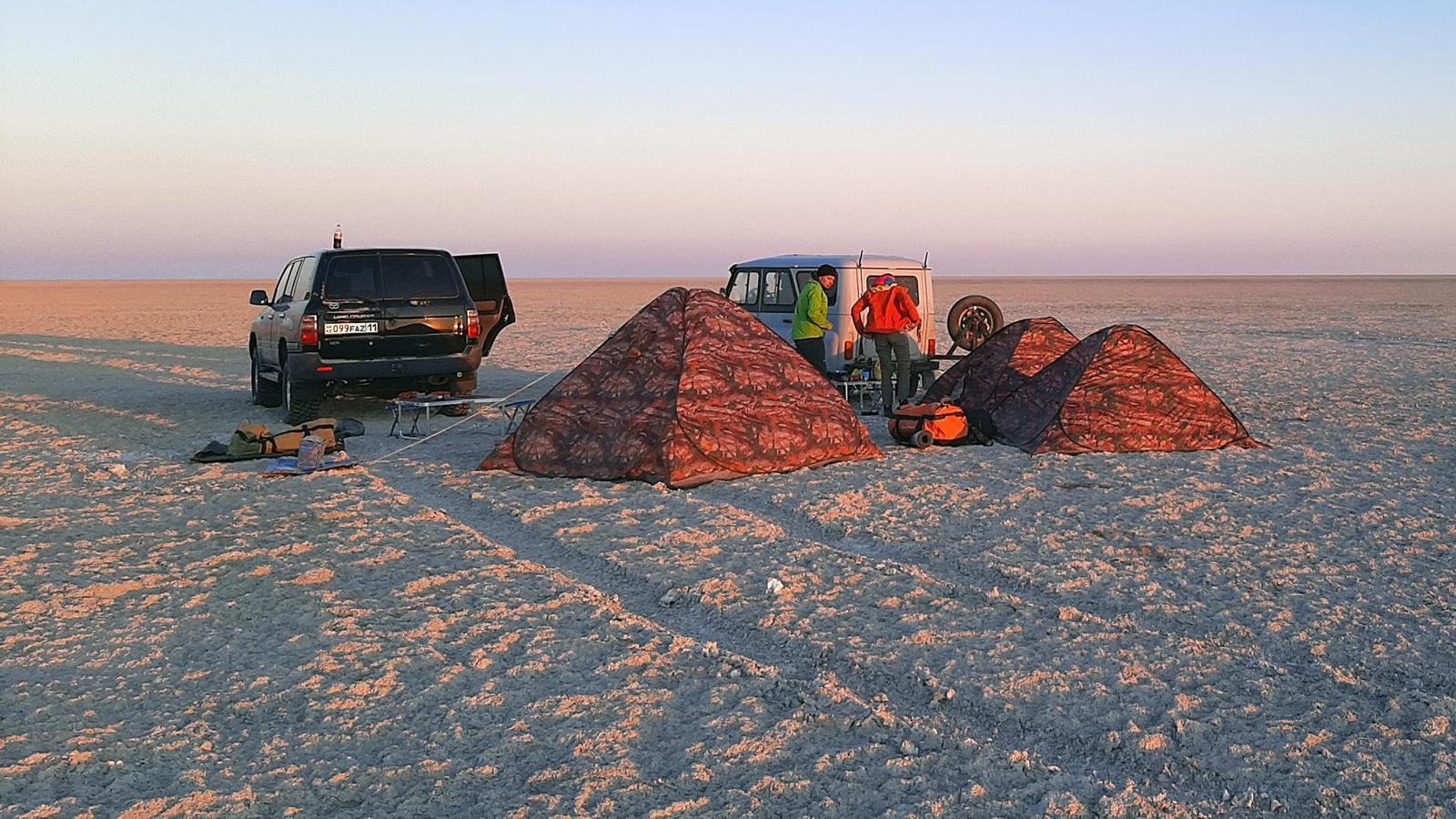
Little could they imagine that their research on the role of freshwater ecosystems in the climate crisis would end up becoming an epic and risky adventure into the unknown. In 2022, a small group of Catalan researchers embarked on an expedition in the purest Shackleton style to the heart of the Aral Sea. What decades ago had been the fourth largest freshwater lake in the world and one of the main climatic regulators of Central Asia, is today a desolate desert of sand and salt, a vestige of one of the greatest environmental disasters caused by human action.
“Before traveling to Kazakhstan, we didn’t even know what we would find,” assures, still excited, Rafael Marcé, a researcher at the Centre for Advanced Studies of Blanes (CEAB-CSIC), to ARA. For days, this small Catalan expedition, accompanied by local guides, traveled more than a hundred kilometers through this inhospitable landscape, without being clear whether the vehicles would withstand it, if an unexpected rain would leave them trapped in an immense quagmire in the middle of the desert, or if the salt crust would crumble and they would sink into the Aral riverbed. With marathon days at over 40°C, spending nights in the desert with just enough water and food, and with discussions with local guides who did not want to take them to some places because they considered them too dangerous.
“Although we weren't looking for it, it was a comprehensive adventure,” admits Marcé.
The Catalan mission aimed to answer a question that, until that moment, no one had considered: what happens to the CO₂ that had been buried in sediments for thousands of years when this sea, with a surface area comparable to that of all of Ireland, disappears?
After four years of analyzing samples, they now publish the answer in Science: CEAB ecologists, who also had the collaboration of experts from other Catalan universities and research centers, have demonstrated that the Aral Sea is a key, hitherto ignored, piece of the global carbon cycle. And they suggest that re-flooding the sea would turn it into an ally in combating the climate crisis.

The sea that evaporated
In the 60s, the government of the former USSR decided to divert water from the two enormous rivers, the Amu Darya and the Syr Darya, which fed the Aral Sea, to allocate it to irrigated crops. Specifically, under the command of Presidents Khrushchev first and Brezhnev later, it was decided that in that area, between Kazakhstan and Uzbekistan, which was desert, cotton would be grown, a crop that requires immense quantities of a resource that was not available there.
Therefore, to make this possible, water diversion infrastructure was built from the rivers to the cultivation fields. This destroyed the delicate hydrological balance of the Aral Sea, which began to evaporate remedilessly.

In little more than half a century, it lost nearly 90% of its surface area. Fishing towns were left hundreds of kilometers from the water. Endemic plant and animal species disappeared. Dust and salt storms became common, and an immense desert plain occupied the space where there was once water.
“It was a designed disaster,” denounces Marcé, who explains that at the time Russian climatologists already knew what the consequences of their actions would be. “They were clear that the sea would dry up and that this would cause a huge social upheaval: there were entire cities of 40,000 and 50,000 inhabitants who depended on it, and an important canning industry. And they decided to sacrifice them,” laments Marcé.
The climatic and social consequences went far beyond the disappearance of the lake. The majority of those families were left without a livelihood, and, moreover, the temperature extremes in the region were exacerbated.
From drain to transmitter
20 years ago, the role of aquatic ecosystems as sinks for the CO₂that humans emit into the atmosphere began to be studied. This anthropogenic carbon is absorbed by trees and plants that, with sunlight and water, generate leaves, branches, flowers, fruits, i.e. organic matter, part of which ends up being carried by river water and ends up in lakes or inland reservoirs. And part of this material ends up in buried sediments, in some cases for thousands of years.
However, in some regions, such as the Mediterranean, aquatic ecosystems often dry out. When this happens, when the water layer that acted as a cover disappears, atmospheric oxygen activates the microbial communities present in the sediments, which begin to degrade the organic matter accumulated over years, and release CO₂and methane, which contribute to the climate crisis.
Fifteen years ago, Marcé and researchers from the University of Barcelona began studying this phenomenon in Catalonia. “I perfectly remember the moment the lightbulb went on. I was on a bus to the airport reading the newspaper when I saw the news that Bolivia’s Poopó Lake, a giant one, had completely dried up,” says the CEAB ecologist. That made him understand that the phenomenon they were studying in small Catalan ecosystems could have a global dimension. And the Aral Sea was the ideal natural laboratory, the largest inland lake that was drying up on the planet.
His hypothesis was that this sea was progressively returning vast quantities of carbon to the atmosphere. “When a lake dries up, we are not only facing a hydrological, ecological, or socioeconomic problem. The carbon cycle is also altered in ways that, until now, have been practically absent from climate accounting,” points out Núria Catalán, also a researcher at CEAB-CSIC and co-author of the study.
After an odyssey of nearly four years to secure funding, they finally obtained a project from the National Research Plan, managed by the Spanish Ministry of Science. “We had to perform real feats with the only 150,000 euros from the Spanish Government that we had,” states this ecologist. In 2022, they managed to reach the center of the ancient sea and traveled across the desert collecting sediment samples from the lakebeds, measuring CO₂emissions and methane. They used remote sensing techniques, including satellite data on plant biomass and drone photogrammetry to reconstruct carbon dynamics over more than five decades of desiccation.
“We took a kind of trip back in time,” says Marcé. The desiccation process had imprinted a chronology on the lakebed; each strip of the bed corresponded to a different era. Thus, walking from what were once the shores of the Aral Sea to the center, it was possible to find sediments that had dried up from the 1960s to just a few years ago.
The hypothesis of the Catalan researchers was clear: if all those sediments initially contained similar amounts of carbon, those that had been exposed for longer would have lost much more because microorganisms had had decades to consume it. The data confirmed this idea.
A hidden treasure
As they publish in an article in the journal Science, they have calculated that since 1960 the exposed sediments of the Aral Sea have released 748 megatons of CO₂, that is, 748,000 million kilos of this gas. They have also seen that there are still enormous reserves of carbon buried under the ancient lakebed that have not yet been released. If the system were partially reflooded, the researchers state in the paper, we would still have time to avoid the emission of an additional 605 megatons of CO₂. To get an idea, this amount is equivalent to about three years of current greenhouse gas emissions caused by human activity in Spain.
For Marcé, this discovery is very relevant: "There is a hidden treasure of carbon under the Aral Sea. If these sediments remain exposed, the carbon will continue to be released. If the sea is reflooded, this same carbon could go from being a source of emissions to being part of the climate solution".
But how can this sea be reflooded? The World Bank has been financing projects and studies for decades to try to restore this ecosystem without success. The geopolitical context is complex: the rivers that could bring water back to the lake pass through seven different countries and their economies depend largely on agriculture. “It is really a very complex puzzle that can only be solved with coordinated international action and a lot of political will,” considers Marcé.
However, Catalan researchers propose a way to recover part of the water from the Aral Sea, starting by improving crop irrigation systems. “They have an efficiency in some places below 10%. There is a lot of room to increase it and recover a lot of water that could return to the sea,” proposes Marcé, who insists that: “We are talking about an irrigation system that can be seen from space. Cotton cultivation represents a two-digit weight in the GDP of these countries.”
Modernizing this system would involve an investment of tens of billions of euros. But it is precisely here where the Aral Sea's sink role offers a potential solution. As the study suggests, this carbon reserve could be a climate mitigation opportunity that had not been considered until now: monetizing the carbon stored in the sediments through carbon credits could mobilize international funding that would allow for improved irrigation and, in turn, partially re-flood the Aral Sea.
“We have calculated that in the Aral Sea there are as many carbon credits left to be issued as the entire world's supply of these credits currently on the table,” highlights Marcé. And this, he says, offers a solution.
9.7 billion dollars
Irrigation improvement projects can be certified if this allows carbon credits to be claimed for re-flooding the lake and thus reactivating this carbon sink. Researchers have evaluated measures to improve the water contributions of rivers to the sea, not only better irrigation efficiency, but also the optimization of water transport infrastructures and more coordinated governance among the countries of the basin.
Based on these restoration scenarios, they have estimated that with an investment of approximately 9.7 billion dollars, about 50% of the lake's surface area in 1960 could be restored. This would generate approximately 323 megatons of CO₂in marketable carbon credits.
Although the complete restoration of the Aral Sea remains a colossal challenge, technically, socially, and also politically, because the rivers that fed the lake cross several countries, climate finance could be a driver.
“It must be reflooded, not only for its key role as a CO₂ sink, but also for moral and ecological imperatives. The dry riverbed is like all of Ireland, an enormous scale that makes the magnitude difficult to imagine,” argues Marcé.
The Aral Sea, which has sequestered carbon in its sediments for thousands of years, is perhaps the most spectacular example of a phenomenon that also affects other large continental bodies of water that are also disappearing around the world, such as Lake Urmia (Iran), Lake Chad (border between Chad, Niger, Nigeria, and Cameroon), the Salton Sea (California), the Great Salt Lake, or even much smaller ecosystems, such as Las Tablas de Daimiel, the Gallocanta lagoon, or Doñana National Park, in Spain.
The disappearance of these spaces not only entails an irrecoverable loss of biodiversity, economy, and landscape. It also dismantles a piece of the natural mechanism that regulates the planet's carbon. Perhaps, too, beneath the inhospitable deserts they leave behind, some of the great unknown allies against climate change may still be hidden.
