Spain turns towards the extreme right

-
CAT -
CAST
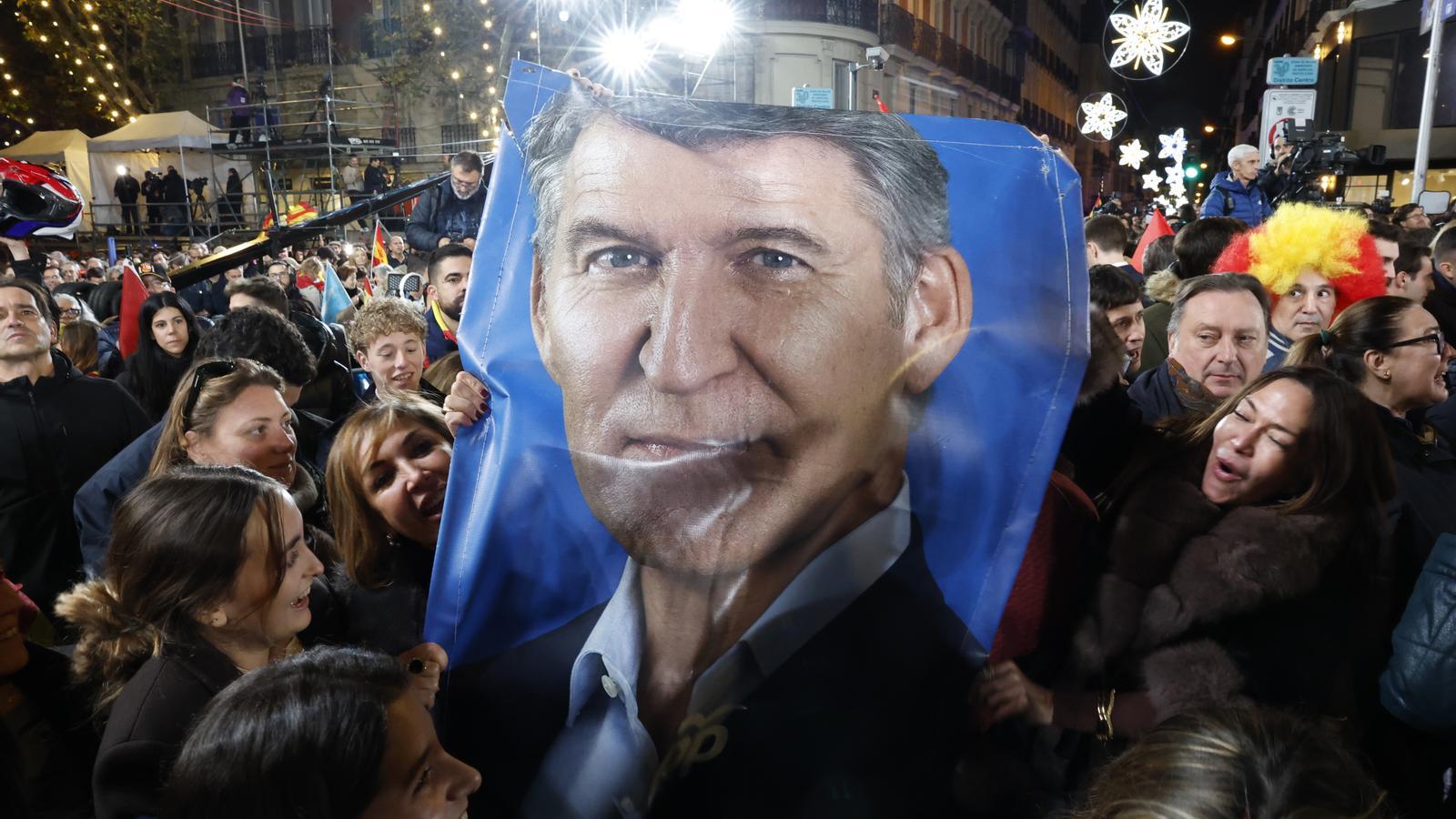
Alberto Núñez Feijóo will be the new Spanish president with the support of Vox, the party that has emerged most strengthened from elections marked by an extremely high mobilization: participation has exceeded 79%, one of the highest ever recorded. The victory of conservative and ultra Spanish nationalism is, therefore, incontestable and at the same time represents a historic involution in every sense with the upcoming entry into government of Santiago Abascal's followers, the far-right with Francoist roots and a Trumpist discourse. We are not, therefore, facing a mere political alternation. What emerges from the 29-N is an involution in the wake of a global populist wave that here arrives stained by the endemic denial of respect for plurality and the fight against inequalities: ultimately, Ceuta (immigration) weighed more than Maricarmen Abascal (the housing crisis).
After Giorgia Meloni's Italy, Spain will become the second major European state where the far-right will set the political pace. Undoubtedly, the anti-immigration discourse has worked. Feijóo, who traveled to Ceuta on the day of reflection, and Abascal, who has strengthened himself on the demagoguery of fear of an Islamic invasion, have managed to mobilize their electorate among a middle class that needs to find culprits for its feeling of economic fragility and identity insecurity. Vox, which in recent years had already begun to touch power in regional governments, will now make the leap to the true power of the State.
The PP-Vox sum gives a comfortable absolute majority. The plural majority of the left of Pedro Sánchez, with the support of the nationalist formations of Catalonia and the Basque Country, has vanished, not so much because of the setback of the PSOE, which maintains positions in votes and seats, as because of the fall of what Sumar represented in 2023: Ada Colau's Broad Front has fallen very short, while Podemos has only survived in Catalonia invisibilized within an ERC led by Gabriel Rufián.
The nationalist rights of Catalonia (Junts) and the Basque Country (PNB) have also retreated. For Junts, the in extremis entry into the campaign of the amnestied former president Carles Puigdemont did not serve to stop the bleeding of votes, to the point that the 'juntaires', with 5 deputies, remained slightly behind Vox in percentage, also with 5 elected representatives. The absence of Aliança, which did not run in the Spanish electoral event, was not capitalized on by the list headed by Miriam Nogueras, which finished far behind ERC (which went from 7 to 11 deputies). The PSC of president Salvador Illa, despite maintaining the first position, also emerges weakened (from 19 to 15 seats), while the PP of Xavier García Albiol, on the other hand, gains 3 (obtaining 9).
In fact, the global victory in the State of PP-Vox for the first time receives significant endorsement in Catalonia. As it also does in another territory that had historically been a stronghold of the left, Andalusia. However, Catalonia becomes a state exception with its progressive and Catalanist majority. A new and unsettling stage begins in Spain, which remains in the hands of the far-right. A situation that will not be easy at all for a Catalonia for which the improvement of financing or the future of the language becomes complicated.
