"Speculators" end SpaceX's stock market euphoria
Elon Musk loses billionaire status as IPO investor sentiment wanes

-
CAT -
CAST
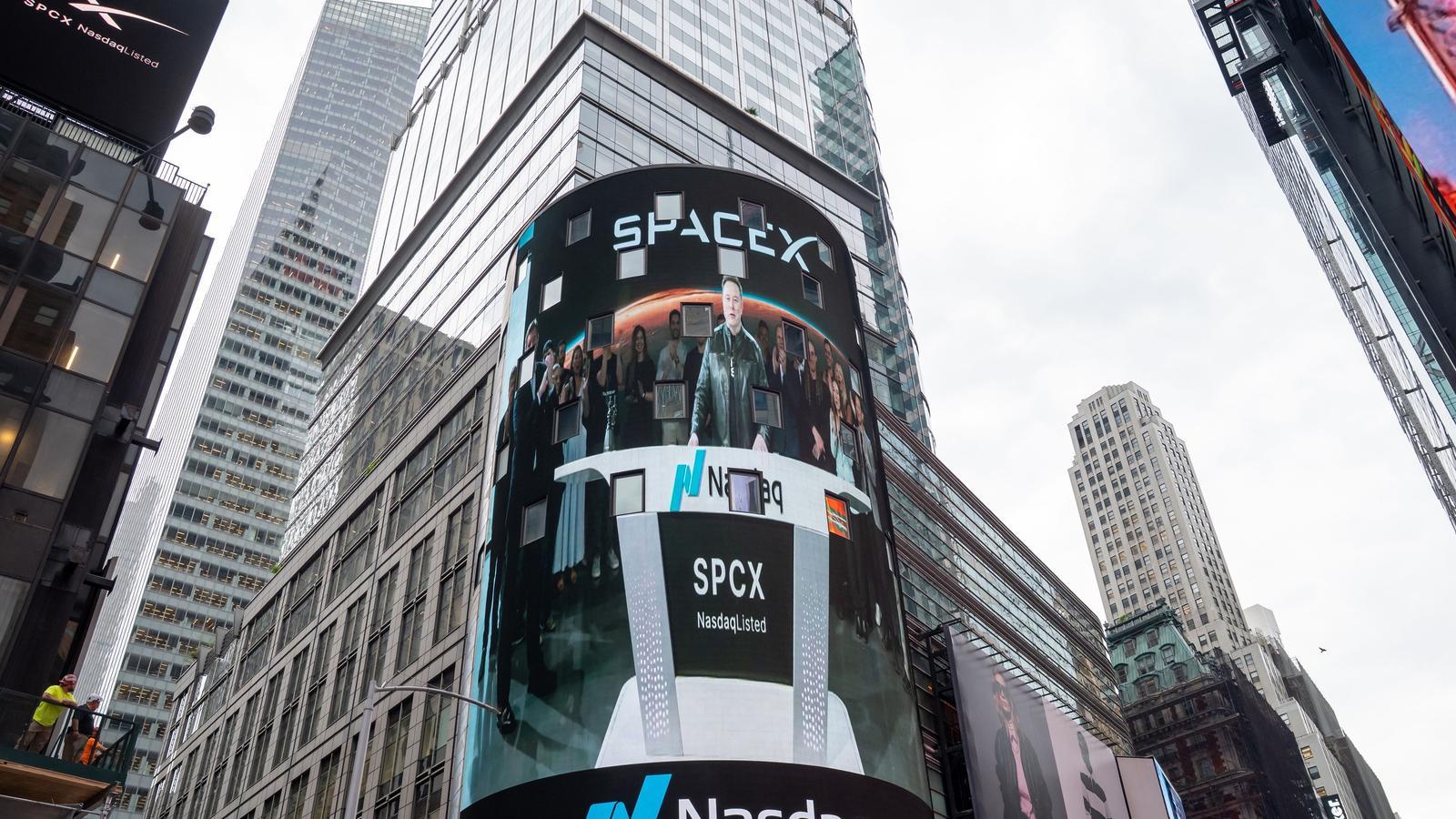
BarcelonaThe SpaceX IPO, Elon Musk's tech giant that groups its aerospace and artificial intelligence operations, was an unprecedented explosion. The initial public offering (IPO) of the first major AI player to assault Wall Street was executed at around $135 per share; but upon its entry into the Nasdaq 100 index, it had already soared to $160. After nearly a week of unprecedented ascent, the shares surpassed $200 and the company's global capitalization dwarfed tech giants on the scale of Amazon or Meta. The euphoria, however, lasted less than a week: since Monday, the quotation of Musk's new crown jewel has fallen by more than 13%. It opened this Friday's session, in fact, just above $150, and moved around the same price all day, with a slight upward trend, to close at $153.
At this quotation level, an investor who had bought shares on the first day on the stock market would already be losing money. The company's decline on the New York Stock Exchange has also left a hole in Musk's fortune, who last Tuesday, with the initial stock crash, lost his status as the first billionaire in history. According to the index of the world's richest people compiled by the Bloomberg agency, the South African magnate's fortune has retreated in recent days to around $940 billion.
The main market voices, it must be said, were already warning before the Nasdaq debut that SpaceX would be a highly volatile stock. "It's not a stock for the faint of heart," jokes, in conversation with ARA, the director of equity at Trea AM, Xavier Brun. According to Brun, the tech company's nature "appeals to speculators," due to the extremely high quotation levels and its vulnerability to general market sentiment. Similar is the assessment by Javier Cabrera, an analyst at XTB, who recalls that many retail investors "entered looking for short-term appreciation." These profiles, with high probability, sold at their peak when the stock surpassed $201; and have motivated a good part of the sell-off (massive sale) that has led to the company's dizzying stock market decline.
Is SpaceX a tech company?
At the beginning of its life as a public company, SpaceX seemed immune to any movement in the technology sector. According to Brun, the company's valuation was "completely detached" from both its own performance and that of its entire immediate environment. With this week's sharp correction, however, the company has aligned itself with the pullback of other major tech companies, which have caused cumulative losses in both the Nasdaq and the New York benchmark index S&P 500.
For Cabrera, SpaceX's shares will be "exposed to great speculation and market movements" more profoundly than its competitors. The company, it should be remembered, went public with losses of over $4.2 billion, and does not expect to achieve profit or distribute dividends in the short term. This transparency generates "doubts" among analysts, who do not see a clear fundamental trend in the short term.
For Brun, in fact, "whoever buys SpaceX is not buying results, but a narrative: that Musk is King Midas, that everything he touches turns to gold." In this sense, if tech companies regain their good stock market pace in the coming weeks, he does not rule out another intense rally; but it can also suffer even more severe drops if the corporate environment continues to deteriorate.
