The IMF raises Spain's growth forecast for 2026 to 2.5%
Inflation forecasts are increasing and prices will rise above the eurozone average
-
CAT -
CAST
BarcelonaThe International Monetary Fund (IMF) raises the growth forecast for the Spanish economy to 2.5% for this 2026—four tenths of a percentage point more compared to July– and maintains the outlook for the global economy with an increase of 3.1% (an extra tenth). Regarding the euro zone, the increase is a moderate 1.1%, although this is two tenths more than in the IMF's projections in the seventh month of the year.
However, while the IMF improves the growth forecasts for Spain, it also warns of price increases above what had been expected. Specifically, the organization predicts an inflation rate of 3.7% for this 2026 and 2.7% for 2027.
In any case, the IMF again points to Spain as the most dynamic major European economy, with an expansion rate more than double in 2026 than the 1.1% projected for the euro zone, which will grow by 1.2% next year. Compared to previous projections, the countries using the single currency have seen this year's forecast improved by two tenths and that of 2027 confirmed.
In this way, Spain's GDP will continue to grow substantially more than the rest of the major euro economies, as the IMF anticipates an expansion for Germany of 1.3% in 2026 and 1.1% in 2027; of 0.4% and 0.7%, respectively, for France; and also 0.8% this year and 0.6% the following year in the case of Italy.
Regarding prices, the IMF expects the inflation rate in Spain to average 3.7% in 2026. This represents seven tenths more than in its outlook report from last spring and exceeds the 3.1% estimated for the euro zone as a whole, although it trusts that the rate will moderate the increase in Spain to 2.7% for the following year.
Likewise, the new projections from the Washington-based institution maintain the estimated unemployment rate for Spain at 9.8% this year and next, below the 10.5% corresponding to 2025, although above the average of 6.3% forecast for each of the two years for the euro zone.
The President of the Spanish Government, Pedro Sánchez, and his Minister of Economy, Carlos Cuerpo, have boasted about the economic prosperity after learning of the IMF's forecasts. Sánchez highlighted that Spanish growth is occurring "with work and transformations, but without asking for sacrifices from the people". "Take note, your honors from the PP and Vox", pointed out the head of the executive in a message published on X. For his part, Carlos Cuerpo said "We continue" in a message also published on X.
The fund acknowledges an energy market disruption "more persistent than expected" due to the Middle East conflict, but attributes the good figures and the resilience of the global economy to the change in energy supply routes, the increase in energy production in other countries, and the boom in investment in artificial intelligence.
"Without these adjustments, the oil interruption alone would have significantly reduced global growth in 2026", states the IMF, which also applauded that labor markets have remained "unexpectedly strong" and financial systems have endured "the shocks and the sharpest monetary tightening in nearly half a century".
Looking towards 2027, the IMF keeps its growth forecasts for the Spanish economy (1.8%), the global economy (3.4%), and the Eurozone (1.2%) unchanged. In parallel, it expects global inflation to rise to 4.7% in 2026, reflecting higher raw material prices, and to fall back to 4.1% next year. Core inflation is projected at 3.9% and 3.7% for 2026 and 2027, respectively.
Inflation and public debt
Despite this favorable horizon, the institution led by Kristalina Georgieva warns that the decrease in energy and raw material stocks "could test the resilience of the global economy." "Low-income countries and families are still particularly vulnerable to higher food prices caused by transport disruptions, rising fertilizer costs, export restrictions, and extreme weather events," the IMF listed. "Technological investment, despite being a great boost against the energy shock, is concentrating risks by making global expansion heavily dependent on a small number of companies, sectors, and economies," the fund stressed.
On the other hand, the IMF also keeps an eye on the high public debt of many economies as one of the factors to take into account in the coming months. "This causes an increase in the term premium and inflation expectations," the international monetary organization stated, warning that—in this scenario—global growth in 2027 would be "materially lower" than that of the baseline projections.
"To support medium-term growth, countries should safeguard financial stability, support private sector dynamism, and strengthen fiscal resilience," the IMF prescribed. "International cooperation is indispensable. Many of the shocks weighing on the global economy cross borders, and the response must do the same," the fund concluded.
Greater economic integration
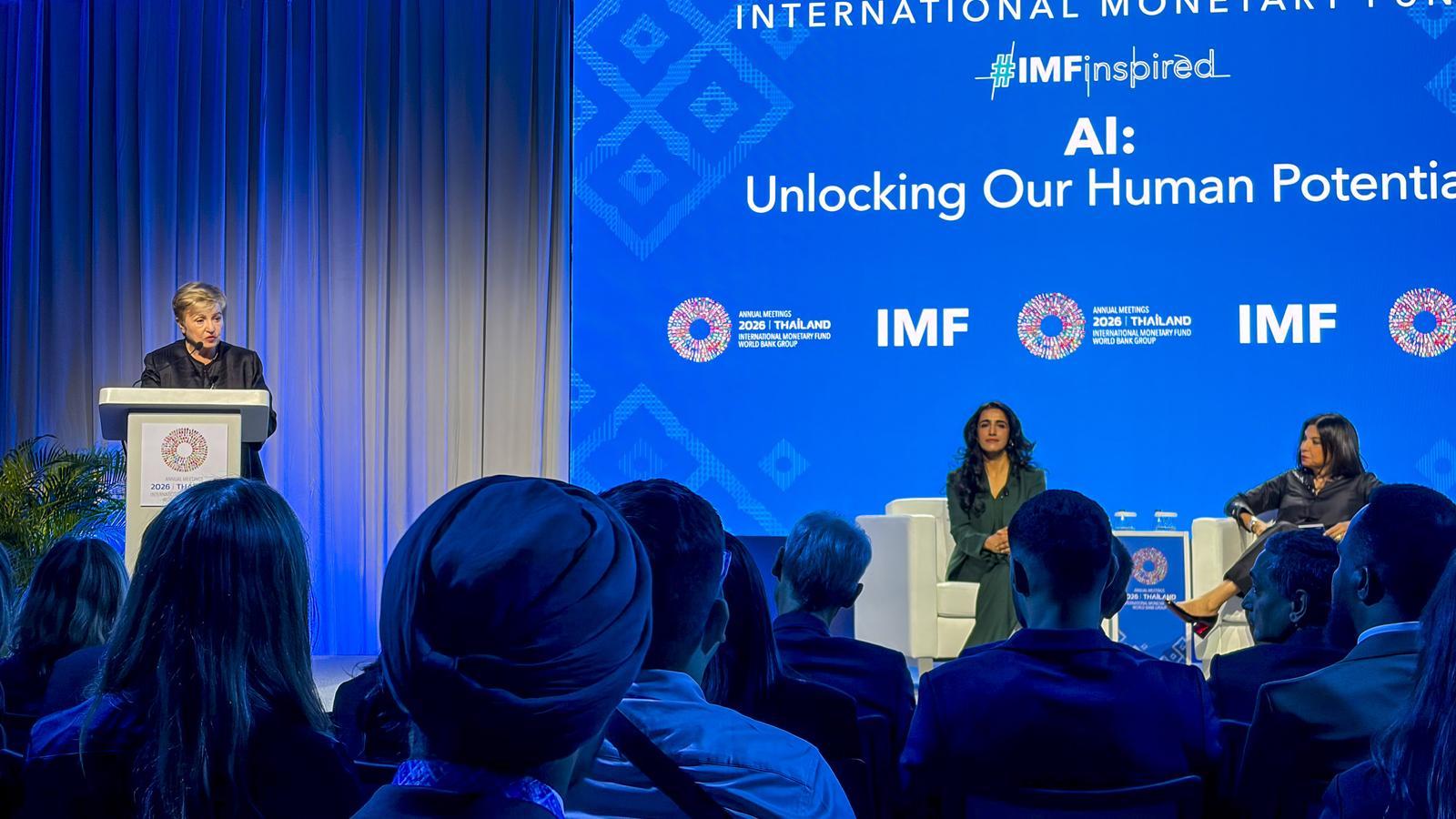
The director of the International Monetary Fund (IMF), Kristalina Georgieva, has called on countries to seek greater economic integration and cooperation in a world that, she warned, is increasingly fragmented and experiencing events that were “unimaginable” a few years ago. From Bangkok, where the annual meetings of the IMF and the World Bank (WB) are being held this week, the Bulgarian economist has insisted on the importance of building bridges to strengthen financial systems amidst the wars in Ukraine and the Middle East, as well as trade tensions between China and the United States.
"Cooperation and integration cannot be something we forget in a fragmented world; on the contrary, we must work more intensely to achieve them," Georgieva maintained. Due to this fragmentation, she asserted, countries' economies face two paths: a diversification that connects them with emerging markets or self-sustainability for nations that choose to close their doors to the world, which would be a mistake, in her view. "It is very important that we encourage diversification," she reiterated.
