The ECB keeps rates on hold pending the war in Iran
The banking entity avoids making a move and leaves the price of money at 2.25%

-
CAT -
CAST
BrusselsThe meeting of the Governing Council of the European Central Bank (ECB) has been transitional. After raising interest rates by about 0.25 percentage points last month, Frankfurt has avoided making a move while awaiting developments in the Middle East and has kept them at 2.25% this Thursday.
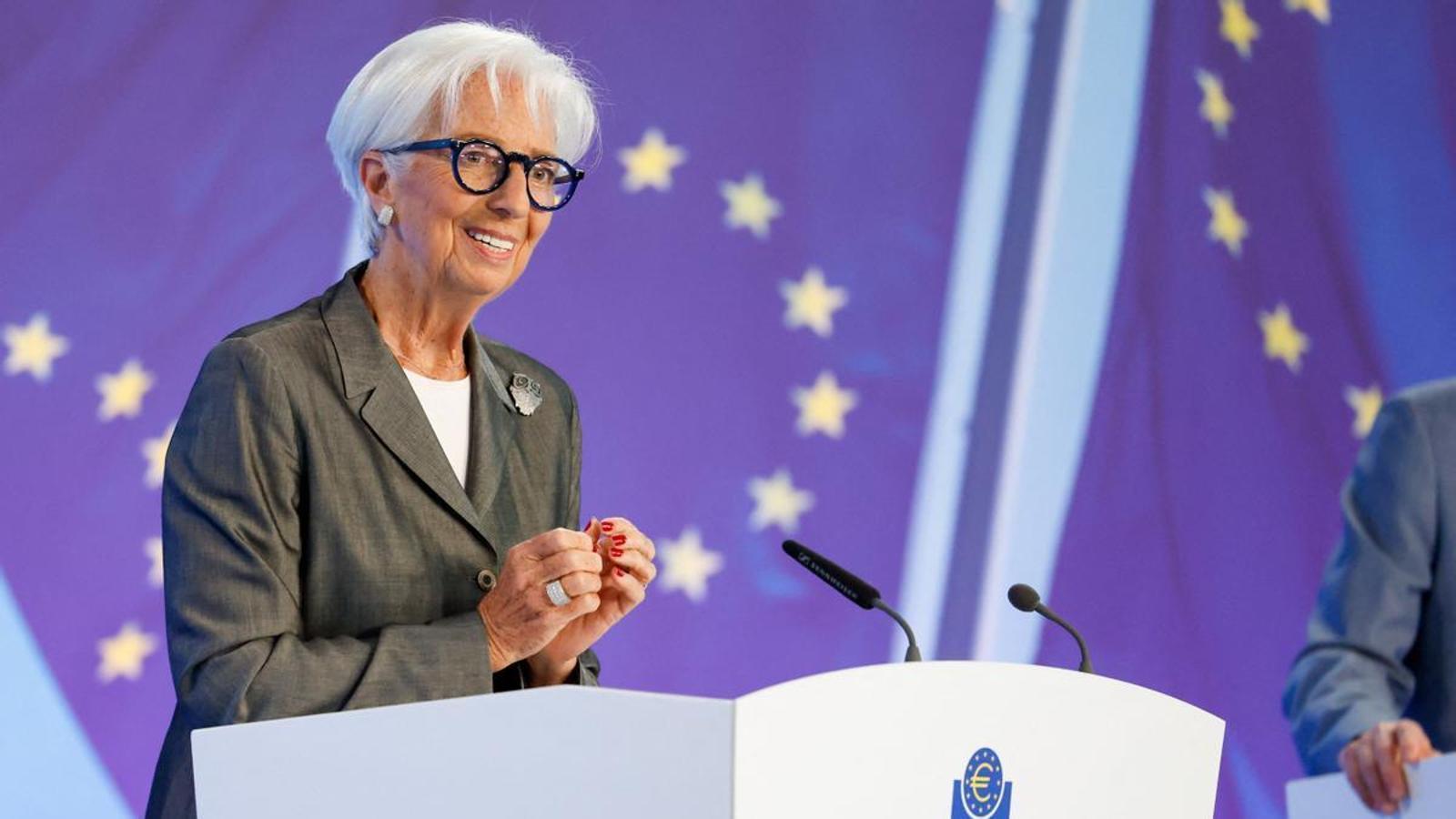
The banking institution did not want to take a misstep and prioritized the fact that, despite the resumption of attacks on Iran, the inflationary trend that the conflict itself initially caused is decreasing, partly thanks to the truce —temporary and unstable— between the administration of Donald Trump and the ayatollah regime. The president of the institution, Christine Lagarde, defended the decision at a press conference, stating that it is the best option to have room to "navigate the uncertainty caused by the conflict".
The French leader avoided announcing what decision the ECB's governing council will make at the next meeting on September 10, and limited herself to saying that it "will depend on the data" macroeconomics of the moment, which can vary according to the evolution of the war initiated by Donald Trump in the Middle East. In fact, next September, Frankfurt plans to publish the update of forecasts for price increases and economic growth, two key factors in setting the price of money.
High uncertainty
Despite Thursday's decision, Lagarde also warned that "uncertainty remains high," especially regarding volatile energy prices, and pointed out that "the inflationary impact of the energy shock has not yet fully materialized." For this reason, the ECB President warns that the financial institution will continue to "closely monitor the intensity and duration" of the war in the Middle East, and the consequences that may arise in economic terms in the eurozone, especially "in the next two weeks".

In this regard, Lagarde explained that, although the governors of the eurozone's central banks made Thursday's decision unanimously, some of them "wondered if the interest rate hike" should have been considered. Finally, however, the ECB president assured that there was consensus to "wait" and "pay close attention over the next two weeks to the evolution" of the war and to the macroeconomic data, which the ECB will have in September.
Be that as it may, the eurozone's price increase rate is slowly but surely moving back towards the 2% target set by the European Central Bank (ECB). Eurostat, the community's statistical agency, points out that in June it fell to 2.8%, four tenths less than in May. The inflationary trend was also broken with regard to core inflation – the index that excludes products with more volatile prices, such as energy or food – which went from 2.6% in May to 2.4% in June. Nevertheless, Lagarde warned that the ECB expects the rate to remain "well above" the 2% target.
It should be remembered that raising the price of money is the ECB's main tool for curbing inflation, but it causes a slowdown in economic activity. An increase in interest rates makes it more expensive for banks to borrow money and, at the same time, banks pass this on in the form of more expensive loans to their customers. And, naturally, if credit is more expensive, families and businesses find it more difficult to borrow from banks to consume or invest, which leads to a drop in demand and a reduction in the pace of the economy.
A "modest" growth
The war in the Middle East not only negatively affects inflation, but also the economic activity of the countries of the single currency. At its last meeting, the ECB worsened the growth prospects for gross domestic product (GDP, the indicator that measures economic activity) in the eurozone and maintains it in an almost anemic situation: this year, at 0.8%; in 2027, at 1.2%, and in 2028, at 1.5%.
However, the French leader pointed out that "modest" economic growth has been slightly better than expected during the second quarter of this year, mainly thanks to the "robust" services sector. She also highlighted investments in artificial intelligence and European rearmament, and the "strength" of the labor market and the creation of new jobs. Unemployment in the eurozone countries remains at historic lows and in June it stood again at 6.2%.
