The (difficult) solution to the rail freight transport blockade
The sector, outraged, is demanding more roads be built and more maintenance.


-
CAT -
CAST
BarcelonaRail freight transport has seen everything suddenly come to a standstill.Gelida commuter train accident, where a train driver died, cutting off passenger traffic, but also that of the trains that They carry cargo From the port of Barcelona to the rest of Spain. A blockade that worsened with the closure of the Rubí tunnel, an infrastructure located on the route of goods to Europe and which has had internal cracks for some time. The solution to this standstill was to return to road transport those few goods that are currently being moved by rail. Weeks later, rail container traffic has resumed, but with restrictions and the expectation that this precarious situation will continue for years.

When asked how everything could fall apart after these two incidents, experts repeatedly point to a lack of maintenance. "The network we use to move goods was built a long time ago and requires rigorous monitoring," emphasizes Juan Diego Pedrero, president of the Association of Private Railway Companies, which includes freight companies such as Captrain, Continental Rail, Alsa Rail, and Medway. "The necessary preventative work hasn't been carried out, neither on the embankments nor the retaining walls nor on the overhead lines. An unforeseen accident is always possible, but prevention is key," laments Joan Amorós, president of Ferrmed. As the College of Civil Engineers points out, in a future scenario where trains will play an increasingly important role, both for passengers and freight, it is essential that the existing tracks are in good condition. "What happened in the Rubí tunnel is an example of how to monitor infrastructure: this freight line isn't saturated, but if you have to close it, you end up creating a problem," emphasizes railway expert and director of the Center for Transport Studies, Joan Carles Salmerón. To avoid this, the network must be continuously and proactively reviewed before reaching a point where the only possible alternative is to halt traffic.
Build more tracks
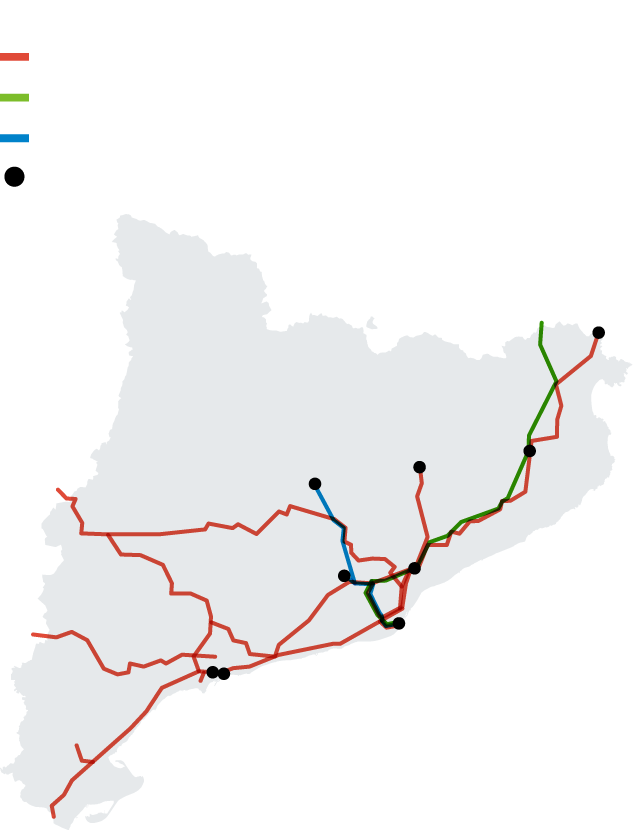
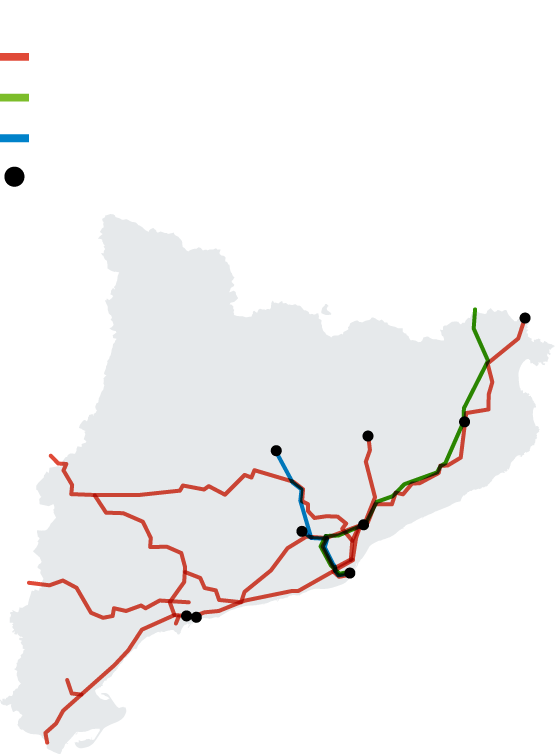
Some are also calling for the construction of more tracks to prevent freight trains from coinciding with passenger trains. Currently, both domestic and international freight share the same tracks as commuter, regional, and high-speed trains. In all of Catalonia, there is only one dedicated freight line between El Papiol and the Port of Barcelona, a very short journey.
The most significant rail freight traffic is that which moves containers to the rest of Spain. Both domestic and international goods enter and leave the Port of Barcelona, but those destined for Spain represent 80% of the total, with Zaragoza as the main destination. In this case, freight is transported on the Iberian-gauge rail network, which is also used by commuter and regional trains. The main bottleneck here is located on the section between Sant Vicenç de Calders and Martorell, where many freight trains pass through daily, coinciding with the passage of trains carrying passengers on the R4 line.
"It's intolerable. Now almost everything goes by road, packed to the brim, and if the commuter rail service is already bad, it will be even worse when more freight trains start running. The lines need to be separated from one another." hub "A logistics hub as important as Barcelona's, where more than 130,000 tons are transported long distances daily, is a major problem. We can't run freight trains alongside commuter trains because they interfere with each other," Amorós explains. A more interconnected network would allow goods to be rerouted if incidents occur. Amorós cites the example of when a key connection like the Fréjus line between France and Italy was severed years ago. In contrast, goods coming from France travel on standard gauge track. "It's essential that connections with Europe reach important industries like Seat and the petrochemical plants in Tarragona. They've been suffering losses for some time now due to the lack of direct access," Salmerón asserts.
On the route of goods coming from the border to reach the Catalan capital, from Mollet onwards, the freight trains circulate through the Cercanías network: they go along a short line like the R8, with the Rin that needs a strong intervention to guarantee its reliability.
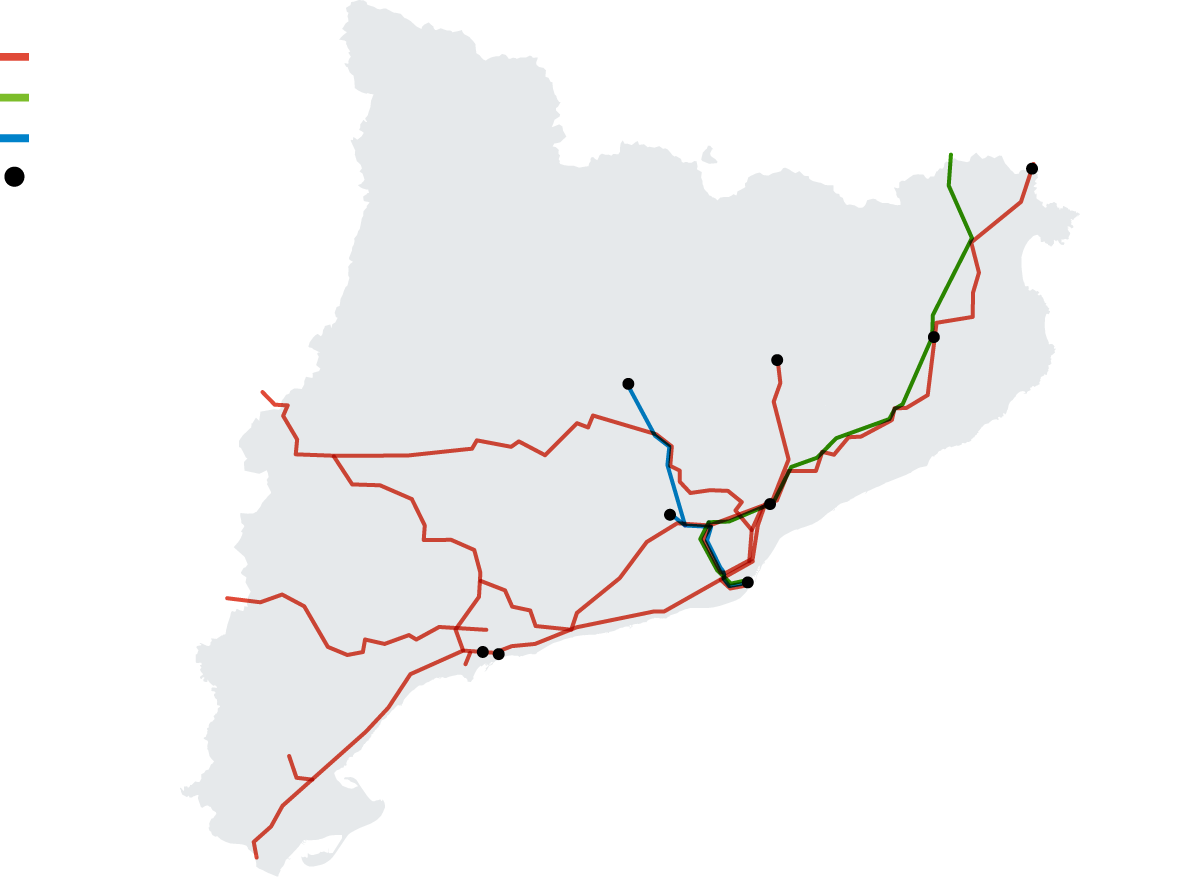
Segons l’ample de via
Ample ibèric
Ample internacional
Ample mètric
Portbou
Terminal ferroviària
Girona
Vic
Súria
la Llagosta
Seat Martorell
port de Barcelona
port de Tarragona
Constantí
Segons l’ample de via
Ample ibèric
Ample internacional
Ample mètric
Terminal ferroviària
Portbou
Vic
Súria
Girona
Seat
Martorell
la Llagosta
port de
Barcelona
port de
Tarragona
Constantí
Segons l’ample de via
Ample ibèric
Ample internacional
Ample mètric
Terminal ferroviària
Portbou
Vic
Súria
Girona
Seat
Martorell
la Llagosta
port de
Barcelona
port de
Tarragona
Constantí
This corridor, starting from Mollet, has been adapted to operate with standard gauge, including a third rail to allow freight trains to pass. This is the same option being used to bring trains from Europe to the Seat factory and the port of Tarragona, gradually extending the already precarious Mediterranean Corridor. This measure has sparked public opposition because it will bring freight trains too close to residential areas. Platforms like Mercancías por el Interior (Freight Through the Interior) criticize the fact that it will cross densely populated areas of high tourist and environmental value, especially in the Vila-seca, Tarragona, and Sant Vicenç de Calders section. "Freight trains cannot pass through city centers; separate tracks are needed," argues Ignasi Sayol, president of Pimec Logística. There is a third, more limited route for freight transport, which also coincides with passenger rail service: the Llobregat line operated by Ferrocarrils de la Generalitat de Catalunya (FGC). Built on meter gauge track, it departs from the port of Barcelona towards the Seat factory and the potash mines of Súria. Four years ago, a train loaded with potash derailed and collided with an FGC train at Sant Boi station, an accident in which the FGC driver was killed instantly.
The College of Civil Engineers acknowledges that the ideal would be separate tracks for different services, each with its own needs, but also points out that this requires a very high investment that will not be immediate. Furthermore, it highlights the public opposition generated when it is necessary to expropriate land to build new tracks. "Throughout Europe, passengers and freight use the same tracks. We need freight to reach all parts of the country, and it must be able to share the route with commuter trains. However, as passenger and freight traffic is growing, more tracks will be needed. Then, some will be allocated more to passengers, others more to defense, and still others more to freight; the third-track solution should only be temporary."
Only a 4% rail share
In recent weeks, the already limited rail freight sector has lost what little credibility it had, still far from gaining a more prominent role in road transport. Currently, rail accounts for only 4% of freight traffic in Catalonia, well below the European average of 17%, which aims to reach 30% by 2030—a target year for many objectives that are drawing ever closer without being met.
