Sánchez intensifies his challenge to Trump and writes in 'The Economist' that he owes "blind obedience" to the US.
The Spanish president will appear before Congress to give an account of the conflict in the Middle East.
-
CAT -
CAST
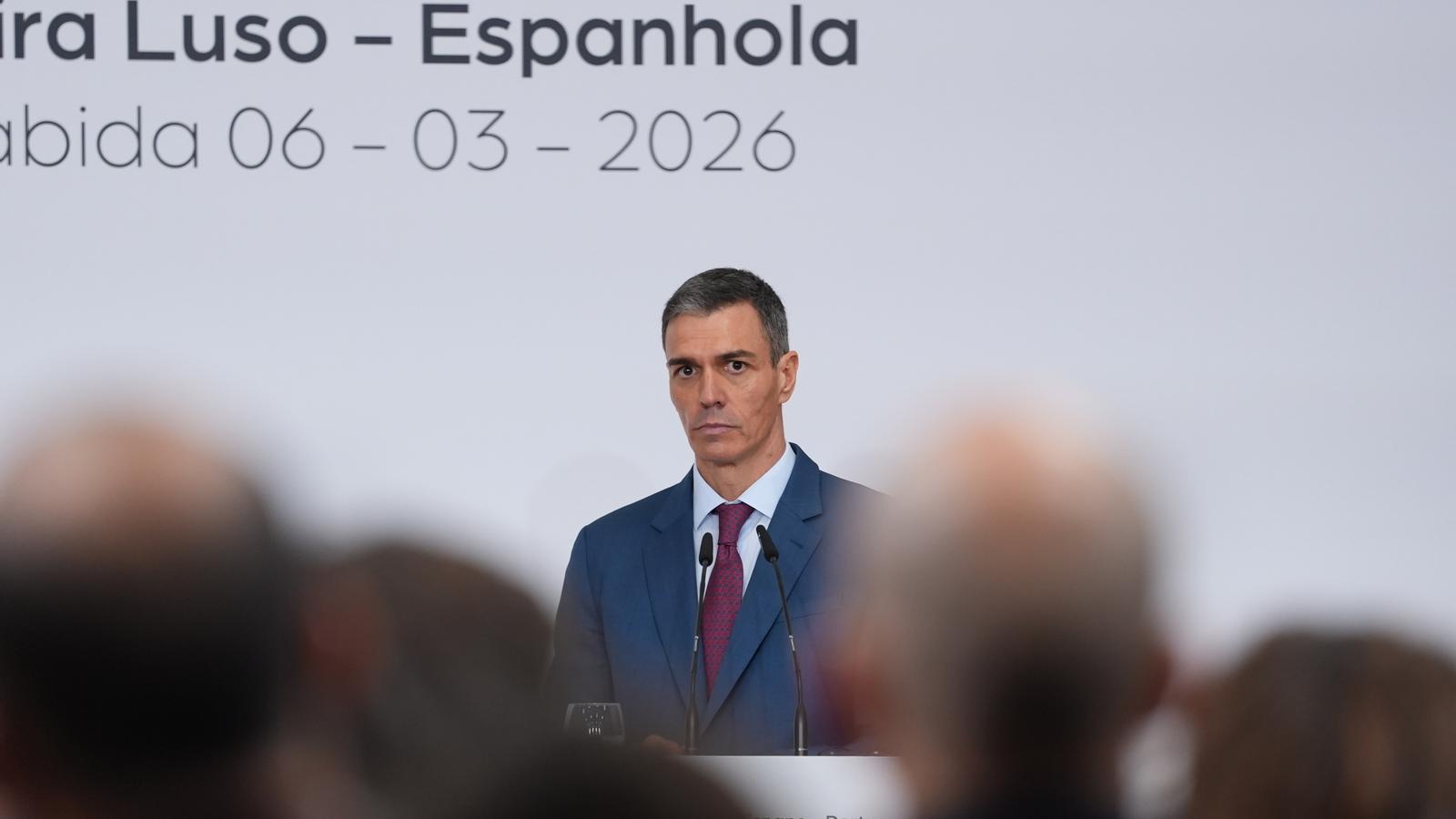
MadridPedro Sánchez has reaffirmed his "No to war" stance, which positions him as the antithesis of Donald Trump within the European Union, and has intensified his confrontation with the President of the United States. the publication of an article in 'The Economist' this FridayIn it, the Spanish Prime Minister explains the position that has led to his clash with the Trump administration and argues that he owes "blind obedience" to the US in the "reckless path" it has embarked upon in Iran, however much it may be an allied country. Sánchez insisted on this point in his appearance following the Spanish-Portuguese summit held in Huelva. "Among allied countries, it is good to help when one is right and also to point out when one is wrong or is making a mistake," he said.
In this regard, the head of the Spanish government has labeled the war in Iran an "extraordinary mistake." "No to repeating the mistakes of the past. No to the idea that the world's problems can be solved with bombs," Sánchez states in the British weekly, recalling the precedent of the 2003 Iraq WarIn The Economist, Sánchez denies that this stance stems from "antipathy" towards the US government, "and even less from sympathy towards the brutal regime of Iran." However, the Spanish president is adamant in his rejection of "the unilateral violation of international law" and the use of force. "It doesn't work," he warns in the article, hoping that more countries will eventually adopt Spain's position.

In parallel with this message on the international stage, in Spain, Sánchez will appear before Congress in the coming weeks to address the conflict in the Middle East. He himself requested this appearance as the issue becomes a new battleground between the two main political parties. A date has not yet been set, but it appears it will be at the end of this month. Sources at La Moncloa (the Prime Minister's residence) place it after the next European Council meeting with the heads of state of the 27 EU member states, scheduled for March 19 and 20. The objective of the appearance is to "listen to the opinions and suggestions" of the other groups, although without requesting any authorization from them, as First Vice President María Jesús Montero explained to the media. Montero was responding to the demand made by the People's Party (PP) this Friday. Alberto Núñez Feijóo's party maintains that the Spanish government must request permission from the Spanish Parliament to... send military aid to Cyprus"Sánchez cannot endanger the lives of our military personnel without congressional authorization," argue sources within the People's Party. The Spanish government has ruled out putting the deployment of the frigate to a vote. Christopher Columbus to the island —where an attack by Iran and its allies was intercepted against a British military base— in coordination with the rest of the European countries. Montero argued that it is not necessary because "it is not an offensive action," but rather a defensive move to "strengthen the capabilities of EU allies." In his appearance, Sánchez stressed that sending the frigate, without prior congressional approval, "is in accordance with national law" and is compatible with the "No to war" stance due to the "defensive and not at all offensive" nature of the mission.
The People's Party (PP) disagrees with this interpretation—Feijóo has insisted on X—while the Spanish government criticizes the main opposition party for its "erratic and subservient" stance toward Trump, or, as in the case of military aid to Cyprus, for its complete lack of transparency. PP Deputy Secretary Cuca Gamarra avoided answering whether they are for or against sending the frigate. In another appearance before the media, the PP leader did not clarify the issue, hiding behind the need to have all the information first. Amid the tension with the United States, and while the PP headquarters in Genoa is balancing between "denouncing the tyranny of the Iranian regime" and calling for "restraint," Isabel Díaz Ayuso—who acts independently and who He has clearly established himself as the antithesis of Sánchez— has announced a trip this weekend to New York to "attract new investments from leading global companies to Madrid."
Citizen opposition to the war
Beyond the parties' positions, a 40dB poll published this Friday on Cadena SER and in The CountryThe poll indicates that two out of three Spaniards (68%) oppose the war started by the US and Israel in Iran. Only 23.3% support the military campaign against the Iranian regime, according to the survey, which also points out that slightly more than half of the citizens, 53.2%, support the Spanish government's decision to veto the US use of the Morón and Rota air bases to attack Tehran. Sánchez, who has a 42.2% approval rating for his actions regarding the conflict—Feijóo's reaction only has 18.7% public support—conveyed Spain's solidarity this Friday to the Sultan of Oman and the Emir of Qatar for the "unjustifiable attacks" their countries have suffered at the hands of Iran. Twenty-four hours earlier, he made the same gesture to the President of Lebanon, Joseph Aoun, to whom he conveyed "full support" in the face of the Israeli bombings.

