SMEs were already "stagnating" before the war in Iran
The Spanish employers' association Cepyme warns of "structural" increases in energy and labor costs that threaten the competitiveness of companies

-
CAT -
CAST
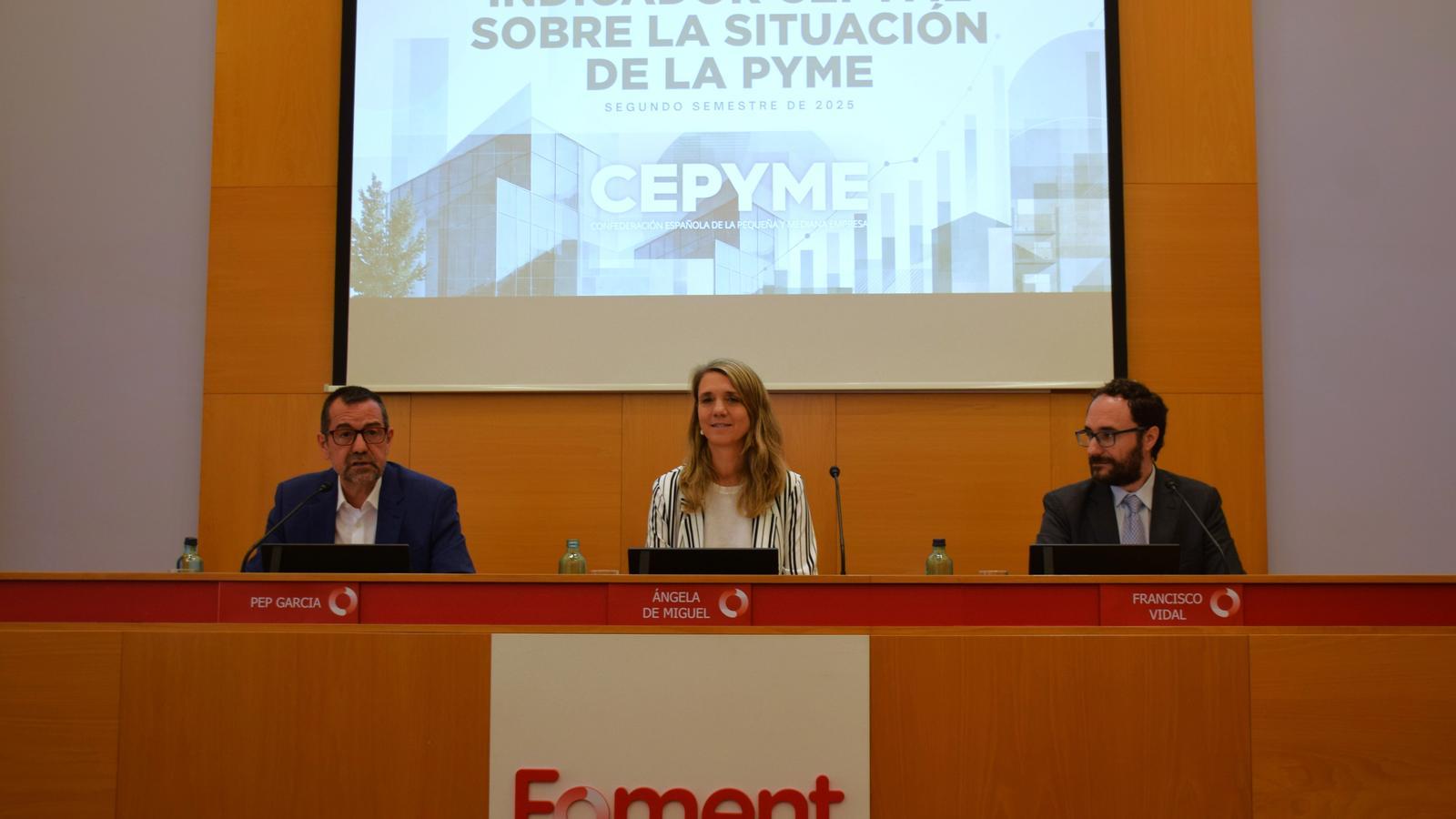
BarcelonaThe war in Iran and its global economic ravages have made it rain on wet for Spanish small and medium-sized enterprises. According to the latest indicator of the SME situation prepared by the Spanish employers' association Cepyme, state SMEs were already suffering a situation of "stagnation" in the second half of 2025, before the start of the conflict. According to the employers' association of SMEs linked to the CEOE, the smallest companies reached 2026 in "a more unfavorable situation to face the risks" that materialized with the clashes in the Middle East. The president of the business organization, Ángela de Miguel, has lamented the conclusions that can be drawn from the semiannual report, which shows "weak and unequal growth" among small companies. "Today, SMEs are not doing well," she said in a press briefing.
According to the SME situation indicator, two risk factors converge in the Spanish business fabric: an "structural" increase in costs in the last five years and a business pace that is far from the medium-term forecasts that had been made before the pandemic. According to the document, Spanish small companies are invoicing 11.3% less than they would have invoiced if the growth trend marked in 2019 had been maintained; while medium-sized companies are 5.5% below this threshold. It is worth mentioning that, in absolute terms, there has been growth: on average, state SMEs invoice 15% more than in December 2019.
Energy and wages
In this context, the progressive increase in costs – the "great elephant in the room", in the words of the director of Economy at Cepyme, Francisco Vidal – is shaking, according to the employers' association, the business of many small companies, especially micro-enterprises. According to the study, operating costs have soared by 25% compared to 2019. According to De Miguel, the situation could be even worse in the first months of 2026, due to energy cost overruns caused by the closure of the Strait of Hormuz. Catalonia is particularly vulnerable to this threat, due to its concentration, above the Spanish average, of industrial SMEs, which are very sensitive to the prices of electricity, gas, and fuels.
All public policies should be oriented towards this, but now it seems to be the opposite"The imbalance favoring large companies is related to the cumulative rise in the interprofessional minimum wage, which is more common among smaller businesses. Inflation, after four years, has become "structural"; and, therefore, it is increasingly difficult to pass it on to the final prices of the products and services offered by companies.
A "regulatory tsunami"
For the business associations of small and medium-sized enterprises, the bad mood of costs and business has few ways to be resolved due to a "regulatory tsunami" that hinders the expansion of many companies. According to the president of the Territorial Council of SMEs of Foment del Treball, Pep Garcia, the administration's focus should be on "making SMEs grow". "All public policies should be oriented towards this, but now it seems to be the opposite", denounced the business representative.
De Miguel, in a similar vein, has advocated for a regulatory approach that leads to legislation "thinking first about a micro-enterprise of three or four workers". "It is impossible for a small company to correctly adapt a regulation designed for a large multinational", he criticized.
Regulatory barriers prevent, in Vidal's eyes, the growth of companies. "Regulatory uncertainty", according to the director of Economy at Cepyme, has led some companies to decide to stop their expansion. For the expert, this trend is observed in the low indebtedness of Spanish SMEs, which stands at 62%, the lowest in two and a half decades. "Companies think it is better to reduce debt than to invest, and this is a problem, because investment is the source of growth. And companies act this way because of the burdens that hinder their activity", concluded Cepyme.
