Enric Aragonès: "Increasing the housing supply without changing the rules is like trying to fill a bathtub without putting a plug in it"
Spokesperson for the Tenants' Union

-
CAT -
CAST
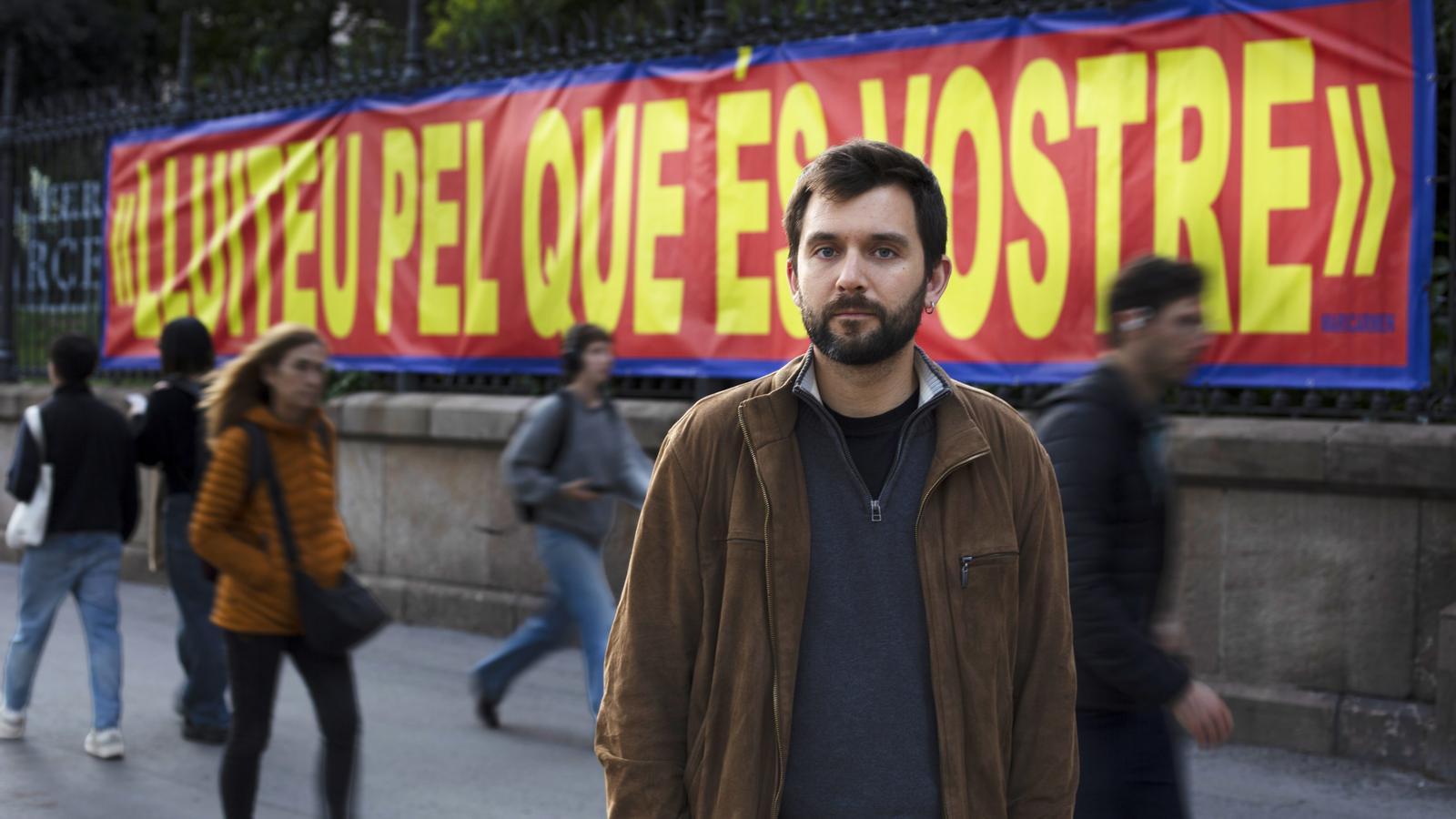
BarcelonaEnric Aragonès (Reus, 1991) arrives directly from work—in a job that has nothing to do with activism—at the space in the central headquarters of the University of Barcelona from where the Sindicat de Llogateres (Tenants' Union) is organizing the general strike of November 11. Between photographs, he is grateful that we are conducting an in-depth interview to discuss the call to action on the eve of the elections, in a fast-paced world where current events usually move from one statement to the next.
Why have they called a strike for the right to housing directed at business owners who, in most cases, have nothing to do with the residential market?
— The price of housing has risen well above wages, but so has the price of food and energy. The cost of living is excessive, and it has its origins in hoarding and speculation. The employers' association does indeed have many ties to rent-seeking and investment funds.
Companies are also harmed by the housing crisis. For example, according to Pimec, half have renounced expanding their workforce due to residential difficulties.
— It is curious that some sectors do not cry out until they see that this social fracture harms them. The same ones who warn of the problems that the housing crisis poses for the economy will later oppose any measure that cuts the profit of the real estate sector. One cannot pretend to address the situation without understanding that it is a conflict: there are opposing interests. Advancing the right to housing implies less business.
Is the housing strike a strike against private property?
— No, on the contrary. Homeowners are part of the majority we are appealing to: we want them to be on strike because they see how the shopping basket has become more expensive and how their children cannot become independent. Most owners have one property and use it to live in. They are much more similar to a tenant than to the rentiers who accumulate apartments and buy entire buildings to kick people out.
Therefore, does it make sense for the Tenants' Union to emphasize policies to manage the existing stock, such as caps, instead of focusing on demanding more supply?
— One of the points of this strike is to promote a large public housing stock. However, increasing the supply without changing the rules of the game is like trying to fill a bathtub without having put a plug in it first. In certain places it may be necessary to build and rehabilitate, but we must ensure that the apartments that are built serve to provide affordable rent. In Barcelona, apartments are being built at prohibitive prices and nothing guarantees that they will be used for rent for the people.
Starting from this premise, are builders and developers the enemy of the Tenants' Union?
— It depends on the practices they carry out. The question is not whether to build or not, but what the apartments are intended for, both those that already exist and those being built. The association of developers is the one that, when the 30% rule came into effect in Barcelona, said that two doors should be placed in the buildings: one for the neighbors living in market-price apartments and another for social housing, so that they would not have to cross paths.
The 30% reserve has allowed for the incorporation of 156 subsidized housing units in Barcelona in five years, even though the initial estimate was for 330 per year...
— When looking at what results the policies have had, we must know if we have had governments that have applied them. The 30% is a blatant example of this. We know of cases where it is evident that it should have been applied and the City Council has done nothing to make it so. We also see this in price regulation: it has taken two years for some sanctioning proceedings to start being opened.
You claim that houses are for living in and not for speculation. Does this not infringe upon private property?
— Private property is subject to the social function of housing. This is not against those who have an apartment to live in. We have a kidnapped supply and an inflated demand because two publics are competing: on one hand, people who want apartments to live in, and, on the other, a minority who want them to speculate. Therefore, banning speculative buying benefits the people who want an apartment to live in.
The Catalan and Spanish governments have not attacked the strike. Is it a criticism against them?
— Blatantly, yes. I would highly question that they view it favorably. They do not move until the mobilization rolls over them. They do nothing until they are forced to. Pedro Sánchez will try to surf the situation by acting as if, in some way, this strike were not against him. But it is, among others, also against the PSOE for how it has dragged its feet until now. We must not lose sight of the fact that, in the end, this happens because the PSOE has obvious ties to rentierism and the real estate sector.
In the Spanish government there is not only the PSOE.
— Obviously. The entire government is the one that has dragged its feet on the matter. Let us not forget also that it was the PSOE and Unidas Podemos government that took, for example, the Catalan rental regulation to the Constitutional Court.
The strike arrives at the doors of the general elections and, in part, it is posed against what defines itself as "the most progressive government in the history of Spanish democracy". Under these conditions, what would be a good result for the Tenants' Union?
— We want the six points we bring in the general strike program to be implemented, regardless of who is governing. And, if they are not implemented, the mobilization will continue. On November 11th, we must demonstrate that we are a social majority, not just the tenants.
Are there any political parties that have knocked on the door of the Tenants' Union ahead of the elections?
— No. I assure you. I think they have already understood that it will not work, and I am very proud of that. The union is not about that. We have total political and economic independence, we sustain ourselves only through the fees of the affiliated people so as not to depend on any party or administration. The Tenants' Union is very shielded in this regard.
Are you worried about looting?
— We are all expectant; we cannot quite see where this phenomenon has come from. It is difficult for me to make assessments on this matter. But it is evident that, to reach this point, something was broken before. It is necessary to channel the frustration towards the tools of struggle that we have, and that is what we will do on 11-N.
