Green light for the master plan that projects 220,000 more apartments in the metropolitan area by 2050
The AMB approves the initial phase of the PDUM again after receiving more than 5,000 comments on the text from three years ago


-
CAT -
CAST
The most important urban planning tool for the Barcelona metropolitan area, designed to improve the territorial conditions of its 36 constituent municipalities, received renewed approval on Tuesday. This new framework will initiate the renewal of the Metropolitan General Plan, in effect since 1976 and based on an outdated model of growth through territorial expansion and occupation. Its objective is to address current challenges, particularly regarding housing, but also to balance the entire metropolis in terms of activity, mobility, land use, and development. This tool, the Metropolitan Urban Master Plan (PDUM), was approved by the Metropolitan Council, the highest governing body of the Barcelona Metropolitan Area (AMB). The process began in 2015 with the initial drafting; the first version was presented in 2019, and it received initial approval in 2023. In recent years, the plan has received more than 5,180 objections and reports from administrations and entities, such as the Federation of Neighborhood Associations of Barcelona (FAVB), which has required a second initial approval almost three years later. Provisional approval is expected before the next municipal elections, and final approval by 2028. "Now we have to see what changes have been made compared to the previous version. Of course, housing is an important issue, but it will have to be put into practice. They need to explain the contents very well," explains Jordi Giró, president of Confavc, in ARA. The approved text has not yet been made public. The guidelines now incorporated into the text, which will affect the 36 municipalities and 3.38 million inhabitants of the AMB (Barcelona Metropolitan Area), will create a unified urban planning framework of possibilities for the next 25 years. The PSC, ERC, Junts per Catalunya, En Comú Podem, Vivim Montcada i Reixac, Compromís, Acord per Torrelles, and Junts per Tiana voted in favor, while Vox voted against. The PP and the councilors from Hospitalet de Llobregat, David Quirós (PSC) and Jesús Husillos (PSC), abstained. The needs that the PDUM seeks to address—such as access to housing and integrated mobility—also exist in the municipalities just outside the AMB, such as Maresme, Vallès, Vallès, and Garraf. However, these municipalities are not part of the metropolitan institutional structure and, therefore, lack planning instruments. This absence is a long-standing demand in the debate on the metropolitan region. What does the new plan consist of?
This is a strategic urban development master plan, meaning it focuses more on the how and the processes, rather than on closed and defined proposals. It doesn't guarantee specific measures, but rather authorizes what can and cannot be done. "It's not a catalog of projects, but a document that provides guidance for ensuring that growth is carried out properly," explained Damià Calvet, Vice President of the Urban Planning and Natural Spaces Department, at a press conference on Tuesday. Thus, the plan defines objectives and also the processes for achieving them, which "doesn't mean it's less executive, but rather more operational," added Xavier Mariño, Director of the Urban Planning and Natural Spaces Department at the AMB (Barcelona Metropolitan Area). The text incorporates proposals and also the way to develop them with a set of "rules of the game" between the final phase of the PDUM – which will arrive from 2028 onwards – and the Metropolitan Urban Development Plan (POUMet), which is the metropolitan plan that will be activated to specify how the PDUM is applied in each area. In short, the approved master plan establishes a general framework, and the POUMet develops it with the detail corresponding to a municipal urban development plan (POUM). Precisely for all these reasons, Mariño also highlighted legal certainty as a final guiding principle, since the PDUM must comply with the hierarchy and respect the still-valid metropolitan general plan and the Barcelona Metropolitan Territorial Plan (PTMB) of the Generalitat, as well as fit within the legislative and urban planning framework.
Castellbisbal
Sant Andreu
de la Barca
Badia
del Vallès
Pallejà
el Papiol
Barberà
del Vallès
Cervelló
Sant Cugat
del Vallès
Molins de Rei
Sant Vicenç
dels Horts
Cerdanyola
del Vallès
Ripollet
Santa Coloma
de Cervelló
Sant Feliu
de Llobregat
Montcada
i Reixac
Sant Just
Desvern
Sant Boi
de Llobregat
Castelldefels
Badalona
Santa Coloma
de Gramenet
Tiana
Gavà
l’Hospitalet de Ll.
Montgat
Sant Adrià
de Besòs
El Prat
de Llobregat
Barcelona
- 01 Garraf Gate
- 0.2 Delta - Gran Vía
- 0.3 Morrot
- 0.4 Sant Boi Crossing
- 0.5 Green Cornice
- 0.6 Diagonal speaker
- 0.7 Diagonal - Llobregat
- 0.8 Four Roads
- 0.9 Nexo Baix Llobregat
- 10 Mediterranean Corridor
- 11 Vallès Crossing
- 12 Montcada Crossroads
- 13 Besòs Central
- 14 Besòs - Gran Via
- 15 Cerro de Sariol
- 16 Puerta Maresme

How to have more living space in less space
One of the key projections is the forecast for housing construction in a highly densely populated area. In this regard, the PDUM (Urban Development Plan) anticipates the possibility of building an additional 220,000 main apartments in the metropolitan area—with a range of between 167,000 and 262,000—to accommodate population growth until 2050, projected at 184,000 new inhabitants. It also stipulates that 10% of housing be affordable. This represents reaching 3.58 million people.
The master plan anticipates this increase by doubling planning capacity, but by reclassifying land rather than creating new developments. This means that, instead of expanding, it will do the opposite: it will reduce the hectares of urban and developable land in the area—1,850 hectares less—which will become non-developable. So how will growth be possible? Through instruments such as metropolitan opportunity areas—existing areas in strategic locations with the potential to accommodate growth—and urban regeneration areas.
"The document does not incorporate extensive growth factors," Calvet stated, noting that in recent decades many municipalities have been occupying land because the 1976 Metropolitan General Plan stipulated it. Regarding this aspect, experts warn of several bottlenecks. Urban regeneration, that is, growing in intensity or density rather than in extent, is a more complex, slow, and costly task. In December, a report from the APCE-UPF Chair already warned that 73% of the PDUM's housing potential "rests on urban renewal and the existing city" and cautioned that instruments are needed to overcome property fragmentation and reduce costs, since transforming existing areas typically clashes with private interests, relocation costs, and litigation.
In fact, the Deputy Secretary General for Technical Affairs of the APCE, Carles Sala, is calling for swift action to reach the maximum number of homes proposed in the PDUM, which is more than 200,000. "And this is only possible by modifying densification and building criteria," he added.
Rebalancing the territory
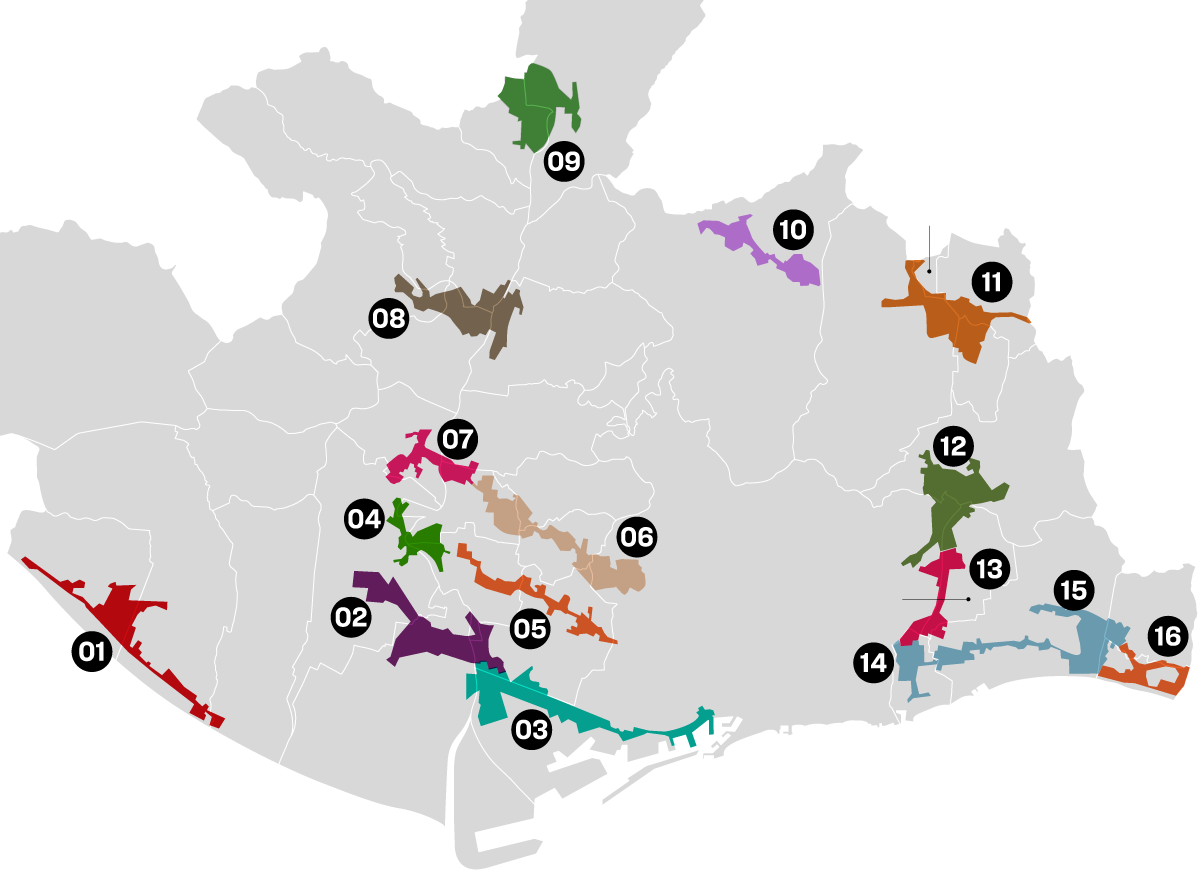
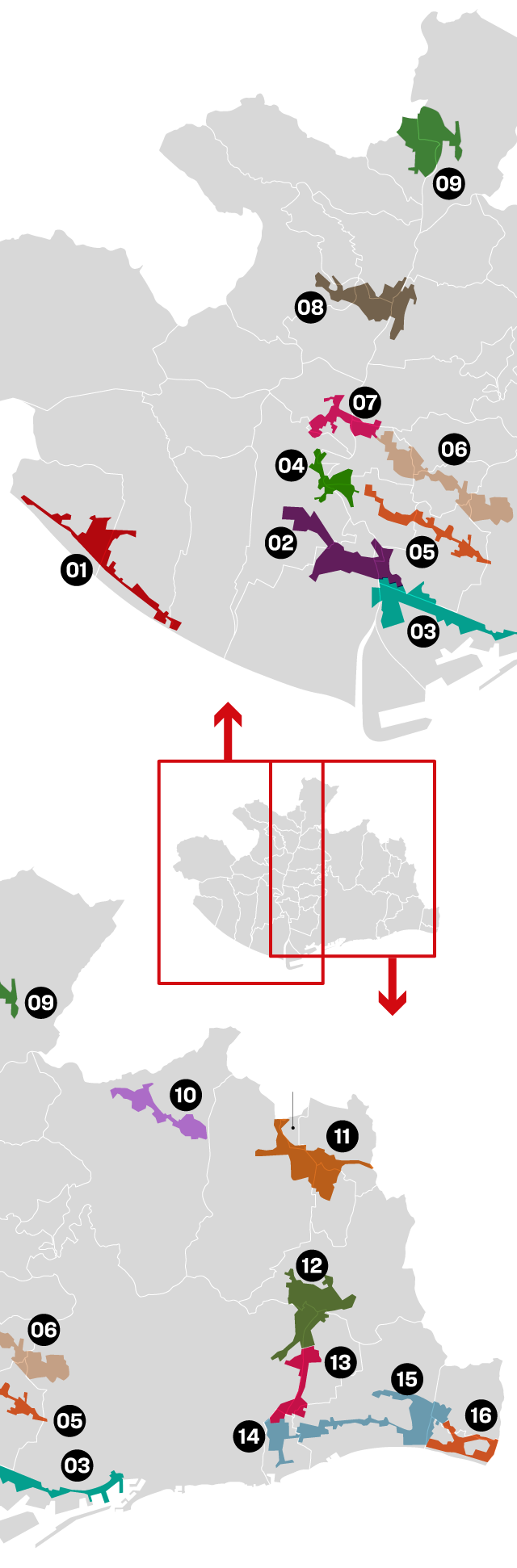
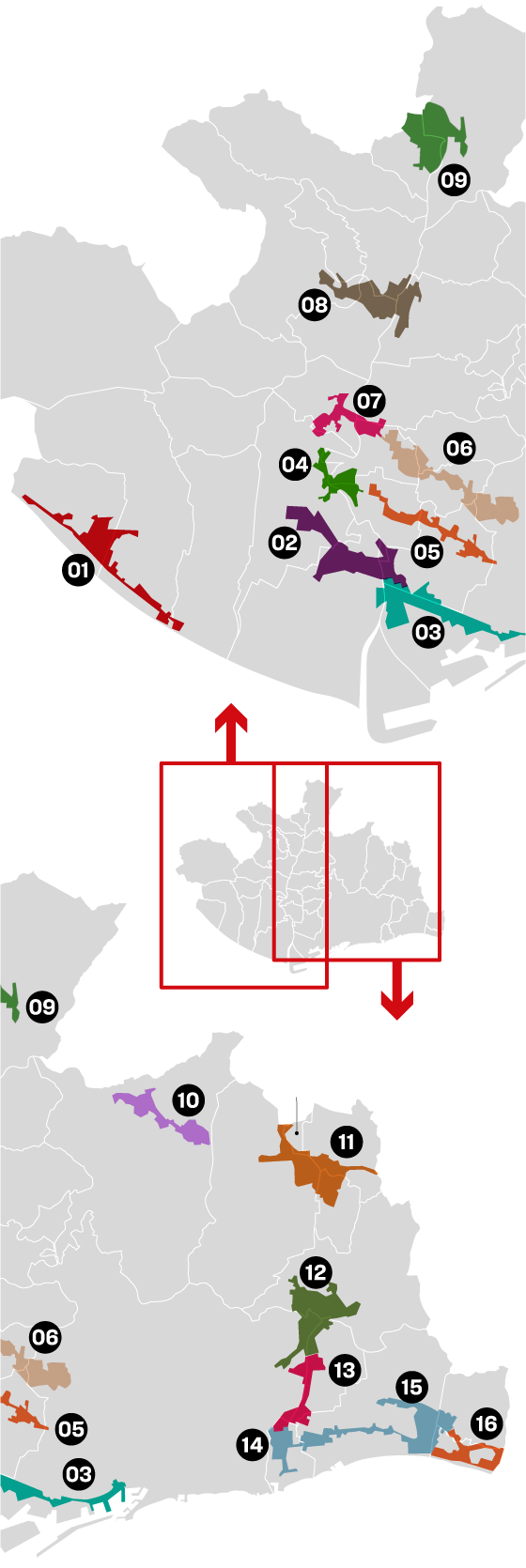
The new PDUM (Urban Development Plan) also anticipates that virtually all municipalities in the metropolitan area will increase their proportion of housing if they specialize in business activity, or conversely, increase the building area designated for business activity if they specialize in residential areas. This planning challenges the idea of a radial city, in which Barcelona is the hub of activity and the other cities are primarily commuter towns. In this regard, the master plan identifies 16 "metropolitan centers" where this transformation can take place, with new balances between business activity, housing, amenities, and services. These areas are Porta Garraf, Delta-Gran Via, Morrot, Cruïlla Sant Boi, Cornisa Verde, Diagonal Ponent, Diagonal-Llobregat, Quatre Camins, Nexo Baix Llobregat, Corredor Mediterráneo, Cruïlla Vallès, Cruïlla Montcada, Besòs Central, and Besòs-Gran Via.

- If you want to examine the chart in more detail, open the high-resolution version in another tab.
The goal is to achieve mixed urban fabrics, a distribution of activities closer to where people live, and a reduction in motorized traffic.
Mobility and emissions
This focus on housing and mixed-use development has implications for mobility and amenities. The master plan proposes a 240-kilometer network of metropolitan avenues connecting several municipalities and concentrating surface public transport, as well as bicycle and pedestrian routes. This network should allow half of the current residential land and 58.2% of the land in industrial parks to be located within 500 meters of these new channels for public transport and active mobility. With all this, a reduction in emissions and energy infrastructure consumption is expected, as well as a 5% decrease in waste generation per capita.
