Europe debates its future in the race of the AI giants
The launch of the latest Mistral model defies the pessimism in the EU in the competition with Anthropic or OpenAI

-
CAT -
CAST
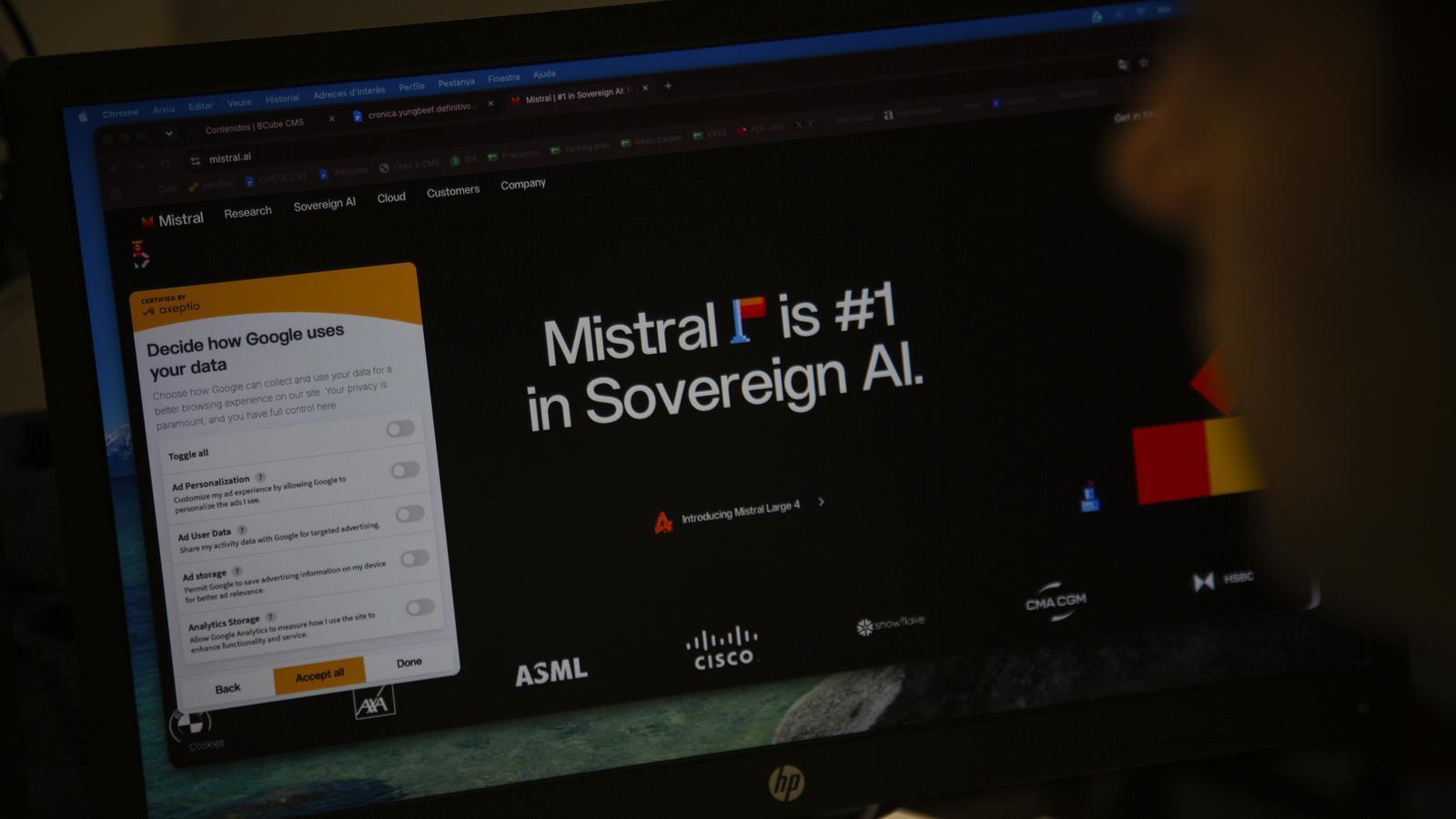
BarcelonaIn an autumn marked by the discourse surrounding artificial intelligence, Europe seemed far from any seat of power. Just a few weeks away from the predictable mega-IPO of Anthropic, and still with the echoes of the controversy over the technology's safety that shook the United States in September, the Twenty-Seven have moved a relevant piece for the first time in recent years. At the beginning of October, Mistral, the French benchmark for AI –the only European player mentioned in the conversation of the most advanced models– launched its latest model, Mistral Large 4, also known "very officially" as le Chonk.
It is an open-weights model –that is, its main parameters will be available to the general public– which, according to the company itself, "performs better than any other model developed in the US or Europe" with the same characteristics. The French tech company aspires to keep alive the European hope of having a horse in the final race of AI. Its position, however, is not a consensus in the Union, and the launch of Mistral Large 4 has not yet served to shed light on the path that Brussels wants to follow for this technological competition.
The experts consulted by ARA view the launch with optimism, but with some caution: the new model still needs to pass an independent evaluation. "Until Mistral opens the weights at the end of the month, we will not be able to have evidence to prove that what it says is a reality," warns Josep Curto, a professor at the UOC and founder of AthenaCore. The professor of the master's degree in business data analytics at the UPF-BSM Alexandra Abós also demands it; although she considers that "the Mistral model has some very interesting characteristics, and it has served to give a little air and pride to the European ecosystem."
An investment leap
Abós warns that Mistral's new model does not necessarily mean that Europe is capable of competing with the "large foundational models"; the frontier AI that comes out of the USA. Both experts point to a common obstacle to achieving the kind of performance that Anthropic or OpenAI already have in their hands: "It cannot be said that Europe will be capable of generating frontier models without a change in investment mechanisms," observes Curto.
The enormous computing needs that US laboratories are revealing are proof of this: the company led by Dario Amodei revealed in its IPO documents prospects for spending on data centers and cloud of about 518 billion dollars, an amount unimaginable for a European company. In Curto's opinion, however, Europe could make a virtue of necessity: the community business fabric, with smaller actors, does not have the financing capacity to "tackle pharaonic projects"; but if European technology is capable of "adjusting to real needs," it can offer "much more interesting" models. In other words, Abós continues: "the most important thing is that AI solves concrete problems, regardless of whether you have the most powerful model on the market".
European institutions are moving in a similar direction. In her State of the EU speech in mid-September, the President of the European Commission, Ursula von der Leyen, asserted that "we do not need to be the ones developing frontier technology to be the ones who extract the most value from it". In Curto's words, Europe could be on the path to building an "ecosystem focused on value, compliance and governance," and not so much on advancing the AI frontier.
Convinced of defeat?
It is a reading that Mistral, in fact, does not share. In a recent post on his LinkedIn page, the CEO of the French laboratory, Arthur Mensch, warned that, should it follow this roadmap of supporting medium-sized businesses, Brussels would be committing "a fundamental error". Against this position, the CEO called for continuing efforts to build a European frontier AI, a purpose that should not clash with more specific initiatives: "pitting frontier AI against industrial AI is a trap".
In line with the leader of Mistral, Abós acknowledges that the most desirable scenario would be "to have a bit of everything": a powerful emerging ecosystem dedicated to concrete applications to cover specific needs, in parallel with ambitious bets on frontier AI. In a way, this is the current state of affairs: last April, the British AI firm Ineffable Intelligence secured a round of 1.1 billion dollars to aspire to "make first contact with superintelligence". The investment was led by the American fund Sequoia Capital; although it shared funding with the United Kingdom government.
Similar was the bet of Mistral itself, which announced last month a round of more than 3 billion led by Samsung and with the participation of the Scaleup Europe Fund. In both cases, the funding has been led by foreign capital, but with support from European public funds. The UPF-BSM professor encourages Mistral and other ambitious actors to jump into competition, although she lowers expectations. "As a European, I would love to have models that rival OpenAI or Google. But it is true that we are a bit far from that", she concludes.
