Common front to ensure the survival of Catalan family businesses
Professional associations and organizations highlight worse tax treatment in Catalonia than in other communities

- Only 1.3% of family businesses reach the third generation
- Andalusia, Madrid or Galicia have a more favorable taxation for the succession of these companies.
- Better treatment of the treasury, expanding the degree of kinship, lowering the age of transfer, or accounting for the family business reduction with the general bonus, among the proposals.
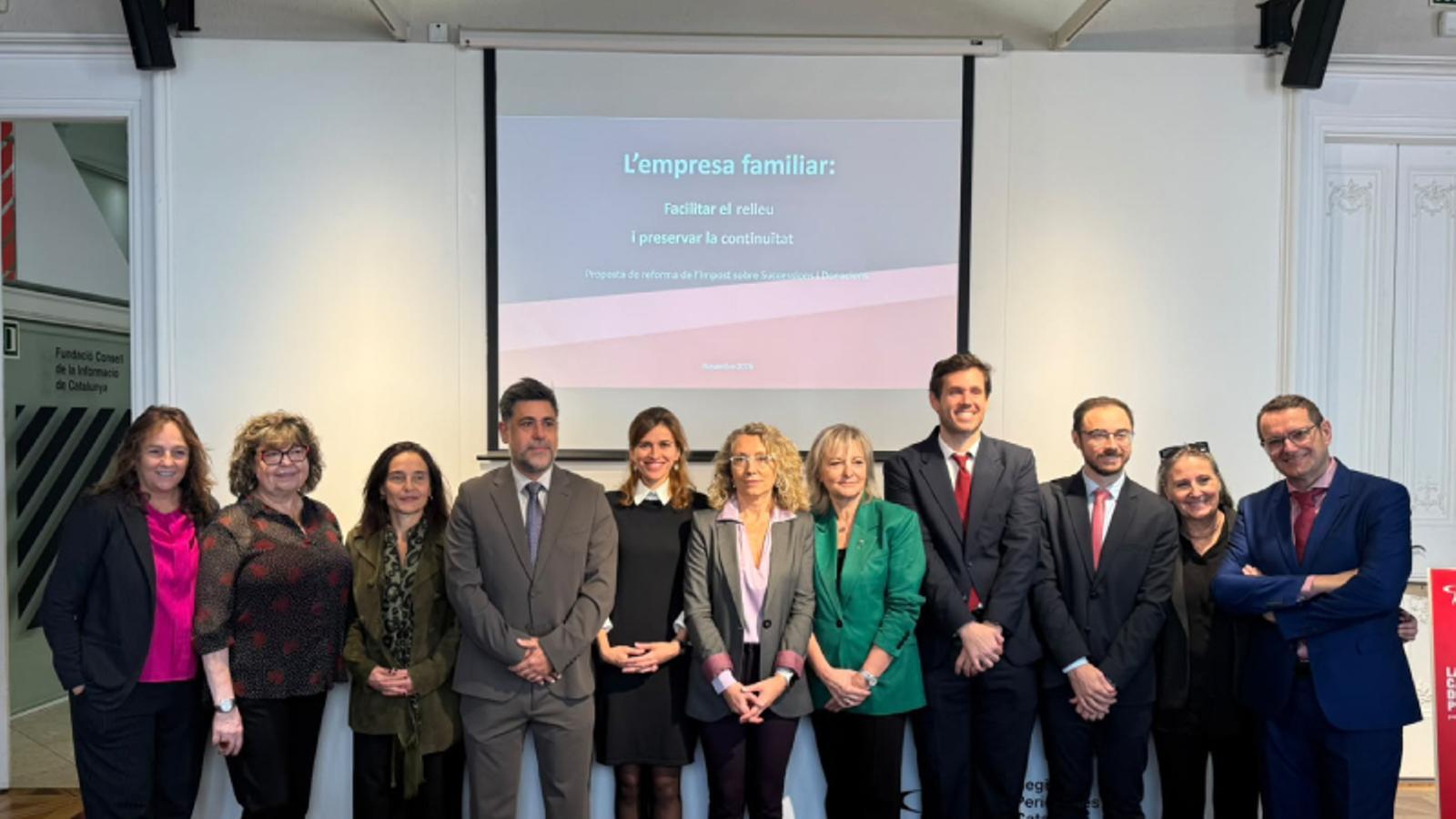
The survival of Catalan family businesses is more at risk during a generational handover than in other communities in the State. This is confirmed by a study prepared by several professional associations, business associations, and employers' organizations, which are calling for improvements in the tax treatment these companies receive when succession must take place.
Participating in the study were the Catalan delegation of the Spanish Association of Tax Advisors (AEDAF), the Professional Association of Tax Technicians of Catalonia and the Balearic Islands (APttCB), the Association of Economists of Catalonia, the Barcelona Bar Association, the Association of Administrative Managers of Catalonia, and the employers' organization Pimec.
This study indicates that in Catalonia family businesses account for 93.8% of the business fabric and 79.1% of employment. Because of this great weight, the authors of the study are asking that generational handover in these companies be facilitated with measures that allow for maintaining Catalonia's tax competitiveness, with greater legal certainty, avoiding these companies ending up sold to foreign investment funds or closing down.
In fact, data show that many family businesses do not reach the third generation: of the total, 67.8% are 10 years old or older, 29.3% are 25 years old or older, but only 1.3% are 50 years old or older.
Thus, the study proposes various reforms to Catalonia's inheritance and gift tax to facilitate the survival of the family business. Thus, among the reforms, it is requested to extend the 95% tax relief to the fourth degree of kinship. This would allow this relief to be enjoyed on a transfer between cousins, which is currently not possible.
It is also proposed to facilitate the transfer to related employees (with a minimum of 10 years of seniority and up to 5 years as executives), without the need to transfer more than 50% of the company to enjoy the relief, according to the member of the Tax Commission of the Association of Economists of Catalonia, Àlex Segarra, who believes that the capital limit to be transferred should be lowered to 5%.
One of the elements that the study highlights the most is the treasury. Currently, family businesses can apply this bonus only on the part of the treasury that affects the company's current activity, while the rest must be taxed with 100% of the tax. This often lends itself to interpretation by tax inspectors. According to the authors of the study, this favors companies that are more indebted rather than those that are more capitalized, which are precisely the ones with the most possibilities of surviving. "Do we want to have weak companies or capitalized and strong ones that can face contingencies?", asked the member of the Regulatory Commission of the Barcelona Bar Association, Emma S. Corretger.
Self-employed and companies
Other proposals ask for lowering the age to access the bonus, which is currently 65 years, or equating self-employed individuals with commercial companies. The head of the Family Business section of AEDAF in Catalonia, Leonardo Cárdenas, has denounced the "unfair" treatment that the self-employed person suffers compared to the commercial company, as the former is required to have very high income levels relative to their global income to apply the bonus.
For this reason, he has requested that business continuity be rewarded rather than its legal structure, and that professional firms (doctors, architects, or other professionals), which are currently excluded from the benefit, also be covered.
The promoters also ask to end the incompatibility that exists in Catalonia, where applying the 95% reduction for the family business prevents benefiting from the general bonus on the tax quota for the rest of the inheritance between parents and children.
These proposals are incorporated, in whole or in part, into the legislation of other autonomous communities, which makes them more competitive for attracting family businesses. "In Catalonia, we must try to ensure that companies do not leave," stated Leonardo Cárdenas.

