Tatxo Benet (FemCat) rails against the "shameful fiscal treatment" that Catalonia receives
Sanna Marin calls to invest in strategic technologies that guarantee European sovereignty

-
CAT -
CAST
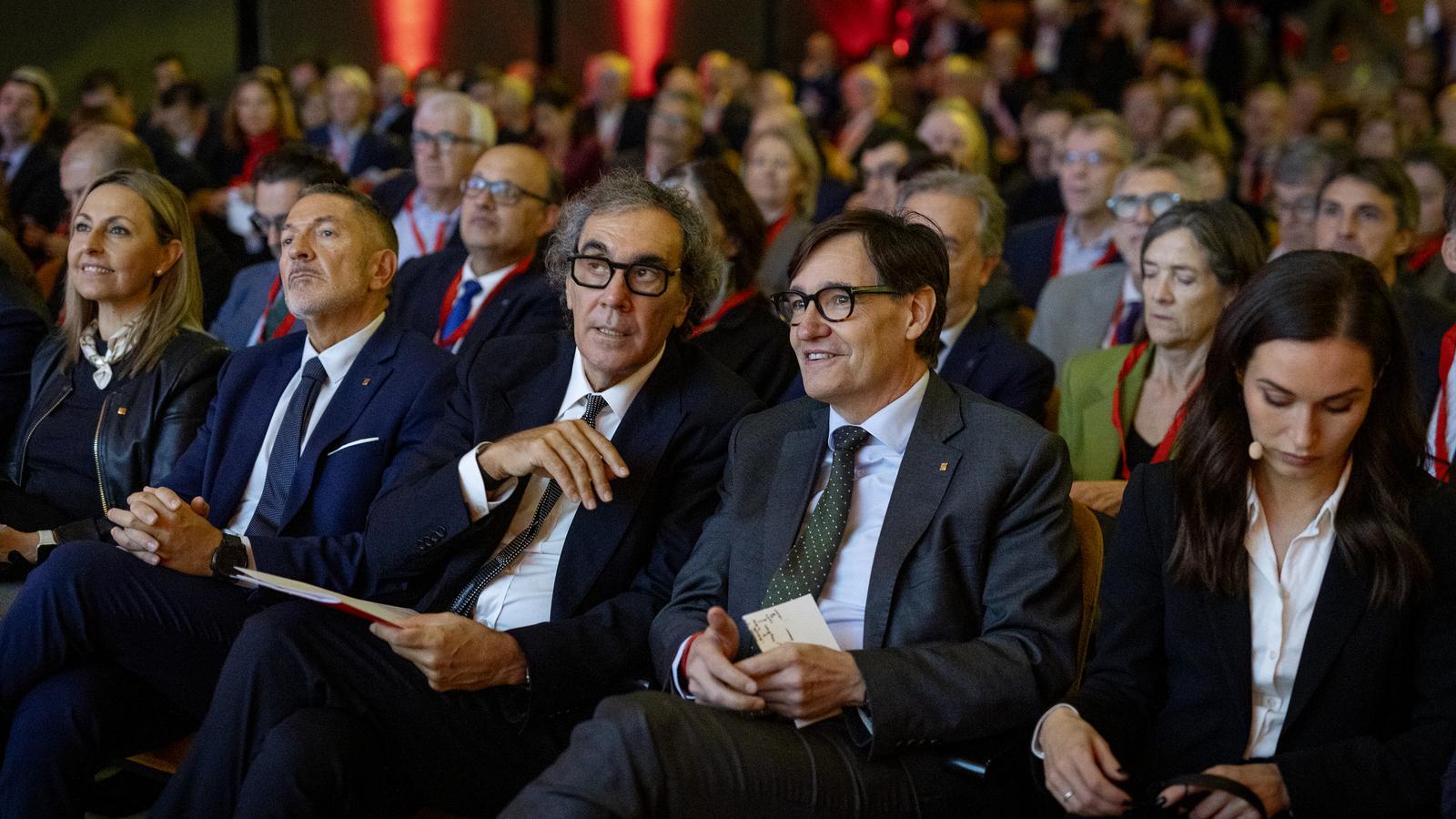
BarcelonaThe president of the business association FemCat, Tatxo Benet, has placed Catalan financing at the center of the private sector's target. In a speech at the FemCat Forum, his first since his appointment, Benet described the “fiscal treatment” that Catalonia receives from the Spanish state as “shameful” and “intolerable.” In this regard, he defended “the right and the duty” to point out this grievance “every time they speak about the development of our country.” The business conference is being held this Tuesday at the Petit Palau of the Palau de la Música.
During the opening of the event, Benet denounced that the Catalan economic fabric competes “at a disadvantage” compared to its environment due to this insufficient financing. Regarding the growth recorded in recent years, he noted: “We have achieved it with one hand tied behind our back.” “And we must say it so that those listening to us on the other side know that we are aware of it, and that we will not settle for this injustice that has lasted for decades,” he retorted. In the midst of a train drivers' strike, and after new days of unrest in Catalan infrastructure, Benet stressed that the fiscal shortcomings that the country laments “have names and surnames”; from the Rodalies commuter rail to the road infrastructure network, passing through healthcare or education, the business leader enumerated.
The financing gap, however, is not the only culprit, in Benet's view, for the poor health of Catalan infrastructure and public services. The president of FemCat warned that “often, the trees of Barcelona do not let us see the forest of Catalonia.” “The lack of investment outside the capital is often our fault,” he acknowledged, with examples such as public transport –“fantastic” in the city, in his eyes; but which degrades as one moves away from it–. In this sense, he called for dedicating more resources to the territory, where “they are lacking the most basic means of transport,” instead of local investments like the tram interconnection.
Business optimism
Despite the disadvantage generated by the Catalan financing system, Benet has chosen to be optimistic about the economic future of Catalonia. In the opinion of the president of FemCat, Catalonia “has many reasons to trust in itself,” from a “solid” industrial base to the capacity of local businesses to compete in international markets. “And we have done all this with one hand tied behind our back. Imagine what we will do when we can use both,” he highlighted.
In his speech, Benet highlighted the role of institutions such as the Barcelona Supercomputing Center or the Synchrotron, as well as the research and innovation capabilities of the Catalan biomedical system. The good foundations, he asserted, “allow us to point out with peace of mind what we are not yet doing well.” “We are good at creating companies, but not as good at making them big,” he gave as an example, and he urged entrepreneurs to make bets to increase the size of their businesses. For Benet, “investment is not vanity: it is productivity, investment, and better wages.” He also left a task for the elected representatives present at the Palau de la Música, whom he reminded that “we know what needs to be done, but it is difficult to reach an agreement, and it is even harder to sustain it over time.” These limits, it must be said, “are not a fatality.” The co-founder of Mediapro foresees a bright future: “The pending work has the virtue that it can be done.”
Before Benet, the president of the Generalitat, Salvador Illa, spoke at the conference, having attended the Forum accompanied by the ministers of Business and Labour, Miquel Sàmper, and of European Union and External Action, Jaume Duch, among other authorities. In his speech, Illa praised the role of entrepreneurs as “creators of wealth” in Catalan society. However, he maintained his maxim of “shared prosperity” and demanded maintaining a balance between both factors. “We cannot place the accent only on generating prosperity at any price, nor only on sharing everything without creating wealth,” he reflected. Just one day before the general strike, he highlighted housing as “the most relevant factor for sharing prosperity.”
Investment in technology
The highlight of the lineup that FemCat has brought together at this year's forum has been the former Finnish Prime Minister, Sanna Marin, who dedicated an extensive reflection to the attendees regarding European strategic autonomy and the need to invest in the strategic industries that guarantee it. Especially in frontier technologies; such as artificial intelligence, quantum computing, or robotics. In Marin's opinion, the Union is at "the last moment to act." "If we depend on other countries, especially those that are not democratic, we run the risk of falling behind in the technological race," she warned.
In defense of this sovereignty, Marin warned that Russia's advances in the context of the war in Ukraine could be dangerous for the entire continent. A Russian expansion could reinforce, she asserted, "its will" to continue doing so. "As a neighboring country, we Finns know this reality better than many others, because of our historical experience," she added.
