Christine Lagarde resigns as president of the ECB: "I cannot continue being neutral"
The entity maintains interest rates but opens the door to a hike in December

-
CAT -
CAST
BrusselsThe European Central Bank (ECB) announced this Thursday that it is maintaining interest rates at 2.5% in a context of uncertainty due to the energy crisis, which has caused energy prices to soar. The institution warns that this situation could put pressure on inflation and slow down growth in the eurozone, and has therefore opened the door to raising the price of money again in December.
The resignation of the president of the Frankfurt-based institution, Christine Lagarde, however, has overshadowed the monetary decision. The former French Minister of Economy and Finance will leave office on February 7, 2027, nine months before her term ends, which was scheduled for October of the same year, as she herself announced in a message on social media. Lagarde justified her decision because, she asserts, she wants to be able to express herself freely on issues that go beyond monetary policy. A statement that comes on the eve of a decisive election year in France.
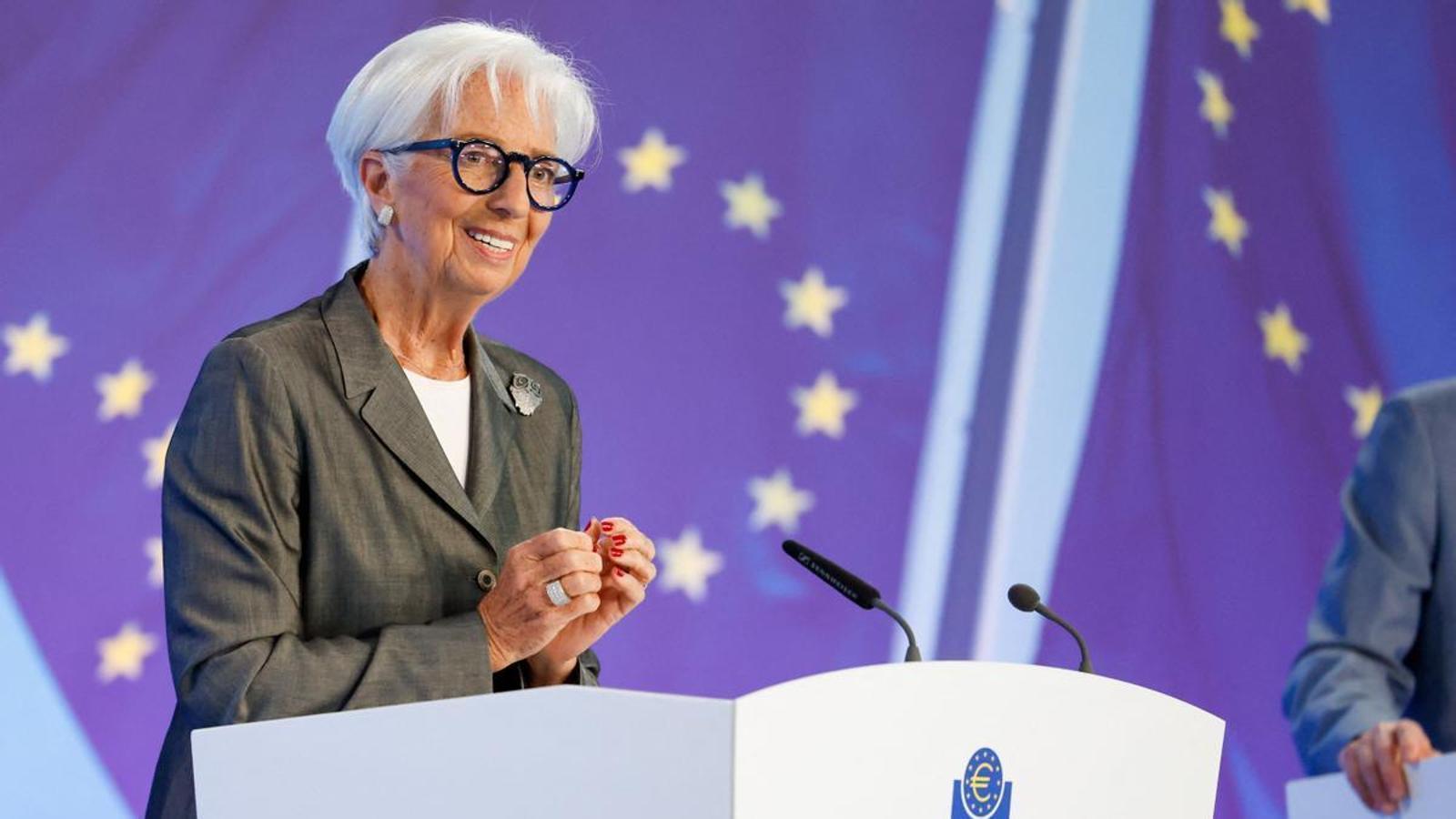
In an appearance following the ECB meeting, she argued that the institution's officials are subject to a mandate that requires them to "maintain neutrality," a condition she considers necessary to preserve independence. But she argued that she can no longer "continue to be neutral." "I don't think I can continue to be neutral. I would not feel comfortable maintaining this neutrality at the present time," she said.
"At this moment, in relation to many parts of the world—not just Europe, or even just the European continent—I believe that my voice and my actions can contribute to defending principles that are very dear to me," she stated. She also argued that she wants to speak out in defense of principles she considers fundamental, especially in the face of distortions of the truth. "There are things I can say [...]. I feel I have to say them, and I cannot do so from the position I currently hold," she added.
The French leader also assured that her departure will not affect the functioning of the organization and confirmed that the process to find her successor has already begun. "The institution is solid and strong as a rock," she stated, dismissing the idea that the transition could leave the ECB in uncertainty.
Her resignation before completing her mandate will allow for an early transition at the head of the ECB and for Emmanuel Macron and Friedrich Merz to participate in the selection of a successor before the French presidential elections. At the same time, Lagarde's insistence on her desire to regain freedom of expression fuels speculation about the role she could play in the French public debate in the face of a possible surge of the far-right at the Élysée. For the moment, however, she has not announced any intention to get involved in the election campaign. Among the possible professional destinations for the economist, the World Economic Forum, based in Davos, has also been mentioned.
The President of the European Council, António Costa, has thanked her for her work as president of the organization since November 2019. "Throughout her mandate, she has led the European Central Bank with a firm sense of duty and responsibility. Europe has benefited from her leadership in times of uncertainty and from her unbreakable commitment to the European project. In the midst of a global pandemic, a war in Europe, energy crises, and inflationary shocks, she has carried out the position with firmness and determination, and has contributed to preserving the stability and resilience of the eurozone," he assured in a statement. The European Council will appoint her successor.
Among the possible candidates to replace her is Pablo Hernández de Cos, who has the public support of the Spanish government. President Pedro Sánchez confirmed at the end of September that he supports a candidacy headed by him, and praised his "necessary capacity, knowledge, and leadership."
Apart from Hernández de Cos, other names that appear in the running are the Dutchman Klaas Knot –who directed the central bank of the Netherlands between 2011 and 2025 and was part of the ECB governing council for fourteen years– and the German Joachim Nagel, president of the Bundesbank since 2022.
Lagarde's decision comes at a key moment for the ECB, immersed in a cycle of interest rate hikes to try to curb prices, pushed upwards due to the energy crisis in the Middle East. At the same time, the financial entity is facing an increase in the yields of public bonds, especially in France, where debt has reached levels not seen in the last twenty years and has fueled doubts about the sustainability of its public finances.
In this regard, the ECB governing council warned today that "it is likely that inflation will increase and slow down economic activity," due to the duration of the energy crisis. Likewise, it acknowledged that the decisions to increase interest rates in the past have "tightened" financing conditions, "which will likely have an impact on inflation and growth." Apart from keeping the reference interest rate at 2.5%, the monetary entity has also frozen the other two rates it controls. It has maintained the basic interest rate at 2.65% and the rate for immediate loans at 2.9%.
