9.5 billion euros until 2050: the cost of decarbonizing the Catalan industry
The Government calculates that the administrations would have to contribute 4,900 million

-
CAT -
CAST
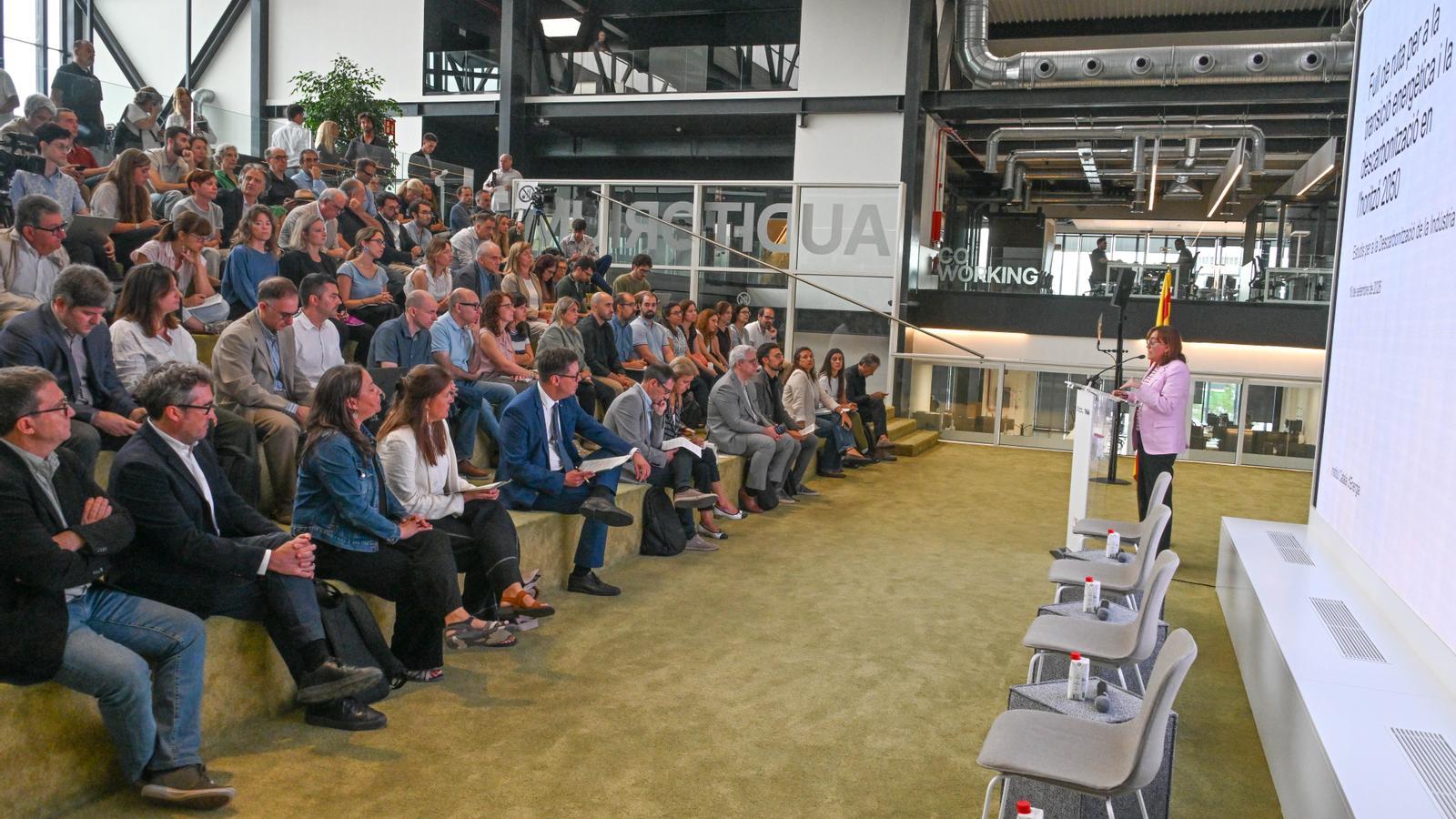
BarcelonaCatalonia now has a roadmap to decarbonize its industry. It was presented this Friday by the Minister of Territory, Sílvia Paneque, at an event at the DFactory in the Zona Franca, Catalonia's major hub for Industry 4.0. Following the work carried out by the Catalan Energy Institute (Icaen), which analyzed all sectors and subsectors, the conclusion is that decarbonizing Catalan industry will require an additional investment—that is, beyond what companies already spend in their normal operations—of 9.5 billion euros. This investment should be made between now and 2050.
The Government estimates that of this amount, about 4.9 billion should come from public administrations. Based on the study conducted by Icaen, the Government aims to promote specific plans with the subsectors of Catalan industry to decarbonize over the next 25 years. The Government will open a dialogue process with stakeholders from about twenty subsectors of the Catalan industry to identify concrete steps to follow, establish specific objectives, and design instruments to provide support. The Executive's goal is for the dialogues with the subsectors to result in concrete agreements with companies.
Although decarbonizing the industry will require significant resources, the final result, once fully implemented, will be profitable for the sector, according to Icaen's calculations. This is because, with the rising cost of fossil fuels and increasingly higher emission rights, stopping CO2 emissions will lead to savings for companies of about 1.2 billion euros annually.
The Government's decarbonization plan sets a target for 2030 for energy distribution in the industry where electricity makes up 36% of consumption, followed by natural gas (29%), refinery gases (18%), petroleum coke (3%), biomethane (2%), biorefinery gases (2%), and hydrogen (1%). In contrast, by 2050, the plan aims for 62% of the energy consumption of Catalan industry to come directly from electricity, followed by biorefinery gases (10%), hydrogen (10%), biomass (7%), and biomethane (7%), along with other residual sources. The study envisions a scenario in 2050 where industry represents a higher percentage of the total gross domestic product (GDP), thus with an increase in energy use, but with fewer fossil fuels and lower CO2 emissions.
Opportunity
"We have the opportunity at this moment to turn what can be seen as a threat, which is the climate necessity, into an opportunity for national transformation, for industrial transformation," asserted the Minister of Territory, Housing and Ecological Transition, Sílvia Paneque. The minister criticized that "there are those who do not want development and do not want infrastructure," and claimed "sustainable innovation" as a priority to generate "development and growth" in Catalonia.
The industrial subsectors that have the most potential to reduce CO2 emissions by the end of the current decade, according to the roadmap, are leather and footwear, industrial laundries, paper and cardboard, steel and iron casting, textiles and clothing, or water treatment. On the other hand, other subsectors such as cement, food and beverages, chemicals, or glass production face more difficulties and will likely have to wait more years.
