A walk through the life of Sala Rovira
An exhibition at the Silvia Sennacheribbo gallery recalls the history of the room between 1942 and 2012
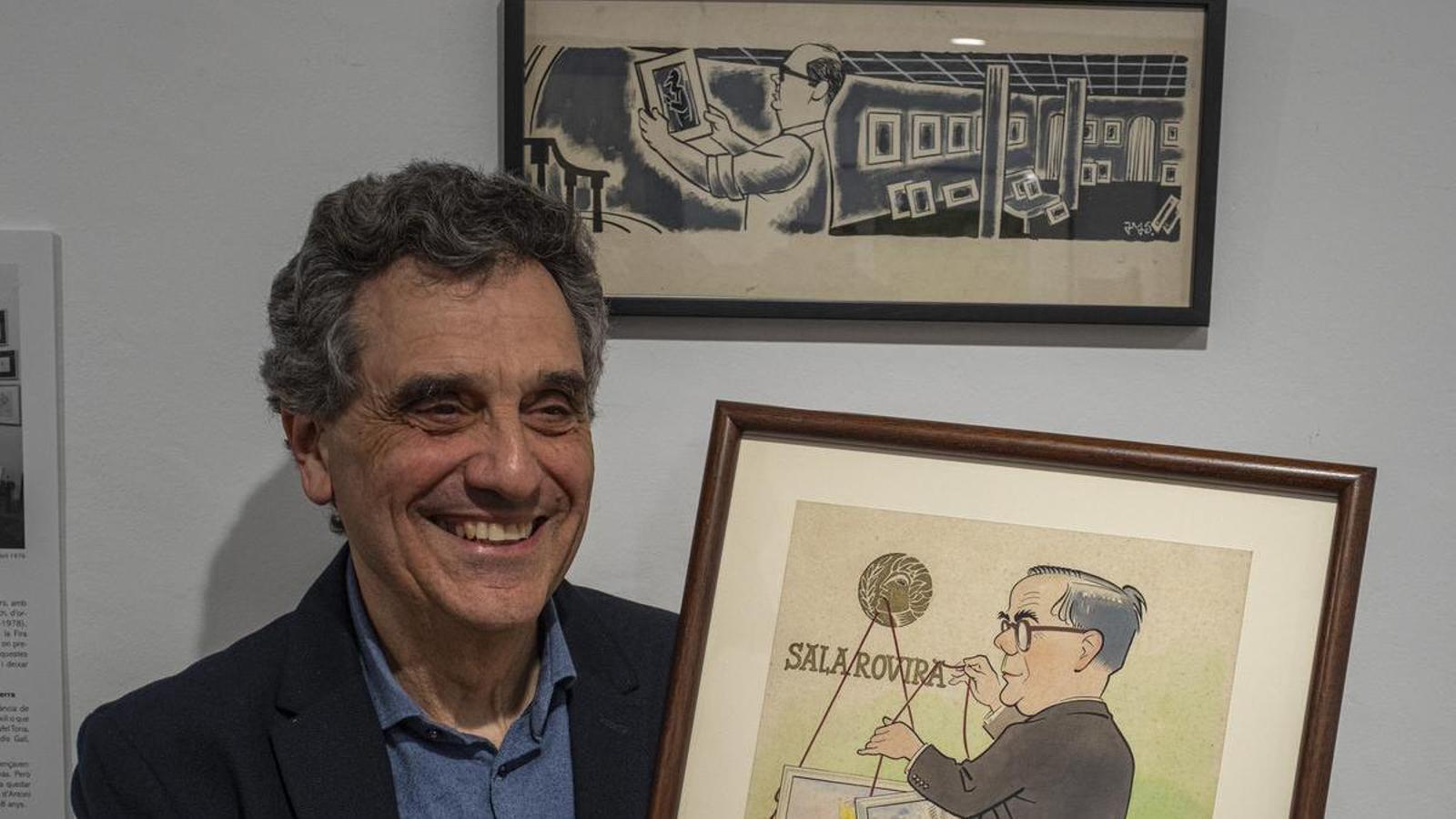

BarcelonaIn Barcelona, some art galleries have family roots. Gallerists Silvia Sennacheribbo and Segimon Rovira i Cambra, who ran Sala Rovira, are cousins. Both continued family businesses, and now Sennacheribbo hosts the exhibition 70 Years of Sala Rovira (1942-2012) at her gallery (Enric Granados street, 106, local 1), drawing from the archive of this gallery known for its dedication to drawing and illustration. The exhibition, which is open until April 19th, includes about 80 works from the three periods of Sala Rovira by artists including Grau Sala, Lola Anglada, Ricard Opisso, Lloveras, Xavier Gosé, Rosa Serra, Torné Esquius, Carles Cardellà, Junceda, Cesc, Tatiana, and Picarol. Among the works are surprises such as a watercolor by Joan Llaverias dedicated to Joan Llimona and a drawing by Francesc Gimeno with a tribute text by the poet Josep Maria López-Picó: "Only with your effort: poor history left us no room for flattery. Only with death: you have left glory because it does not fit, to your honor, rags".
Sala Rovira was founded by Segimon Rovira i Bori in 1942. But its trajectory had begun in 1928 with a printing and stationery workshop. It was later that he remodeled the premises and converted the warehouse into a small exhibition space of 45 m², which was accessed after passing through the stationery shop, while the printing shop continued in the basement, connected to the ground floor by a renovated staircase. Before the Civil War, Rovira was also known for the bookstalls he set up on Rambla de Catalunya with fantastic sets by the painter Ricard Arenys. "After the Civil War, they told him to set up an art gallery, because there was no censorship in the images. My grandfather, who died when I was nine years old, was involved with amateur theater and knew [the set designer and art dealer] Baldomer Xifré Morros, who acted as his advisor," explains Segimon Rovira.
A tribute to Isidre Nonell
From the first phase, the exhibition includes a couple of sketches for calendars that Rovira i Bori commissioned from graphic designer Ignasi Vidal. The first exhibition at the Rovira Art Salon was a tribute to Isidre Nonell organized by the artist's family. It had a lot of impact, but he didn't sell any drawings, which were priced at 250 pesetas. Rovira continued with an exhibition of Ricard Opisso, and at the end of 1943 he dedicated the first exhibition to Cesc (Francesc Vila Rufas) – who was then a teenager – because he knew his father. In fact, Cesc remained associated with the gallery until his death in 2006. "Cesc used to say that the 1943 exhibition was the only one he had attended in shorts," says Rovira i Cambra.
The few art galleries that existed in Barcelona were small cultural oases during the hardest years of Francoism. "In the 50s, watercolors were the most sought after. And there was a time when Antoni Badrinas, who was a draftsman and designer from Terrassa, told him that he had to dedicate himself to drawing, because there was a great tradition in Catalonia and no one was doing it," recalls Segimon Rovira. "In the fifties there were very few art galleries and they opened on Sunday mornings. People went to buy the tortell, went to mass, and to the galleries," he explains.
Rovira i Bori died in 1965. He was succeeded at the head of the business by his son Antoni, who had started helping him in 1940. In the second phase of the gallery, Antoni Rovira i Juyol developed two lines, based on recovering the draftsmen of the first third of the 20th century and those artists who were exiled or had been forgotten. "My father was an only child, and with these more than twenty years of work he was fully involved in the business – says Rovira –. He greatly promoted the subject of drawing, and one of the people who helped him a lot was Josep Maria Cadena. He tried to put on about twelve exhibitions a year." Among the discoveries of that period are Raymond Renefer, a draftsman whom Rovira i Juyol discovered in Paris, Nicanor Vázquez, and the sculptor Rosa Serra. Another discovery is José Robledano, a Republican illustrator from Madrid whom Rovira i Juyol discovered in a copy of the magazine Historia y vida, and he exhibited the drawings he had made in prison. "It was a brutal success," says Rovira i Cambra.
The history of Sala Rovira took a traumatic turn with the sudden death of Antoni Rovira at the age of 58 in 1980. His son, Segimon Rovira, took over and decided to close the printing press to concentrate on the gallery. A distinctive feature of the third stage is that, in addition to continuing with the historical illustrators, it opened its doors to current illustrators, including Carme Solé Vendrell, Mercè Llimona, Fina Rifà, and Jesús Gabán, who was the National Prize for Children's and Youth Illustration. And one of its most successful artists is Tatiana, known for her small paintings of Barcelona's facades. "They were flying off the shelves," says Rovira i Cambra.
